


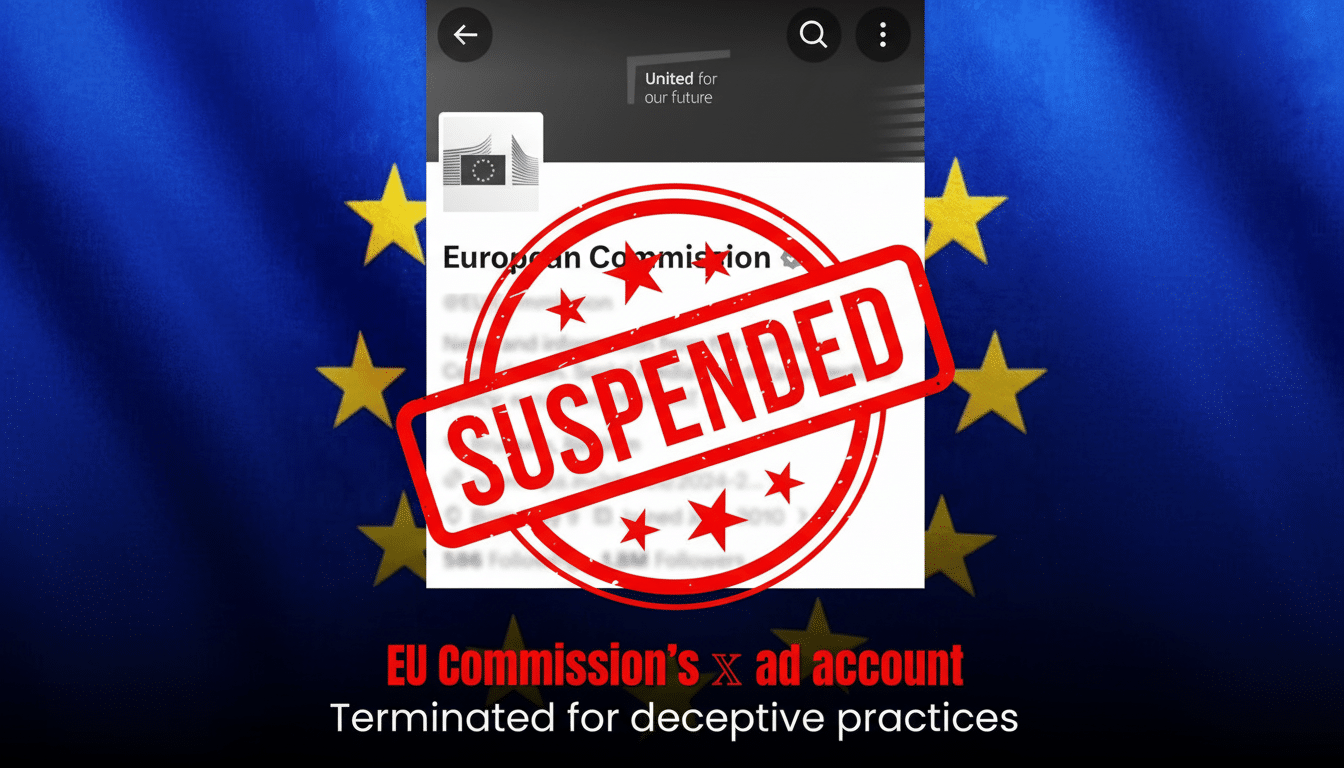
X has shut off the advertising account of the European Commission, marking a serious escalation of a high-stakes showdown between the company and Brussels over verification, advertising transparency, and governance of the platform.
X says the move was related to misuse of its ad tools — not a reaction to the fine — but it’s hard not to think the optics underscore an uneasy period between both sides.
- What Triggered the Penalty Under the EU’s DSA
- X’s response and the EU account deactivation decision
- Why the advertising library matters for transparency
- The verification flashpoint and user trust risks
- Regulatory stakes and potential consequences for both
- What to watch next as X and the EU navigate DSA rules
What Triggered the Penalty Under the EU’s DSA
The European Commission slapped its first-ever fine for violating the DSA on X, by claiming the company’s pay-for-verification system is misleading and heightens the potential for impersonations and scams. Regulators also complained that X’s ad repository was not transparent enough and was too hard to access — chief responsibilities of Very Large Online Platforms under the law.
As for X, the company now has two compliance clocks with respect to removing these ads: about two months on verification and three months on ad transparency concerns. The DSA carries the threat of additional fines specifically for noncompliance, such as a fine of up to 6% of a platform’s global annual revenue (turnover) and periodic penalty payments aimed at forcing changes.
The enforcement emphasis is a reflection of Brussels’ broader anxiety concerning the public perception of verification signals. Placing a badge on a paid feature rather than an identity can blur authenticity cues and be misleading to users, authorities argue — especially during spikes in the risk of impersonation, such as periods of high public interest or elections.
X’s response and the EU account deactivation decision
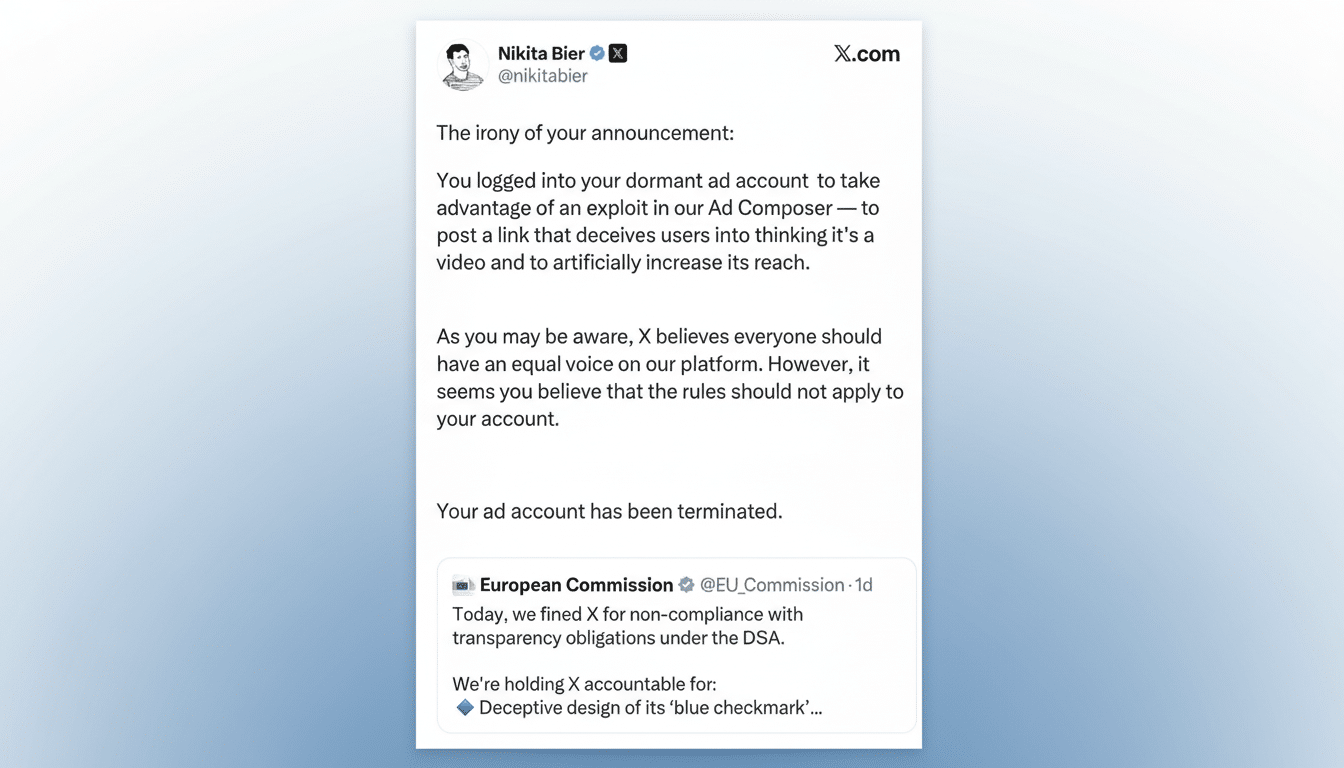
Elon Musk slammed the verdict and X head of product Nikita Bier claimed to me that the Commission took advantage of an internal quirk in how X’s Ad Composer is structured. In a post citing the Commission’s announcement, Bier said the EC posted a link from an inactive ad account formatted to look like it was actually a video, purportedly expanding its reach using an illicit workaround. X said it has fixed the problem since then and “terminated” the EC’s ad account.
Crucially, the Commission’s main profile still appears on X, and it retains its dull grey government tag. The deactivation impacts the EC’s ad purchasing capability, not its posting ability. That matters because paid distribution has been a crucial tool for public-sector accounts to reach people beyond their organic follower base.
Why the advertising library matters for transparency
To that end, ad transparency is a central DSA plank. Platforms would also have to keep a public database that is easily searchable and shows who paid for an ad, whom it was aimed at, what material it ran, and when the ad was delivered. The data underpins the campaigns of researchers, civil society groups, and regulators who are examining political and issue-based messaging at scale.
Major platforms have implemented diverse methods: For instance, Meta’s Ad Library and Google’s political ad transparency reports provide searchable interfaces and programmatic access for vetted researchers. X has run a stash of ads and offered research access through APIs, but critics have long complained that paywalls, rate limits, or incomplete fields stymie public-interest auditing. That is the type of conduct noted above, and one that the Commission’s finding — of an insufficiently transparent repository — reduces to formal regulatory language.
The verification flashpoint and user trust risks
The Commission’s criticism of the labeling goes beyond mere semantics. At one time, verification was designated as a means of confirming identity — it had the societal trust-signaling function that helped identify public figures and add credibility to their views. Paid checkmarks from X altered that calculus by turning the badge into a subscription perk. Regulators argue that shift can confuse users and allow for phishing or fraud, especially when verified-appearing accounts are sharing links or sponsored content.
For platforms, the economic incentive is plain: verification has become a subscription revenue product. The flip side is also clear for regulators: conflation of paid status and authenticity could dilute consumer protections. The DSA leans toward the latter consideration — but would force a more explicit separation between identity verification, subscription content access, and labeling that impacts user trust.
Regulatory stakes and potential consequences for both
The failure to respond to the Commission findings could prompt harsher actions. The DSA gives the EU the power to levy heavy fines and, in some cases, recurring penalty payments of up to 5% of average daily worldwide turnover to ensure compliance. A fine of €120M is no laughing matter, but it’s short of the law’s maximum exposure, which indicates to me that the EU wants real changes in place on their timetable.
For X, it’s also about more than money. Extended conflict with EU regulators can complicate product rollouts, data access programs, and ad sales in a region that’s both influential and heavily regulated. For the Commission, the move is a test of its promise that it can enforce and do so proportionately under the DSA — especially when action involves platforms that are central to public discourse.
What to watch next as X and the EU navigate DSA rules
What everyone will be watching for is whether X tweaks its verification signals, fine-tunes its labels, and opens up more of what is stored inside ads. See also if the EC’s advertising access is reinstated after the hack is fixed and policy compliance gets updated — or how long this standoff lasts.
If X does present a credible remediation within the 60- and 90-day time frames, the direct regulatory heat would let up. If they don’t, anticipate escalations that will influence how much the DSA is enforced across the industry — and how platforms weigh product monetization against trust and transparency in one of the world’s most challenging digital markets.