


If you run a manufacturing site in the UK, the Work at Height Regulations 2005 apply to you. Not to a specialist contractor you occasionally bring in. To you, and to anyone you employ or control who works above floor level.
The thing that catches people out is that there is no minimum height. There is no two metre rule, whatever you may have heard on a site somewhere. If a person could fall a distance liable to cause personal injury, you are in scope. That includes standing on something to reach a high shelf.
- 1. Know your hierarchy and be able to show it
- 2. Assess each task, not just the site
- 3. Be honest about ladder use
- 4. Check the equipment is right for the job, and rated for work
- 5. Inspect, and write it down
- 6. Train people, and mean it
- 7. Plan for rescue
- 8. Sort out storage and access control
- Where to start
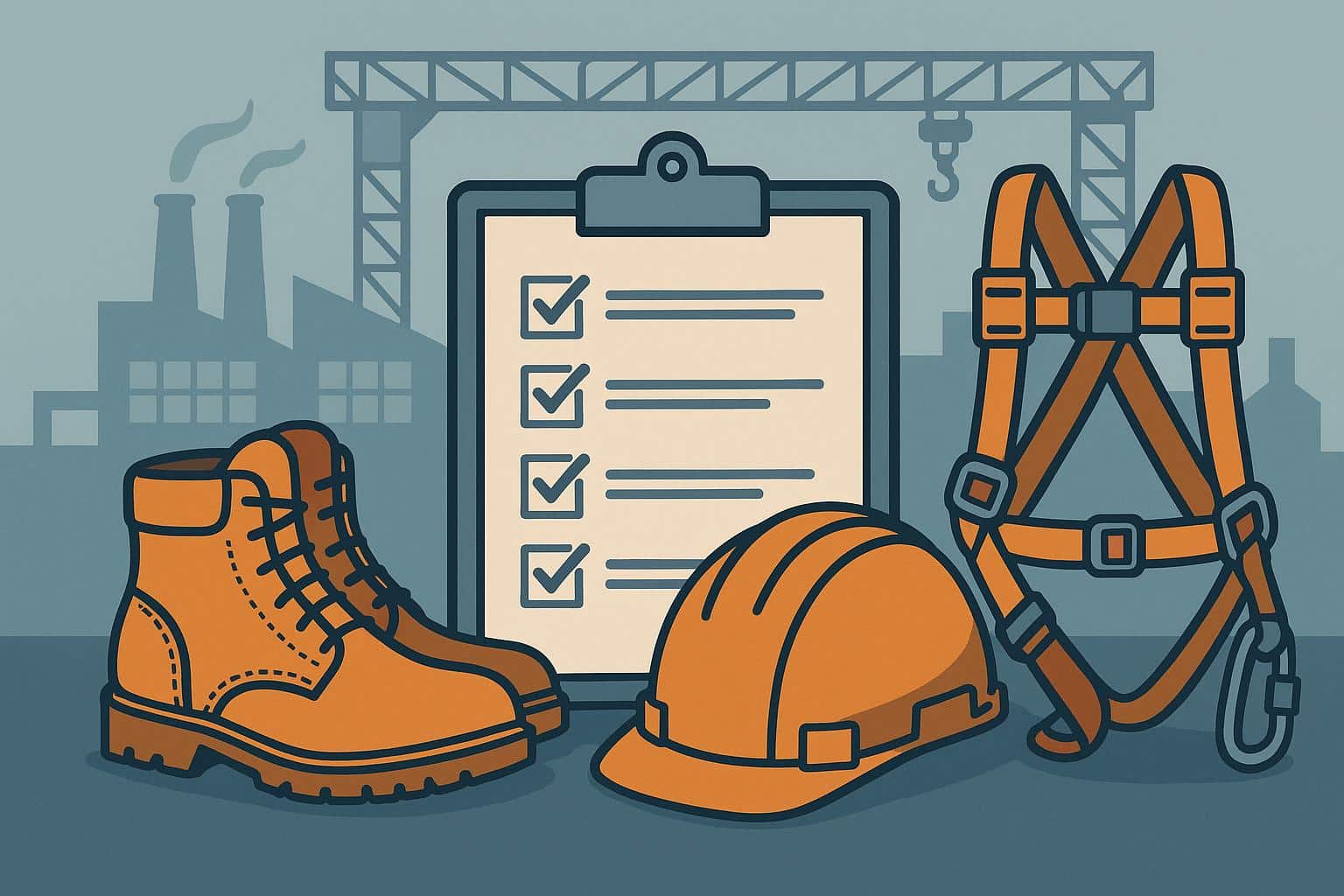
Here is a practical checklist you can actually work through.
1. Know your hierarchy and be able to show it
The regulations ask you to avoid work at height, then prevent falls, then minimise the distance and consequences. In that order.
In practice this means you should be able to explain, for each height task on your site, why it cannot be done from the ground. Can the light fitting be lowered? Can the gauge be replaced with a remote readout? Can the filter be serviced at floor level? Sometimes the answer is genuinely no, and that is fine. What matters is that somebody asked.
2. Assess each task, not just the site
A single site wide risk assessment covering “working at height” is not much use to anyone. The assessments that hold up are task specific. Changing bulbs in the warehouse aisles is a different job from accessing the roof plant, which is different again from reaching into a machine guard enclosure.
Record the height, the duration, the frequency, what the person is carrying, the floor surface below, and what happens if they fall.
3. Be honest about ladder use
Ladders are legal. That myth about them being banned has been doing the rounds for twenty years and it has never been true. What the regulations say is that they should be used where the risk is low and the work is short duration, or where site conditions genuinely rule out something better.
Short duration is usually taken as around half an hour in one position. If a task regularly runs longer than that, it is a signal to move up to a tower, platform or podium instead.
The key point is that you should be able to justify the choice. “It was the right tool for a low risk, ten minute job and we selected it deliberately” is a defensible position. “It was what was leaning against the wall” is not.
4. Check the equipment is right for the job, and rated for work
This is where a lot of factories quietly fail. Domestic grade access equipment finds its way onto industrial sites all the time, usually because someone bought it locally in a hurry.
If you are browsing ladders for sale for a manufacturing facility, you want equipment built to the professional side of EN 131 rather than the lighter domestic specification. Higher duty rating, more robust construction, and built for repeated daily use rather than occasional household jobs. Check the label. It should be there, and it should be legible.
5. Inspect, and write it down
Two separate duties here. Everyone doing the work should carry out a pre-use check, every time. Separately, your access equipment needs formal recorded inspections at suitable intervals by someone competent to do them.
Tagging systems make this manageable, because the inspection status travels with the equipment instead of living in a filing cabinet. Anyone can look at the tag and know whether the thing is fit to climb.
6. Train people, and mean it
Training needs to cover the specific equipment your people use, not height work in the abstract. Someone competent on a stepladder is not automatically competent on a mobile tower, and tower assembly in particular needs proper instruction.
Keep records with dates, and diary the refreshers.
7. Plan for rescue
If your control measures include a harness, you need a plan for what happens after a fall arrest. Suspension trauma is a real and fast moving risk. Somebody hanging in a harness waiting for the fire service is not a plan.
8. Sort out storage and access control
Ladders left lying in a yard get damaged, and damaged equipment gets used because it is closer than the good stuff. Designate storage, keep it dry, keep it off the ground, and make the condemned equipment physically unavailable rather than just labelled.
Where to start
If this list looks daunting, pick items two and five. A set of task specific assessments and a working inspection regime will get you further than anything else, and they tend to surface the equipment problems on their own.