


Most sellers who configure quantity discount tiers on Amazon Business think about tier pricing from the seller’s side: what discount can I offer, what floor do I need to maintain, how do I stay competitive for the B2B Featured Offer. This is the right set of questions. But it is incomplete without the buyer’s perspective — an understanding of what a procurement manager actually evaluates when they encounter a listing with quantity discount tiers and decide whether to purchase from that seller.
The procurement buyer’s evaluation process is not the same as a consumer’s price comparison. It is a more structured, more deliberate assessment of whether the pricing structure on offer meets the requirements of a purchasing decision that will be justified to their organisation. Understanding what that assessment involves changes how tier pricing should be configured and it reinforces why
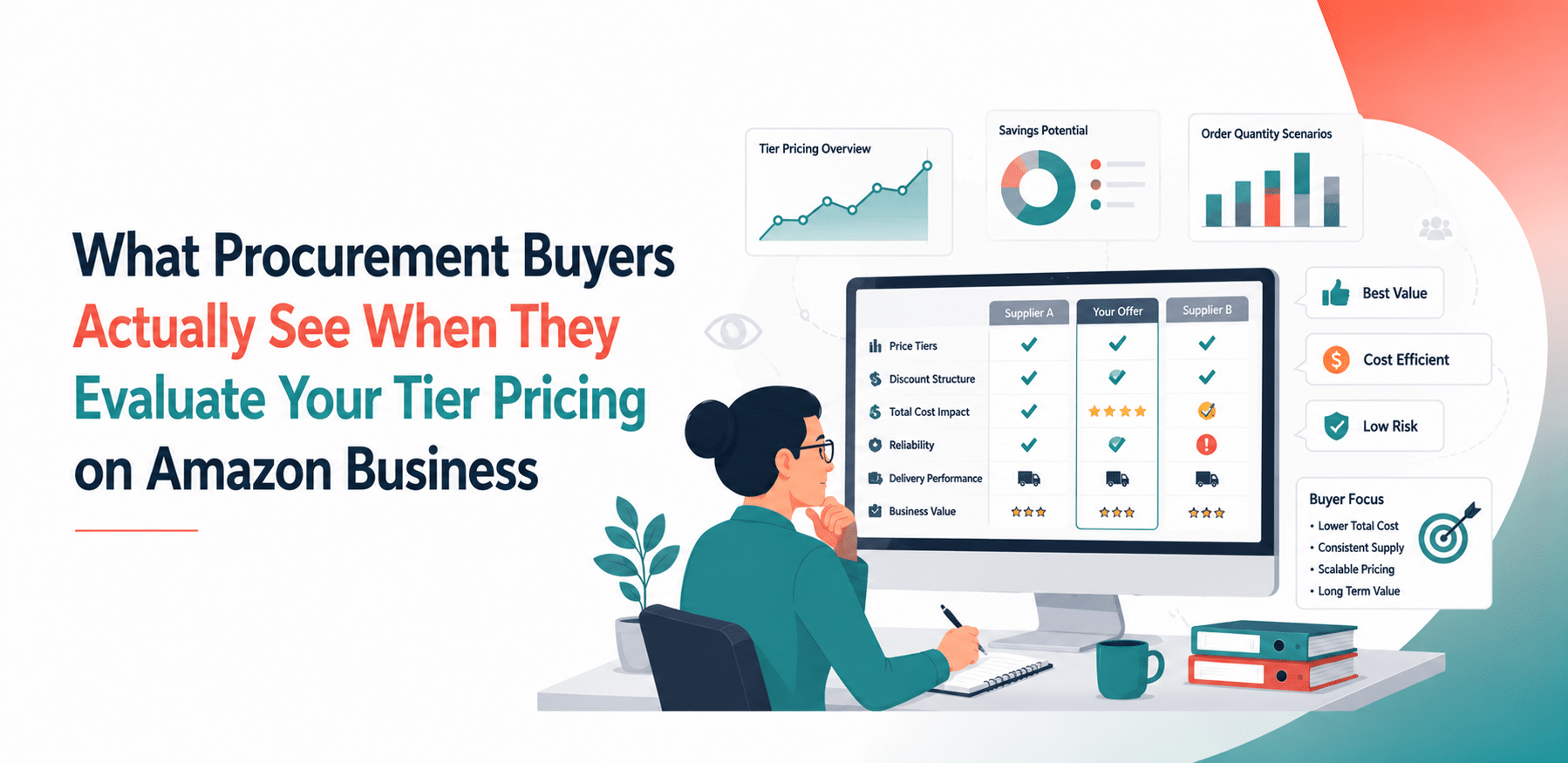
the structural complexity of that evaluation is exactly the reason quantity tier automation for Amazon B2B sellers is the correct operational approach rather than manual tier management. The competitive landscape that procurement buyers evaluate is not static. Their evaluation happens at a specific moment in time, against the pricing available at that moment, and the seller who wins is the one whose tier structure was correct at that moment — not the one whose tier structure was correct when it was last reviewed.
The Procurement Buyer’s Evaluation Criteria
Criterion one: does the tier structure match the procurement quantity?
A procurement manager purchasing on behalf of their organisation has a required quantity. It is not a flexible number, it is determined by the organisation’s needs, budget allocation, and inventory management targets. The first question the buyer asks about a tier structure is whether the tiers are structured around quantities that match their purchasing behaviour.
A seller with tiers at 5, 10, and 25 units is offering price breaks at three volume levels. A procurement buyer who needs 15 units every month evaluates whether the tier at 10 units applies to their purchase (it does) and whether the tier at 25 units might be relevant if they purchase two months’ inventory at once. The tier structure directly shapes the buyer’s purchasing decision, a structure that aligns with real procurement quantities converts to orders. A structure that does not align is ignored even if the pricing is competitive.
Criterion two: is the effective per-unit price competitive across the relevant tier?
Procurement buyers are trained to evaluate total cost of acquisition, not just the listed price. For an Amazon Business order, this means the effective per-unit price at the relevant quantity tier, inclusive of any applicable discounts. When comparing two sellers on the same listing, a buyer evaluating a 15-unit purchase is comparing the tier-2 effective per-unit price across all sellers who have tier-2 pricing that applies to 15 units.
A seller whose tier-2 threshold is set at 10 units and whose discount is 8% is directly competing against a seller whose tier-2 threshold is 12 units at 10% discount. The buyer’s evaluation is not abstract, it is a specific price comparison at a specific quantity for a specific purchasing decision. The seller who wins this comparison wins the order.
Criterion three: is the seller’s business credentials presentation complete?
Amazon Business displays seller credentials, diversity certifications, small business status, quality credentials on the listing page, visible to business buyers. Procurement managers, particularly those purchasing for government agencies or large corporations with supplier diversity requirements, actively evaluate credential presentation as part of the purchasing decision.
For federal contracting and institutional buyers, official status recognition such as registering through the U.S. Small Business Administration or completing federal small business certifications is critical for verification. A seller with correct tier pricing who is missing a relevant certification on their Amazon Business profile may lose a B2B Featured Offer to a seller with slightly less competitive pricing but complete credential presentation.
What This Means for Tier Configuration
The buyer’s evaluation criteria define three specific things that tier configuration must get right to convert a procurement buyer who reaches the listing.
First, tier thresholds must align with real procurement quantities in the category. This is not guesswork, it is analysis. A seller who reviews their B2B order history and identifies that 80% of their B2B orders fall into two quantity bands has the data they need to set thresholds that match the buying behaviour of their actual customer base.
Second, the effective per-unit price at each tier must be competitive at the moment the buyer evaluates it. Not competitive when the tier was last configured, but competitive when the buyer is on the listing. This is the real-time dimension that manual tier management cannot reliably deliver a procurement buyer who evaluates the listing on a Thursday afternoon is evaluating the tier pricing as it exists at that moment, against the competitor pricing as it exists at that moment. A tier configuration that was reviewed on Monday may no longer be competitive on Thursday.
Third, credential presentation should be completed before tier pricing optimisation, because credentials affect B2B Featured Offer eligibility independently of price. A seller who invests in tier pricing automation but has not completed their Amazon Business credential profile is optimising the second-priority signal while neglecting the first.
The Connection Between Buyer Behaviour and Seller Automation
The procurement buyer’s evaluation is a snapshot, a moment in time when they compare what is available at that specific price point, at that specific quantity, from that specific set of sellers. The seller who wins is the one who was correctly configured at that exact moment. The challenge for the seller is that procurement buyers do not announce when they are evaluating listings. They arrive, evaluate, purchase or move on, and the seller learns the outcome only through order data and B2B Featured Offer win rate reporting.
This is the operating reality that makes automated tier management necessary rather than optional for sellers serious about Amazon Business. The buyer-side evaluation is continuous. The competitive environment that evaluation occurs against is dynamic. A static tier configuration was correct at one point in time and may be less correct at the next evaluation moment. The sellers who consistently convert procurement buyers are the sellers whose tier pricing was correct at every evaluation moment not just at configuration time.