


With thousands of competing products in a retail setting, how will your product win on that shelf? For many business owners, the world of professional packaging comes with technical challenges. When searching for product packaging, a manufacturer might ask whether you want display packaging or a rigid box. Thus, leaving you wondering which one actually protects your profits while selling your product.
Choosing between display boxes and rigid boxes is a strategic decision that affects your business efficiency, shipping costs, and how customers perceive your product’s value. Which box type fits your product? Let’s compare these two popular options.
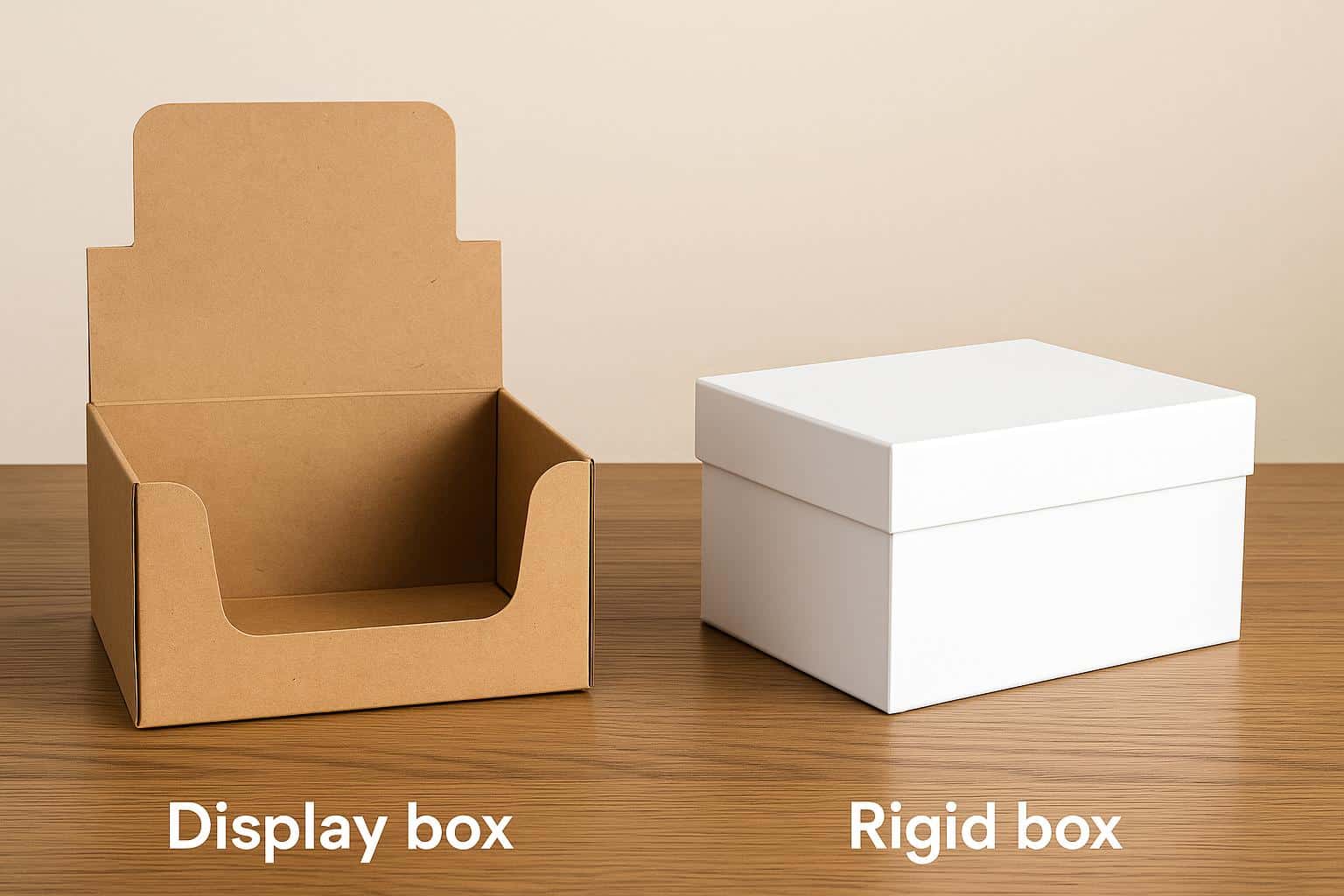
What are Display Boxes?
Have you ever made an impulse purchase when seeing products displayed at the checkout counters? That’s the power of display boxes—the heavy lifters of the retail world.
As the name suggests, custom display boxes are designed to display multiple products at once in a retail environment. You might also know them as point-of-purchase (POP) displays, counter displays, or shelf-ready packaging. Their main strategic locations are at checkout counters or on retail shelves, where they drive impulse purchases
These boxes are typically manufactured from cardboard or high-quality corrugated materials. Some designs feature perforated lines or “tear-away” lids, allowing you to convert a shipping container into a branded showcase in seconds. In addition, they often feature headers or tiered dividers to neatly organize multiple products. Overall, these boxes are the go-to choice when the goal is high volume and quick product access for shoppers.
Widely used across industries, these boxes are ideal for businesses offering products such as lip balms, snacks, accessories, or small electronics. They ship flat, which significantly reduces the logistics costs of packaging for small business.
What are Rigid Boxes?
A rigid box, also popular as a “set-up box,” is designed to stay exactly as it is: solid, sturdy, and unbending. The box is constructed from high-density chipboard that is four to five times thicker than standard packaging materials. This core is then wrapped in high-quality specialty paper, fabric, or exclusive leatherette. Furthermore, this box provides maximum structural integrity, making it the gold standard for luxury packaging in the electronics, jewelry, cosmetics, and premium gift industries.
The main goal of rigid boxes is to create a premium product presentation that feels substantial in the hand and facilitates a high-end unboxing experience. When a customer sees a product packaged in a well-designed rigid box, it triggers a psychological “premium” cue. It tells them that the product inside—be it a smartphone or a high-end watch—is valuable and worth purchasing.
Key Differences Side by Side
When choosing between a display box and a rigid box, you should consider all essential factors.
To make it easier, have a look at the key differences between the two.
Structure & Material
Display boxes rely on the clever engineering of flexible materials, such as cardboard, to create a functional shape. They are designed as retail packaging to be discarded or recycled once the product sells out.
On the other hand, rigid boxes use heavy-duty chipboard that provides a “textured-grade” feel. In most cases, customers keep a rigid box for storage, keeping your brand in their home for years.
Primary Purpose
The primary purpose of each box also defines its design. A display box is built for retail visibility; it is meant to be seen from across the store aisle to drive impulse purchases. This box prioritizes “facing”—ensuring your product is always visible to the passerby.
Meanwhile, a rigid box prioritizes product protection and the unboxing experience. This box isn’t necessarily meant to sit open on a shelf. It’s meant to be handed to a customer in a boutique or delivered as a luxury gift.
Price Point
From a price point perspective, display boxes are significantly more economical. Because they can be mass-produced and shipped flat, their unit cost is low, making them ideal for products with lower retail prices.
On the contrary, rigid boxes require more manual labor to “wrap” the chipboard. Their sturdy material and construction offer premium protection for the product during display, shipping, and storage. Also, they typically ship fully assembled. Hence, you are essentially paying to ship air. This makes them a higher-investment option, usually preferred for luxury products with higher profit margins.
Best Product Types
Display boxes are ideal for high-volume retail, lightweight products, and cost-efficiency, such as consumer goods, small electronics, retail cosmetics, and accessories.
Rigid boxes, on the other hand, are best for premium and high-value items like fragile electronics, jewelry, gift sets, and high-end subscription kits.
Customization Options
Both box types can be customized. However, rigid boxes typically offer more luxurious finishes, while display boxes focus on visibility and structural branding.
How to Choose the Right One for Your Business?
Deciding between these two styles requires an honest look at your business model and your customers’ expectations.
Here are the factors your business should consider when choosing between a display box and a rigid box.
Distribution Channel
Start by looking at your distribution channel. Are you selling through big retailers or local convenience stores? If so, you need a display box that fits standard shelf dimensions and makes life easy for the stock staff. Furthermore, if your product is “grab-and-go,” a point-of-sale display is a requirement. It ensures your product won’t get lost in an ocean of competing products.
Brand Image
Next, consider your brand’s image. If you are selling a premium skincare line or a limited-edition tech gadget, a flimsy box can actually devalue your product. In this case, the investment in a rigid box pays for itself by justifying a higher retail price.
Moreover, the unboxing experience has become a pillar of modern marketing; a rigid box with a magnetic closure or a silk-lined insert turns a simple purchase into a memorable event.
Logistics and Storage Capacity
Finally, think about your logistics and storage capacity. Small businesses with limited warehouse space often prefer display boxes because they can store thousands of them in a small corner.
If you choose rigid boxes, you must have the space to store them. Also, if your product is fragile or heavy, a rigid box may be necessary rather than a stylistic choice, as it helps prevent crushing during transit.
The Takeaway
The choice between display boxes and rigid boxes ultimately comes down to your product’s “lifestyle.” If your product is meant to be seen, grabbed, and enjoyed quickly in a busy retail environment, a display box is your best ally for driving sales.
However, if your product is a high-value investment or a luxury gift, the rigid box provides the protection and prestige necessary to excite customers.
By matching your packaging to your sales environment and brand identity, you ensure that your product doesn’t just “sit”—it stands out.