


The United Arab Emirates (UAE) recently strengthened the regulatory foundations of its fast-developing commercial gaming industry.
The country’s federal gaming authority has agreed a new framework for cooperation with one of the country’s most important financial regulators.
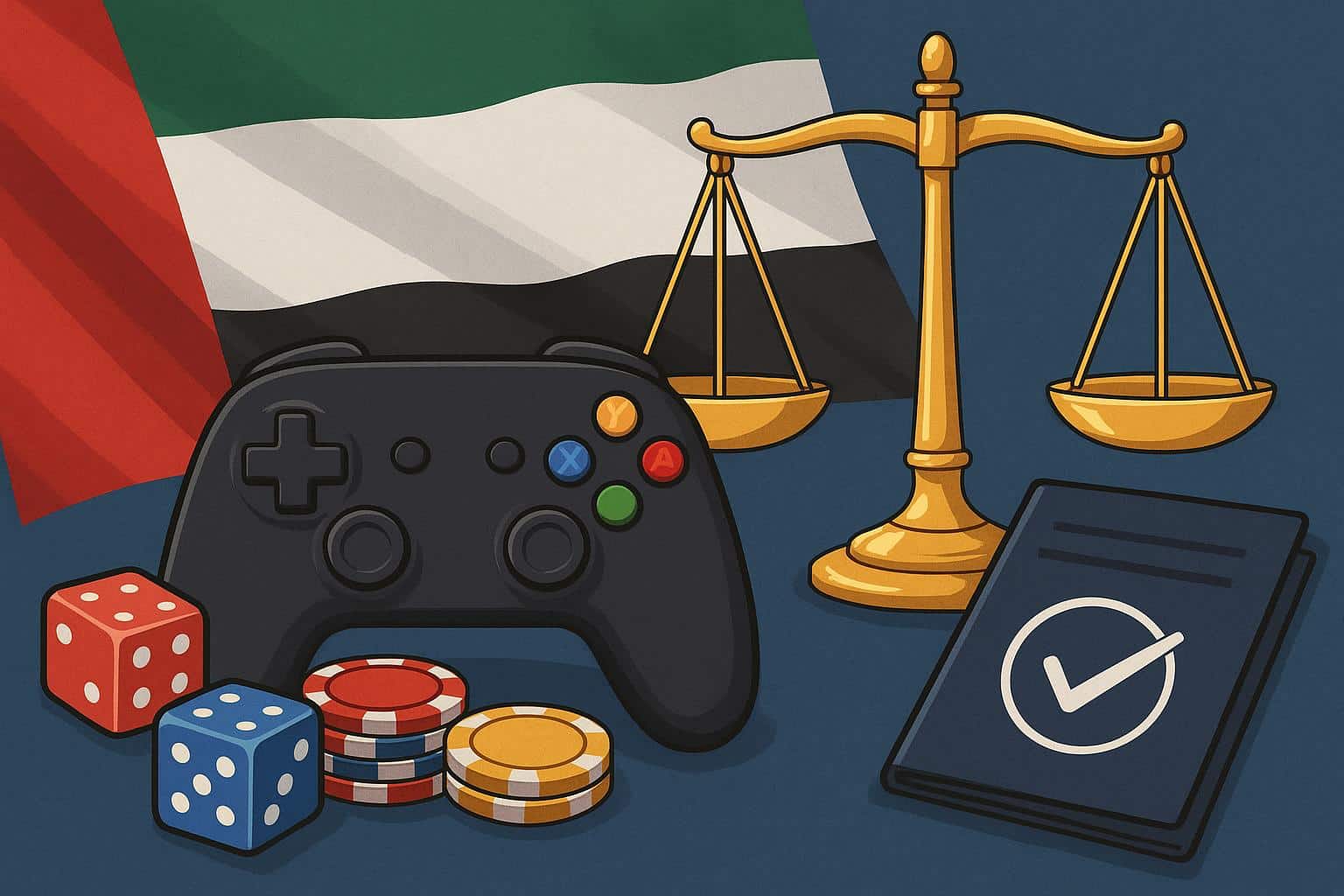
As interest grows in the best online casinos in the UAE, the agreement shows that their approach is extending beyond issuing gaming licences.
The General Commercial Gaming Regulatory Authority (GCGRA) and the Financial Services Regulatory Authority (FSRA) of Abu Dhabi Global Market signed a Memorandum of Understanding (MoU) on August 14, establishing formal mechanisms for cooperation where their responsibilities overlap.
For a sector increasingly involving payment companies, technology suppliers, financial institutions and international investors alongside traditional operators, closer coordination could become an important competitive advantage for the UAE.
Financial Regulation is Increasingly Important to Gaming
Commercial gaming may ultimately be an entertainment business, but the infrastructure required to operate it increasingly resembles that of a sophisticated financial services company.
Operators must manage customer funds, payments, withdrawals and extensive transaction records while monitoring financial crime risks, which means the separation between gaming regulation and financial oversight can quickly become blurred.
The new MoU addresses that intersection by allowing the GCGRA and FSRA to coordinate supervision, exchange regulatory information, engage in policy dialogue and provide investigative assistance while retaining their separate statutory responsibilities.
FSRA chief executive Emmanuel Givanakis said cooperation had become increasingly important as financial services and adjacent sectors grew more interconnected, particularly when regulators were trying simultaneously to encourage innovation and preserve market integrity.
That should give businesses greater clarity when an activity touches both sectors, reducing the possibility that different regulatory systems develop independently as the commercial gaming market expands.
The UAE Gaming Ecosystem is Becoming More Complex
The timing is particularly important because the UAE has moved well beyond merely discussing the possibility of regulated gaming.
The GCGRA currently regulates lottery, internet gaming, sports wagering and land-based integrated gaming facilities, and makes clear that commercial gaming can only be conducted through businesses holding the appropriate licence.
Its public register now includes Wynn Al Marjan as the country’s licensed land-based gaming facility, The Game LLC as lottery operator, and Coin Technology Projects LLC as both an internet gaming and sports-wagering licensee.
The business ecosystem is expanding, with more than 20 gaming-related vendors already listed, including established international companies such as Scientific Games, Sportradar, GeoComply, International Game Technology, Playtech-linked VSTechnology and Cammegh.
These companies provide everything from gaming content and physical equipment to geolocation, data and platform technology, creating exactly the kind of multi-layered industry in which effective cooperation between regulators becomes increasingly valuable.
GCGRA chief executive Ciaran Carruthers acknowledged that complexity, saying the agreement provides a clear route for information sharing and coordinated supervision as the number and variety of businesses surrounding commercial gaming increases.
Stronger Oversight Makes the UAE More Attractive to Investment
Entering a new jurisdiction requires substantial spending on local operations, technology, staffing and compliance, making companies less likely to commit capital when responsibility between regulators is unclear.
The UAE is developing its industry around licensing from the outset, with the GCGRA stating that its process assesses applicants initially and continues monitoring them against technical requirements, international best practices and domestic regulations after approval.
The FSRA partnership adds another layer of institutional credibility, particularly for businesses operating from or working with companies based in ADGM, one of the Middle East’s leading international financial centres.
This may become especially useful as gaming businesses increasingly use financial technology, digital wallets and sophisticated payment processing that falls beyond the traditional definition of casino operations.
Rather than waiting for jurisdictional problems to emerge, the MoU creates a mechanism through which the two authorities can address them as the market develops.
A Sign of What Comes Next for Regulated Gaming
The agreement’s significance lies in the institutional structure forming behind the market.
The GCGRA already has five licensing categories encompassing gaming operators, gaming-related vendors, corporate key persons, individual key persons and gaming employees, illustrating the breadth of oversight required as the industry matures.
Closer links with financial regulators should make it easier to manage questions involving capital flows, payments, ownership structures and investigations while ensuring operators continue meeting the UAE’s wider governance expectations.
That matters because confidence in a newly regulated industry depends not only on attracting recognised companies, but also on showing consumers and investors that oversight can keep pace with expansion.
The UAE has moved quickly from establishing the GCGRA to licensing land-based gaming, online gaming, sports wagering and an increasingly sizeable supplier network.
The latest agreement suggests the next phase will be less about demonstrating that a regulated commercial gaming market exists and more about constructing the interconnected supervisory system required to make it durable.
For an industry expected to bring together hospitality, digital entertainment, payments and financial technology, coordination between the GCGRA and FSRA provides another indication that the Emirates intends to grow commercial gaming without allowing regulatory oversight to lag behind it.