


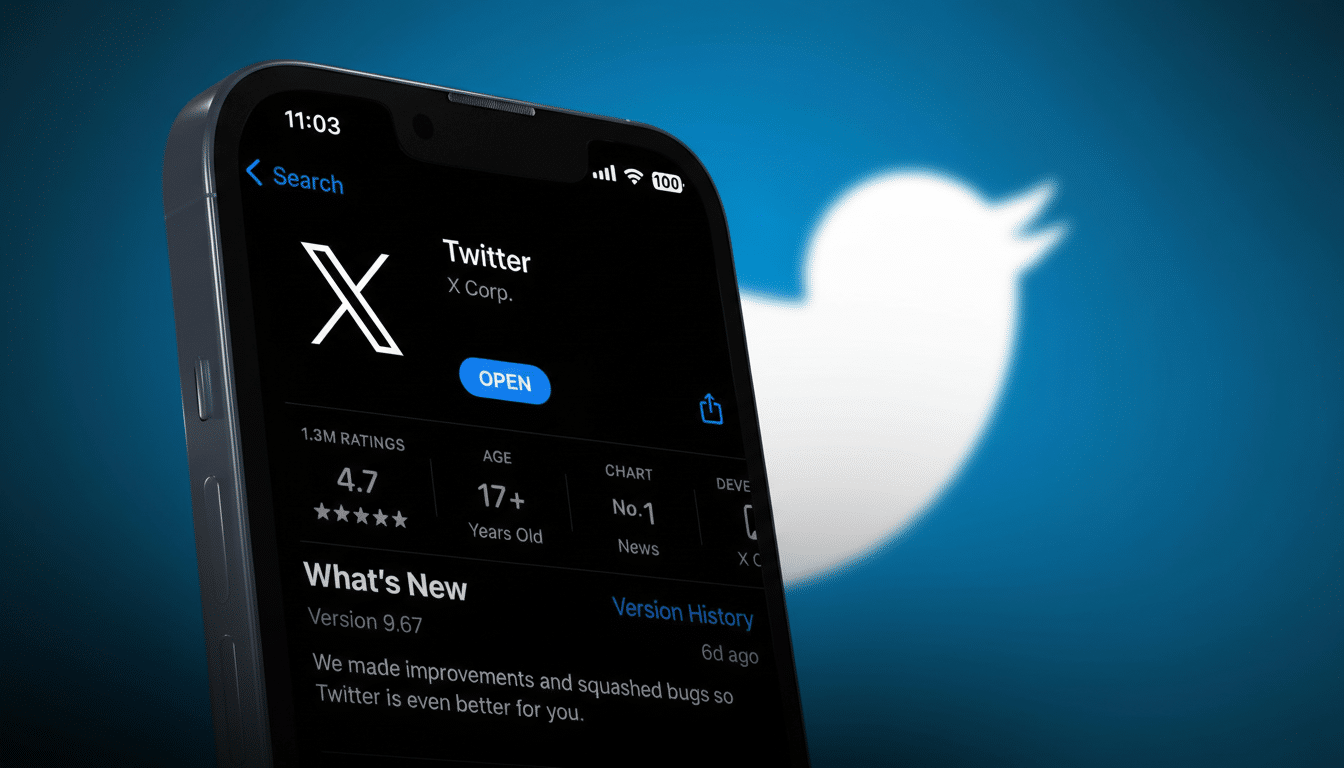
Many users said Twitter, now called X, was unreachable or painfully slow, with timelines stalling, media failing to load, and routine actions like posting or refreshing returning errors. Crowdsourced outage trackers logged a sharp spike in complaints into the thousands before tapering to roughly 1,000 reports, still well above the normal trickle.
The pattern suggested a partial service disruption rather than a total blackout: some core features faltered while others kept working, and the experience varied by device and location. As the wave subsided, users continued to see intermittent glitches, indicating backend recovery in progress or lingering congestion.

What Users Experienced During X’s Reported Service Outage
Reports clustered around timelines that would not refresh, the For You and Following feeds returning “Something went wrong” notices, and images or videos hanging at the loading stage. Several users said Search delivered sparse or no results, while Notifications and Lists intermittently timed out. A smaller subset described login loops and delayed two-factor authentication codes.
Third-party monitoring hinted at uneven impact: mobile app users, especially on iOS and Android, appeared to face more frequent timeline errors than those on the web. Some desktop users could read existing threads but could not publish new posts or view media, a hallmark of API or content delivery hiccups rather than a complete network failure.
How Big Was the Outage Based on User and Tracker Data
Downdetector, which aggregates user-submitted issues, showed a surge from baseline noise to several thousand complaints at peak, later easing to around 1,000. For context, the platform’s baseline often sits below a few dozen concurrent reports; seeing volumes in the high hundreds or thousands typically reflects a broad, user-visible incident rather than isolated ISP trouble.
Geographically, social posts and tracker heat maps pointed to reports across North America and Europe with scattered cases elsewhere, aligning with periods of heaviest platform activity. NetBlocks, an independent internet observatory, did not signal systemic connectivity failures across national networks, reinforcing that this was likely a platform-side disruption rather than government throttling or widespread ISP outages.
What Likely Went Wrong Behind the Scenes at X
While the company had not immediately detailed a root cause, the symptoms line up with common failure modes at large social platforms: partial degradation of API endpoints, a faulty deploy rolling through microservices, transient database or cache saturation, or a content delivery network misconfiguration. Any of these can manifest as feeds that half-load, media that stalls, and actions like posting or searching that intermittently fail.
Rate limiting can add fuel to the fire. When backend capacity is constrained, automated throttling may kick in to protect core systems, temporarily capping requests and surfacing generic error messages. Users then experience the platform as “up but brittle,” which matches today’s mixed ability to read versus publish or to view text but not media.
Why This Keeps Happening on Large, Complex Social Platforms
At X’s scale, even routine maintenance or configuration changes can ripple widely. The service relies on hundreds of microservices, layered caches, global CDNs, and real-time messaging pipelines; a subtle incompatibility in one layer can cascade. Similar partial outages at major platforms are often resolved quickly but leave behind residual issues while caches and edge nodes catch up.
The platform has also undergone significant infrastructure and product changes in recent years. Rapid iteration can improve performance in the long run but increases short-term risk if rollouts outpace guardrails such as staged deploys and automated rollback thresholds.
How to Confirm an Outage and What to Do During Disruptions
To verify whether it’s the platform or your connection, check Downdetector’s incident curve, watch NetBlocks’ application reachability signals, and scan social chatter for consistent error descriptions. If reports are spiking, it’s likely not your device.
Mitigation steps that can help during partial outages include switching between mobile data and Wi-Fi, force-closing and reopening the app, clearing cache, disabling VPNs or ad blockers temporarily, and trying the web version if the app is unstable (or vice versa). If media is the sticking point, toggling data saver modes can sometimes reduce request sizes and improve reliability while the service stabilizes.
Bottom line: Yes, Twitter was affected by an outage, with a documented surge in user reports far above baseline. Service appeared to recover progressively, but sporadic errors persisted for some. When in doubt, rely on independent trackers and wait for the platform to complete mitigation—forcing repeated actions during throttling windows can prolong errors.