


Modern crypto wallet platforms, beyond their primary storage functions, serve as financial centers where users can access both fiat and crypto services. This article takes a look at five top wallets, including the great all-rounder Paybis wallet app. The wallets were evaluated based on the following features: supported asset types (including BTC, ETH, stablecoins, and altcoins), multiple buy and sell options, wallet types, payment methods, security mechanisms, support for beginners, and overall strengths.
What to Check Before Choosing a Crypto Wallet App
Choosing the right crypto wallet application comes down to assessing how well each feature matches your daily trading, transferring, and managing assets routine. Before downloading or even sending funds, consider this list of features:
- Built-in buy and sell options: Seek direct buy and sell integrations so you can buy fiat & sell fiat directly within the software without switching to a third party.
- Fiat payment methods: Verify the platform supports easy payment options in your country, like credit/debit cards, bank transfer, Apple Pay, Google Pay, or local wire options.
- Send and receive functionality: An easy way to copy the receiving address, scan QR codes, and perform outbound transactions effortlessly.
- External wallet transfers: Ensure the platform can allow you to move your assets out to external hardware wallets, software wallets, or exchange accounts.
- Mobile and web access: Multi-device enabled so you can keep an eye on your balance using your portable devices and browse the web using your computer.
- Transparency on fees: Real-time breakdown of transaction fee spread, network gas price charges, and total charge before you confirm an order.
- Verification flow: If KYC is needed for fiat purchases, the onboarding process should be as simple, fast, and easy.
- Security features: Reviewing account security controls, including multi-factor authentication (2FA), biometric logon (Face ID/fingerprint), private key encryption, and transparent seed phrase backup procedures.
- Customer service: Check for contact phone number, email, and live chat.
- Regulation and compliance signals: Reliable apps actively source regulation, keep regional money transmitter licenses posted, and provide company contact details.
5 Best Crypto Wallet Apps in 2026
Each crypto wallet app offers characteristics that vary from one wallet to another, such as security features, the cryptocurrencies it supports, and usability.
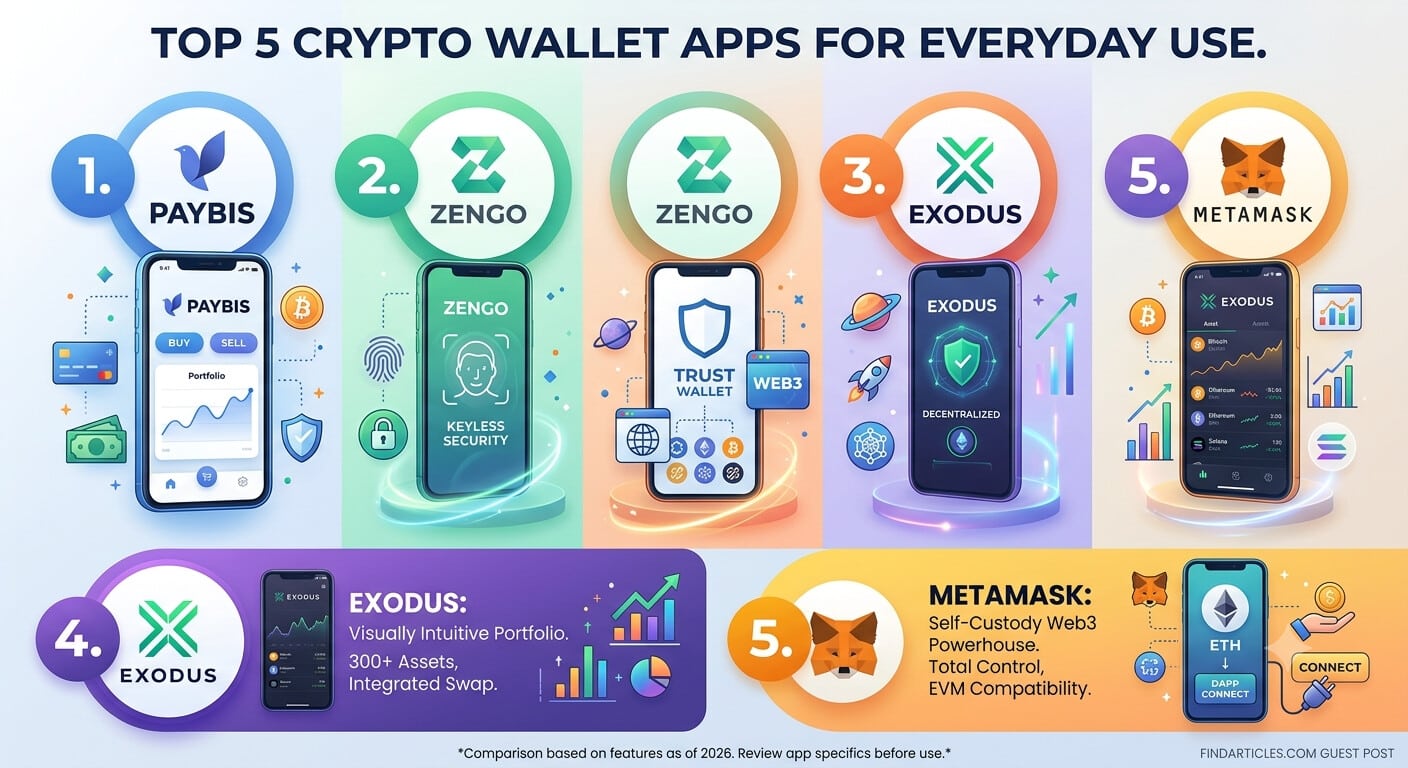
1. Paybis Crypto Wallet
Paybis is a highly user-friendly, all-in-one solution for buying, selling, storing, and managing digital assets without switching between platforms. As a custodial, all-in-one wallet, Paybis empowers users to access their crypto right away, paying with various methods such as credit cards and mobile wallets. With an easy checkout process, a wide range of supported cryptocurrencies, and a modern interface, the Paybis app fits perfectly for everyday small purchases.
2. Zengo
Zengo approaches digital asset management with a strong emphasis on modern security, eliminating the traditional seed phrase entirely. Powered by Multi-Party Computation (MPC) cryptography, it splits private key responsibilities to prevent single points of failure. Users can buy, swap, and manage assets through a streamlined interface while benefiting from biometric recovery options, making it a powerful choice for security-conscious beginners.
3. Trust Wallet
Trust Wallet is widely regarded as one of the top mobile wallets in the Web3 space, offering direct access to millions of digital assets across various blockchains. It is available as both a mobile app and a browser extension, allowing users to buy crypto, swap tokens, stake, and explore dApps without leaving the app. It offers an all-in-one solution for multi-chain users who want to go beyond storing cryptocurrencies every day to also experience DeFi.
4. Exodus
Exodus is known for its clean design and ease of use on both mobile and desktop. It lets you buy, sell, send, receive, swap, or stake your crypto assets across major blockchain networks such as Bitcoin, Ethereum, and Solana. By integrating a comprehensive portfolio-tracking tool with an in-app coin exchange, Exodus simplifies cryptocurrency management for all users, whether they are beginners still learning or seasoned holders.
5. MetaMask
MetaMask remains one of the most widely used self-custody wallet apps for those who want to store their crypto private keys securely, with access limited to their own device. The wallet is also popular for Web3 integration. MetaMask started as an Ethereum wallet but has since expanded to support every major blockchain network, including Bitcoin, alongside EVM-compatible chains, and lets users purchase tokens with a card from several partners worldwide. Users can also sell, trade, and earn interest on their tokens right from the MetaMask app.
| Crypto Wallet App | Supported Assets | Buy/Sell Options | Wallet Type | Payment Options | Security Model | Beginner-Friendliness | Best Use Case |
|---|---|---|---|---|---|---|---|
| Paybis Crypto Wallet | 80+ major cryptos & stablecoins | Built-in buy & sell | Custodial / Integrated | Credit/Debit card, Bank Transfer, Apple/Google Pay | Encryption, Biometrics, Secure Key Management | Very High | Everyday buying, selling, and fast asset transfers |
| Zengo | 380+ popular tokens | Built-in buy, sell & swap | Keyless (MPC) | Credit card, Bank transfer, Apple Pay | MPC Cryptography, 3D FaceLock recovery | High | Security-focused storage with keyless recovery |
| Trust Wallet | Millions across 100+ blockchains | Built-in buy, sell & swap | Non-custodial (Self-custody) | Cards, Bank transfer, Local methods | 12-word seed phrase, Biometric login | Medium | Multi-chain Web3 access, staking, and NFTs |
| Exodus | 300+ cryptocurrencies | Built-in buy, sell & swap | Non-custodial (Self-custody) | Credit/Debit card, Bank transfer | Secret recovery phrase, Passcode/Biometrics | High | Visual portfolio management and multi-asset swaps |
| MetaMask | Bitcoin, EVM chains & custom networks | Purchase via card partners | Non-custodial (Self-custody) | Debit card, Bank transfer, PayPal | Secret recovery phrase, Password protection | Medium | Deep Web3 dApp interaction and EVM asset management |
Start Managing Crypto With the Right Wallet App
The best crypto wallet is ultimately one that fully covers your needs, whether that’s instant fiat conversions, strong security, enhanced Web3 tools, or multichain management. Compare fee models, the wallet’s software architecture, supported tokens, and payment options before making the decision to ensure your daily use is comfortable and easy.
FAQ
Which crypto wallet app is the best?
There is no one-size-fits-all solution. For the simplest, most direct buying and selling transactions, Paybis is a strong pick. If security is the priority, Zengo is perfect, thanks to its keyless MPC technology that keeps safety uncompromised. MetaMask or Trust Wallet will be great for those who want a full-fledged Web3 experience.
What is the most user-friendly crypto wallet for everyday transactions?
Paybis and Exodus are widely considered among the most intuitive crypto wallets. Paybis has a fast, smooth fiat-to-crypto purchase process, while Exodus is famous for its visual portfolio overview.
Do I need to complete KYC to use a crypto wallet app?
It depends on the wallet and the services you use. Self-custody wallets usually do not require KYC for basic storage and transfers, while custodial wallets and fiat buy or sell features often require identity verification. With Paybis, users complete KYC when making their first transaction, allowing them to access integrated crypto purchases and other fiat-related services.
Is it safe to store crypto in a wallet app instead of an exchange?
Yes, a reputable crypto wallet app can be suitable for everyday storage, but security depends on the wallet type and how the account is protected. Paybis uses a custodial wallet infrastructure powered by Fireblocks, with MPC technology and additional transaction protection such as mandatory mobile verification for withdrawals. Users should still secure their email and account access and follow basic security practices when managing crypto.