


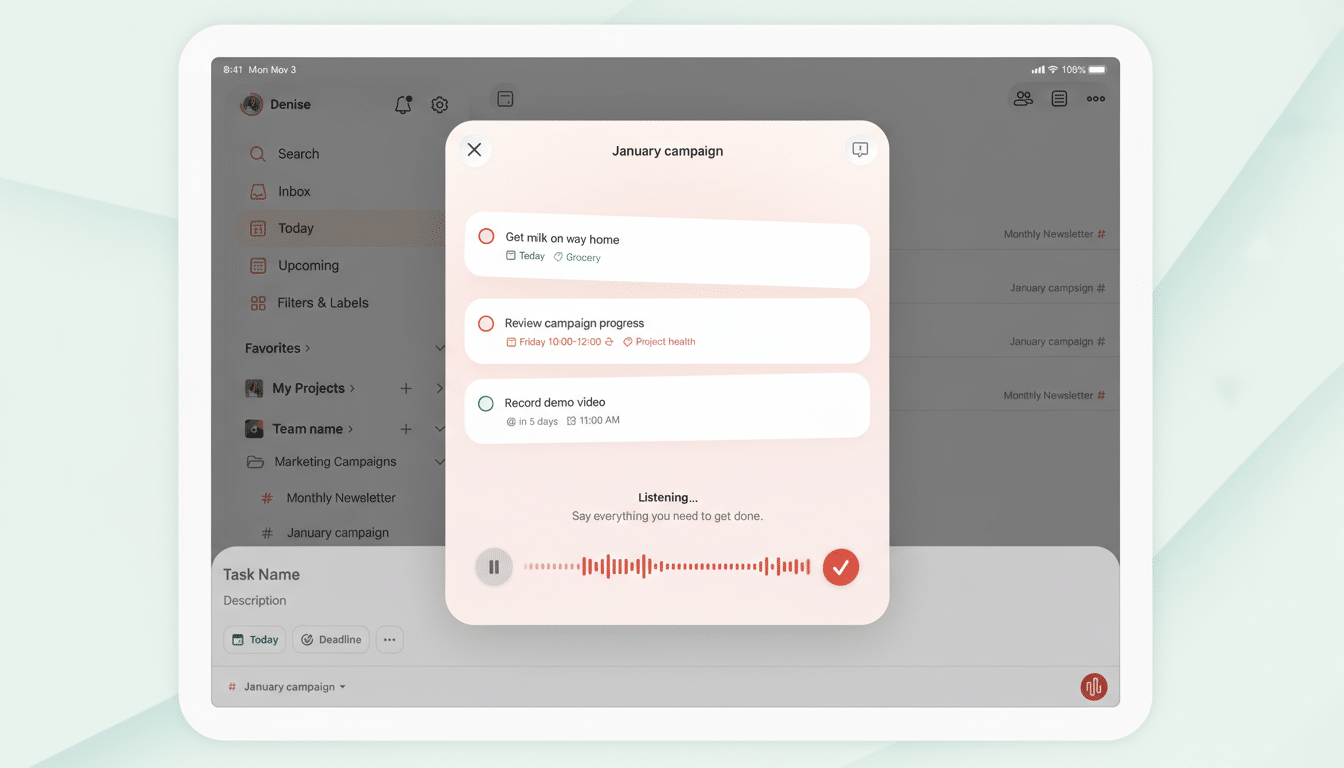
Todoist is rolling out a new way to capture to-dos without typing. Called Ramble, the AI voice feature lets you speak naturally and watch tasks, due dates, priorities, durations, and assignees populate in real time. It’s a direct play at reducing friction in everyday task capture, especially for those who think of action items on the move.
How Ramble Works Inside Todoist’s AI Assist Suite
Ramble sits inside Todoist as part of the company’s broader AI suite, Todoist Assist. Under the hood, it runs on Google’s Gemini 2.5 Flash Live via Vertex AI to handle low-latency, streaming speech understanding. As you talk, your audio is transcribed and parsed for intent, dates, project context, and other metadata, then converted into structured tasks without any manual formatting.
- How Ramble Works Inside Todoist’s AI Assist Suite
- Real-Time Voice Editing with Instant Task Updates
- Early Metrics and Rollout Across Platforms and Plans
- Privacy and Security Promises for Voice Capture
- Where It Fits in the Broader AI Device and Wearables Wave
- Why It Matters for Productivity and Team Workflows
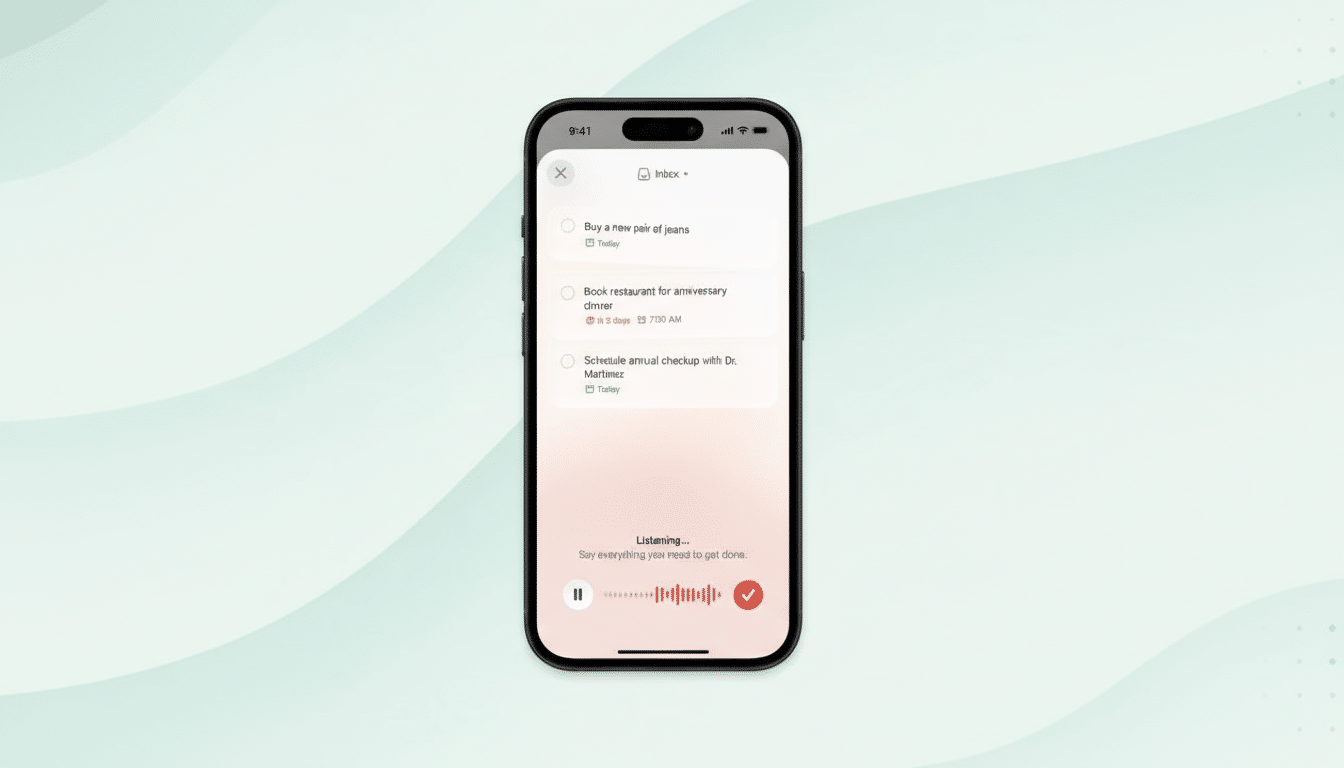
Because the model processes speech continuously, you can speak in a meandering, human way and still get tidy output. Tell it to “add follow-up with Sam about the budget next week, make it high priority,” and Ramble will infer the task, due window, and priority without special syntax.
Real-Time Voice Editing with Instant Task Updates
One of the more practical touches is real-time corrections. If you change your mind mid-thought—“actually, make that Thursday” or “assign it to Maya”—Ramble updates the task on the fly. When you’re finished, a quick “that’s all” wraps the session. It’s an interaction model borrowed from live captioning and meeting tools, but tuned for task management rather than note-taking.
Early Metrics and Rollout Across Platforms and Plans
Doist beta-tested Ramble with its ~150,000-strong Experimental user group ahead of launch. In the first three weeks, roughly 76,000 testers logged about 290,000 Ramble sessions across desktop and mobile. The company says task creation success rose from around 40% in October to about 62% by December, and that new users upgraded at a rate roughly five times higher after using the feature.
The feature is now available on iOS, Android, desktop, and web with support for 38 languages. Free plan users can try it with a limited number of sessions each month, while Pro and Business tiers offer unlimited use.
Quick-launch options include:
- On iOS: Home Screen and Lock Screen shortcuts
- On Android: app shortcuts, widgets, and Quick Settings tiles
Privacy and Security Promises for Voice Capture
Doist says Ramble’s audio isn’t stored or used to train AI models, addressing a common concern with voice tools. The company also points to SOC 2 Type II certification, signaling standardized controls around data handling. For productivity apps that often contain sensitive client and project details, those assurances are quickly becoming table stakes rather than nice-to-haves.
Where It Fits in the Broader AI Device and Wearables Wave
Voice-to-task is showing up across the broader AI gadget landscape. Amazon’s Bee wearable uses AI to turn spoken notes into suggested to-dos. Plaud’s devices focus on meeting capture and summarization. Even smart rings, such as Sandbar’s Stream and Pebble’s upcoming Index 01, promise one-press voice capture that syncs to phone apps.
Todoist’s approach sticks with the phone you already carry. That means no extra hardware to charge, while still benefiting from the same generative models powering dedicated wearables. The trade-off is that you still need to pull out your device, but the elimination of typing narrows the gap for quick capture moments—walking between meetings, commuting, or stepping out of a call with action items.
Why It Matters for Productivity and Team Workflows
Most task managers lose users at the point of capture—the moment an idea arrives but the interface feels like work. Ramble tackles that bottleneck by lowering input effort to near zero and reducing context switching. For busy teams, that could translate into more complete task logs, fewer dropped follow-ups, and better project hygiene.
The real test will be consistency across accents, noisy environments, and edge cases like overlapping tasks or ambiguous dates. But with streaming models enabling instant feedback and correction, voice-driven task creation is crossing from novelty to everyday tool. For Todoist’s substantial user base, the appeal is simple: speak the work, and let the app do the paperwork.