


For most of automotive history, a vehicle’s capabilities were largely fixed the moment it left the factory.
Manufacturers could introduce improvements through new model years, facelifts, or engineering updates, but once a car reached its owner, its core functionality rarely changed. Aside from routine maintenance or aftermarket modifications, drivers could expect the vehicle they purchased to remain fundamentally the same throughout its lifespan.
- From Mechanical Machines to Digital Platforms
- The Rise of Over-the-Air Updates
- Consumer Expectations Are Changing
- Maintenance Is Becoming More Predictive
- Personalisation Through Software
- The Challenges of the Software Era
- The Wider Automotive Ecosystem Is Adapting
- What Ownership Might Look Like in the Future
- Conclusion
That assumption is beginning to disappear.
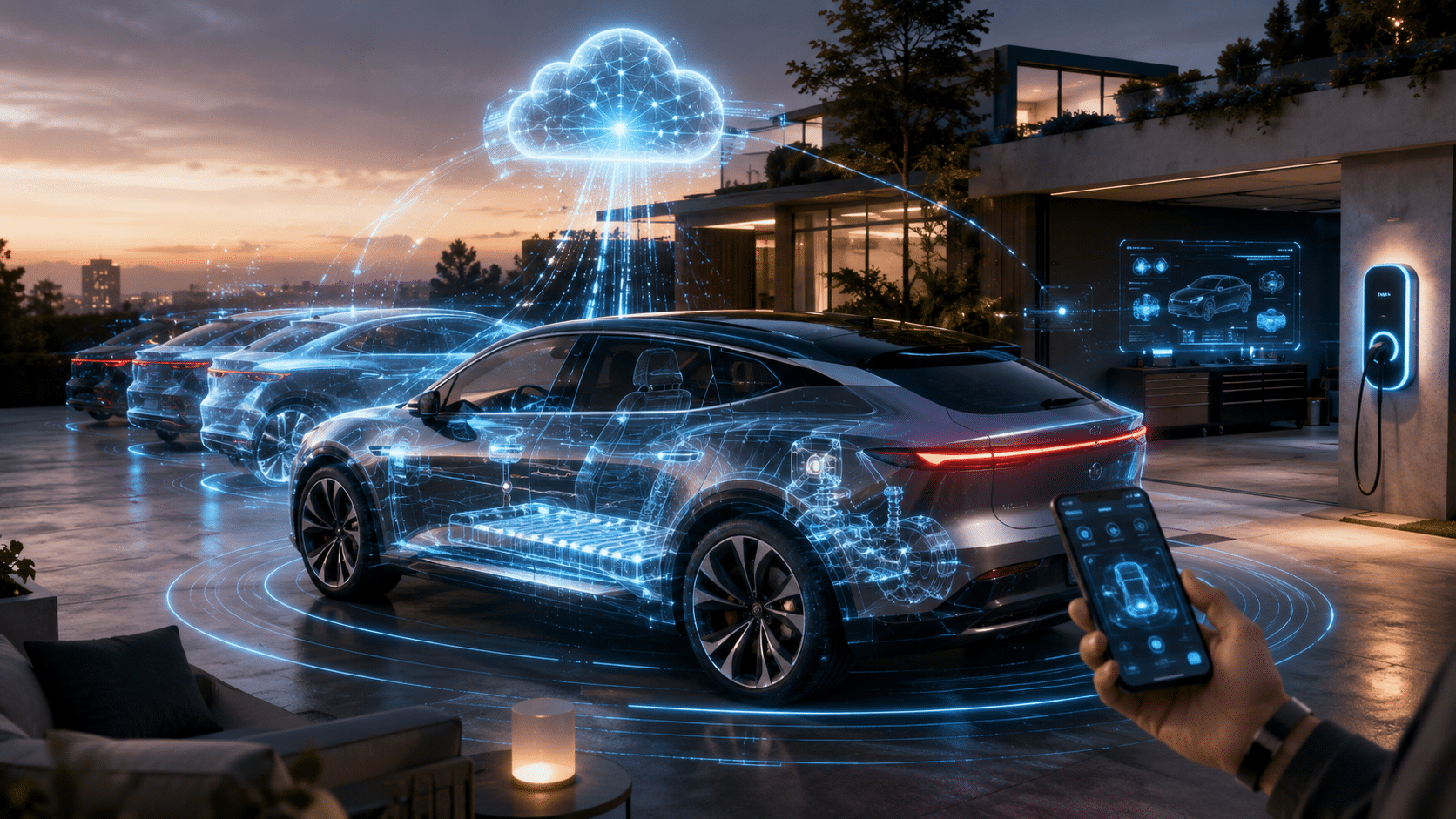
The rise of software-defined vehicles is transforming how cars are designed, maintained, and experienced. Increasingly, modern vehicles can receive updates, improvements, and entirely new features long after they leave the production line. As software becomes as important as hardware, ownership itself is evolving into something more dynamic.
The result is a new era in which cars no longer remain static products but continue to develop throughout their lives.
From Mechanical Machines to Digital Platforms
Modern vehicles contain more software than many consumers realise.
What was once a primarily mechanical product has become a highly sophisticated digital platform. Software now controls everything from infotainment systems and navigation to battery management, driver assistance technologies, climate control, and vehicle diagnostics.
The growing importance of software reflects broader changes throughout the automotive industry. Electrification, connectivity, and advanced safety systems all rely heavily on digital architecture.
As a result, manufacturers increasingly view software as a central component of vehicle development rather than a supporting feature.
This shift is changing not only how cars function but also how manufacturers think about product lifecycles.
The Rise of Over-the-Air Updates
One of the most visible consequences of software-defined vehicles is the growing use of over-the-air updates.
Much like smartphones and computers, modern vehicles can now receive software improvements remotely. Rather than visiting a dealership for every system update, owners can often download enhancements directly through the vehicle’s connectivity platform.
These updates can address software bugs, improve system performance, refine user interfaces, and enhance security.
In some cases, they can introduce entirely new functionality.
Features that did not exist when a vehicle was purchased may become available months or even years later. This represents a significant departure from traditional ownership models, where technological capabilities were largely frozen at the point of sale.
The vehicle becomes an evolving product rather than a finished one.
Consumer Expectations Are Changing
Software updates are also influencing how consumers think about ownership.
Drivers increasingly expect their vehicles to improve over time. Experiences shaped by smartphones, streaming services, and connected devices have created expectations that products should receive ongoing support and refinement.
Automotive manufacturers are responding by treating software development as a continuous process rather than a one-time project.
This has implications for customer satisfaction. A vehicle that gains useful improvements during ownership may feel more valuable and remain relevant for longer. It can also strengthen the relationship between manufacturers and customers by extending engagement beyond the initial purchase.
As digital experiences become more important, software quality is becoming a significant factor in purchasing decisions.
Maintenance Is Becoming More Predictive
Software is changing maintenance as well as functionality.
Traditionally, vehicle servicing has been largely reactive. Problems are often identified after warning lights appear, unusual behaviour develops, or components fail.
Connected software systems are helping shift maintenance towards a more predictive model.
Modern vehicles can monitor system performance continuously, collecting data about battery health, component wear, operating conditions, and potential faults. Advanced diagnostic tools can identify issues before they become serious enough to affect vehicle performance.
This allows maintenance to be planned more effectively, reducing unexpected breakdowns and potentially lowering long-term ownership costs.
For drivers, the result is often a more convenient ownership experience and greater confidence in vehicle reliability.
Personalisation Through Software
Another important development is the growing role of software in personalisation.
Vehicle settings can increasingly adapt to individual drivers, storing preferences for seating positions, climate controls, navigation habits, entertainment systems, and driving modes.
Some manufacturers are exploring ways to create user profiles that move seamlessly between vehicles, ensuring a familiar experience regardless of which model a driver is using.
Personalisation is becoming a defining feature of modern automotive design.
This reflects a broader trend across consumer technology, where users expect products to adapt to their individual preferences rather than requiring standardised experiences.
As software capabilities expand, personalisation is likely to become even more sophisticated.
The Challenges of the Software Era
Despite its advantages, the software-defined vehicle introduces new challenges.
Consumers increasingly depend on reliable software performance, making cybersecurity and data protection critical considerations. Manufacturers must ensure that connected systems remain secure while protecting user privacy.
Software complexity also creates new expectations around support and maintenance. Vehicle owners may require regular updates, compatibility management, and ongoing digital services that did not exist in traditional ownership models.
There is also a broader industry challenge. Automotive development cycles have historically been measured in years, while software development often operates on much faster timelines.
Successfully combining these two approaches remains one of the industry’s most significant tasks.
The Wider Automotive Ecosystem Is Adapting
The transition towards software-defined vehicles is influencing organisations throughout the automotive sector.
Manufacturers, dealerships, insurers, fleet operators, and service providers are all adapting to a future where digital capabilities play an increasingly important role. Even businesses involved in vehicle administration and presentation, including Plates Express, operate within an automotive environment that is becoming progressively more connected, data-driven, and technology-focused.
As software becomes more deeply integrated into vehicle ownership, the effects extend far beyond the vehicles themselves.
The entire ecosystem surrounding mobility is evolving alongside the technology.
What Ownership Might Look Like in the Future
Looking ahead, software may become one of the most important factors differentiating automotive brands.
Hardware will remain essential, but consumers are likely to place increasing value on digital experiences, ongoing support, seamless updates, and personalised functionality.
Vehicles may continue receiving improvements for years after purchase, extending product lifecycles and reshaping perceptions of value. New features could be introduced through software updates rather than waiting for entirely new vehicle generations.
In this environment, ownership becomes less about purchasing a finished product and more about participating in an evolving platform.
Conclusion
The software-defined vehicle represents one of the most significant shifts in modern automotive history.
Through over-the-air updates, predictive maintenance, enhanced personalisation, and continuous feature development, software is transforming the relationship between drivers and their vehicles. Cars are no longer static machines whose capabilities remain fixed from the day they leave the factory.
Instead, they are becoming dynamic products capable of evolving throughout their lifespan.
As consumer expectations continue to change, the vehicles that succeed in the future may not simply be the ones with the best engineering. They may be the ones that continue improving long after the keys have been handed over.