


T-Mobile is pressing its pricing advantage with a new Better Value family plan that starts at $140 per month for three lines — about $46 per line — a limited-time rate that undercuts comparable offers from AT&T and Verizon. The carrier says families can save more than $1,000 a year versus rivals when you factor in bundled perks like Netflix and Hulu, satellite connectivity on compatible phones, enhanced scam protection, and a five-year price lock.
What the price really buys on T-Mobile’s family plan
The headline price applies when you enroll in AutoPay; skip it and you pay $5 more per line each month. Taxes and surcharges are extra, and there’s a one-time device connection charge of up to $35 per line. After the promotional window, T-Mobile lists the same plan at $155 per month for three lines, which still keeps the per-line cost below many premium-tier competitors.
- What the price really buys on T-Mobile’s family plan
- How It Stacks Up Against AT&T And Verizon
- Perks that move the needle for typical families
- Network performance and reliability context for buyers
- Fine print to review before switching your family plan
- Who stands to benefit most from T-Mobile’s family plan
Eligibility matters: the $140 rate requires at least three lines, either when switching from another carrier or for existing T-Mobile postpaid customers with five years of tenure who move at least three lines. The carrier is also dangling its typical switcher incentives, stating it will pay off eligible device balances up to $800 per line for as many as four lines via a prepaid Mastercard, subject to approval and trade-in rules.
How It Stacks Up Against AT&T And Verizon
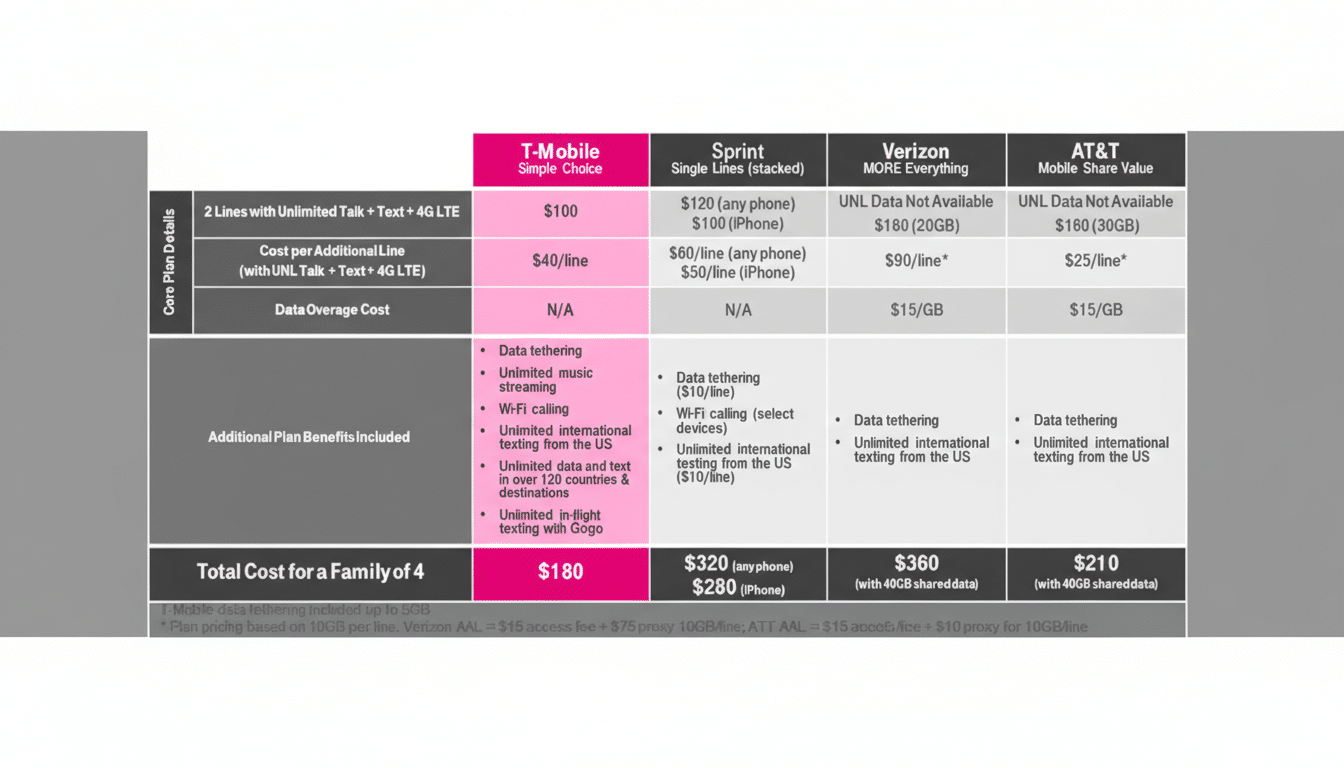
On base price alone, T-Mobile’s offer lands below flagship family plans at AT&T and Verizon, which commonly run around $165 or more for three lines before add-ons. That creates a monthly gap of roughly $20–$30, or $240–$360 per year. The bigger delta T-Mobile touts — $1,000+ annually — comes from perks that rivals often sell as add-ons.
Consider common household subscriptions. Current list pricing for Netflix Standard and Hulu with ads together can approach $20–$25 per month. Over a year, that’s $240–$300 in value if you would have paid for them anyway. Add travel benefits that competitors typically monetize — like day-pass international data or in-flight Wi-Fi — and the savings can snowball. AT&T and Verizon frequently charge around $10 per line per day for international day passes; even a 10-day family trip could otherwise add hundreds to the bill.
Perks that move the needle for typical families
The Better Value plan includes Netflix and Hulu for eligible accounts, T-Mobile’s Scam Shield with caller ID and spam blocking, and a five-year price lock that helps insulate families from creeping rates. For travelers, the plan features international data in many destinations and in-flight connectivity on select domestic carriers, which has meaningful everyday value if you fly or go abroad even a few times a year.
T-Mobile also highlights satellite messaging for supported handsets where the service is available. It’s a nascent capability across the industry, but it can be useful in remote areas with no terrestrial coverage. While you shouldn’t expect broadband speeds via satellite, basic messaging for check-ins or emergencies is a practical safety net.
Network performance and reliability context for buyers
Independent network tests continue to show T-Mobile’s 5G footprint and mid-band performance as a standout. Recent reports from Opensignal and Ookla have credited the carrier with leading average 5G download speeds and availability, thanks to its extensive 2.5GHz mid-band spectrum. That matters if you rely on hotspot data, stream frequently, or have multiple users on the same account.
Of course, your mileage depends on local coverage. Verizon and AT&T still hold advantages in certain rural corridors and specific buildings. J.D. Power’s customer satisfaction studies routinely note that perceived reliability is highly regional. Before switching, check coverage maps and ask neighbors about real-world experience where you live, work, and commute.
Fine print to review before switching your family plan
Budget for taxes, fees, and the one-time connection charge. Confirm which Netflix and Hulu tiers your account qualifies for, as inclusions can vary by plan and number of lines. If you don’t turn on AutoPay, the extra $5 per line bites into savings quickly. And note the $140 monthly pricing is a limited-time promotion; long-term math should consider the regular $155 rate.
If you’re on a legacy T-Mobile plan with a strong discount or prior price-lock terms, run the numbers. Some older plans quietly include perks like taxes-and-fees-included billing or international data that are costly to replicate elsewhere. For many households, however, bundling streaming, travel features, and a five-year price guarantee into one family plan is a compelling simplification.
Who stands to benefit most from T-Mobile’s family plan
Households already paying for Netflix and Hulu, families that travel domestically and abroad, and users who value robust 5G performance are the prime winners here. If you rarely fly, don’t leave the country, or already receive deep multi-line discounts, the effective savings may be smaller than T-Mobile’s headline claim. But for typical streaming-heavy, on-the-go families, the math can legitimately approach or exceed $1,000 per year.
Bottom line: T-Mobile’s Better Value family plan leans on aggressive bundling and a stable price commitment to outflank AT&T and Verizon. The sticker price is lower, the perks are tangible, and the network performance case is credible — just make sure the fine print and coverage align with your actual habits before you switch.