


The question rarely arrives cleanly. It usually follows a long stretch of tests, failed cycles, and shifting diagnoses — and by the time most couples reach it, the emotional weight is already significant. Two routes dominate this decision: IVF and gestational surrogacy. If you're already comparing options at an IVF clinic in Ukraine or researching surrogacy in Ukraine, you've likely moved past introductory research. What's worth slowing down for is understanding which path fits your clinical situation — not which one costs less or sounds less intimidating.
Getting this wrong doesn't just waste money. It wastes time — and for many patients, time is the variable that matters most.
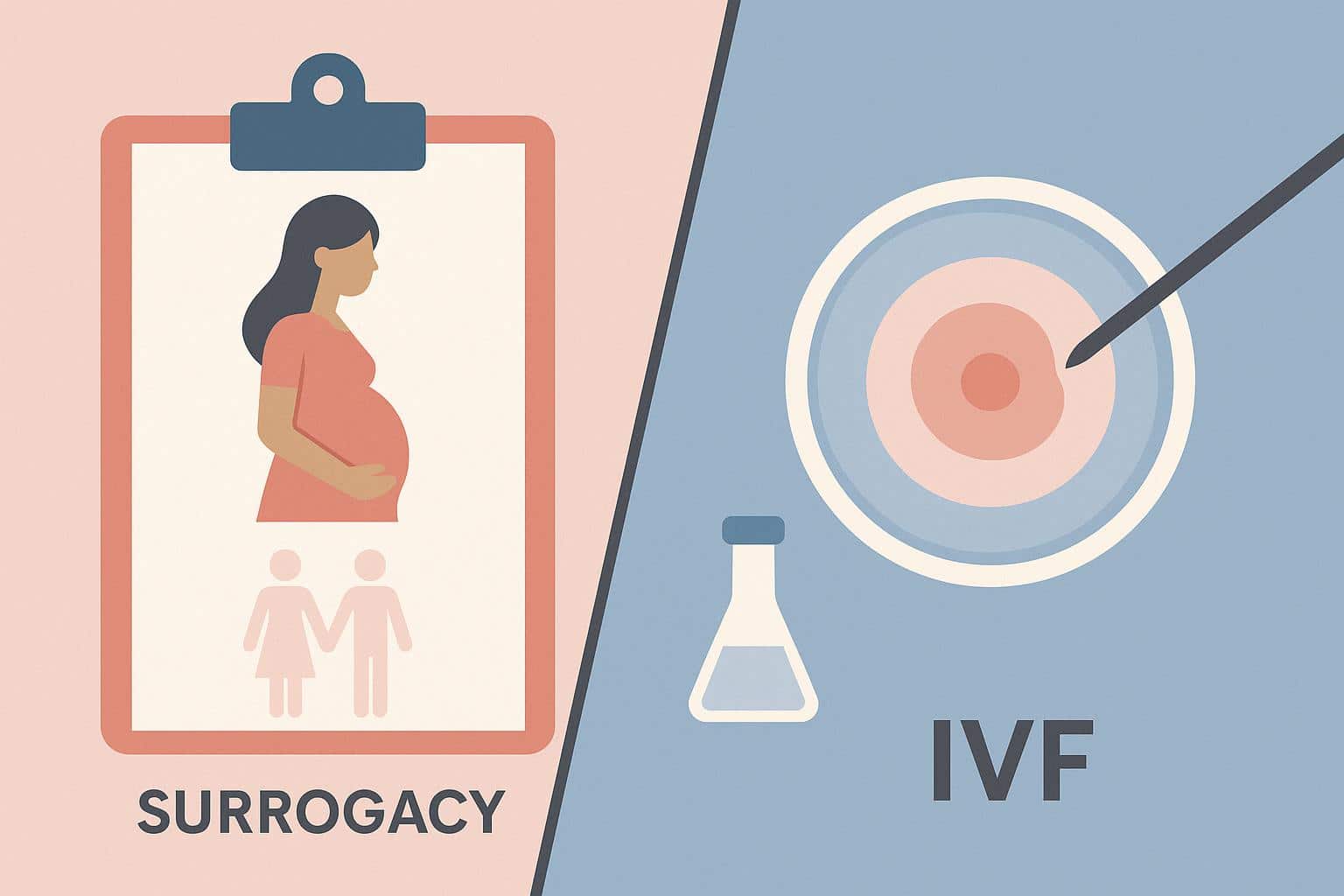
The Core Difference
IVF and surrogacy solve different problems. That's the frame everything else hangs on.
At its core, IVF is a fertilization and implantation solution. Eggs are retrieved, fertilized in a lab, and the resulting embryo is transferred back into the patient's uterus. The uterus does its job. The entire process relies on the body's own capacity to carry a pregnancy.
Surrogacy removes the uterus from the equation entirely. A gestational carrier — genetically unrelated to the child in most modern protocols — carries the embryo to term. The intended parents can still contribute their own genetic material, use donors, or combine both, depending on the diagnosis.
Neither is a fallback. They serve different clinical profiles.
When IVF Is the Right Call
IVF works when the uterus is structurally sound and the barrier is fertilization or implantation. Blocked fallopian tubes, male-factor infertility, ovulatory dysfunction, unexplained infertility after timed cycles — these are IVF problems.
Age is a real variable. Success rates using a woman's own eggs drop noticeably after 38, and more steeply after 42. Switching to donor eggs changes that curve significantly. A 44-year-old patient using eggs from a screened 25-year-old donor at a competent clinic can realistically expect per-transfer success rates in the 50–65% range — comparable to a much younger patient using her own eggs.
Key Metrics Worth Knowing Before You Start
Before committing to any protocol, a serious clinic will assess:
- AMH (anti-Müllerian hormone) — indicates ovarian reserve
- Antral follicle count (AFC) — predicts egg yield at retrieval
- Sperm morphology and motility — directly affects fertilization outcomes
- Endometrial lining thickness — determines whether an embryo can implant
If these numbers are workable, IVF is usually the first clinical recommendation. If they're not, more cycles won't fix them.
When Surrogacy Makes More Sense
Some diagnoses don't respond to IVF — not because the clinic lacks skill, but because the uterus cannot support a pregnancy regardless of embryo quality. Uterine agenesis, severe Asherman's syndrome, recurrent implantation failure across multiple high-quality transfers, or health conditions where pregnancy poses serious maternal risk — these point toward surrogacy.
Same-sex male couples and single men also typically arrive at surrogacy as a primary path, not a detour.
The logistical weight here is real. A surrogacy arrangement involves legal agreements, carrier matching, medical synchronization, and a relationship that spans an entire pregnancy. Going through an experienced agency rather than arranging this independently isn't a luxury — it's a practical necessity for most international patients. Legal protections for intended parents vary sharply by country. That part gets underestimated far too often.
Why Ukraine Keeps Coming Up
Ukraine is one of the few countries with an explicit legal framework governing both donor IVF and gestational surrogacy. Intended parents are named on the birth certificate from birth — no additional adoption process, no legal grey areas post-delivery.
The cost gap is hard to ignore. A donor egg IVF cycle in Western Europe or North America typically runs $12,000–$25,000. In Ukraine, comparable protocols usually fall between $4,000–$8,000. Full surrogacy programs — covering medical, legal coordination, and carrier compensation — often land in the $35,000–$55,000 range, compared to figures that routinely exceed $100,000 in the United States.
That said, quality varies between clinics. Not all of them handle legal coordination or surrogate matching in-house — which matters more than most patients realize until it becomes their problem.
What IVMed Actually Offers
IVMed is a Ukrainian reproductive medicine agency with programs covering both IVF and gestational surrogacy — and they handle the full scope in-house. No handoffs between separate clinics, legal firms, and matching agencies.
For IVF patients, their programs include:
- Fresh and frozen embryo transfer cycles
- Donor egg programs with a fully screened, regularly updated pool
- Preimplantation genetic testing (PGT-A) for embryo selection
- Remote initial consultations for international patients
For surrogacy, IVMed manages carrier selection, medical synchronization, legal registration, and post-birth documentation — all through one coordination structure. Their team works routinely with patients from across Europe, North America, and the Middle East. English communication is standard.
Making the First Move
If you haven't had a complete fertility workup yet, start there. Your diagnosis determines your path — and knowing it makes every subsequent decision faster and less expensive.
If the workup is done and IVF hasn't delivered results, or if surrogacy is already the clinical recommendation, IVMed offers consultations without any commitment. They'll assess your case, identify the right program, and give you a realistic cost and timeline based on your actual file — not a general brochure.
The choice between IVF and surrogacy is clinical, not emotional. Make it with people who read cases like yours every day.