


SpaceX was scheduled to attempt Starship’s first flight intended to enter Earth orbit from Starbase, Texas, on Sept. 28, a test that would move beyond the vehicle’s previous suborbital trajectories and add a commercial payload objective: deploying 26 Starlink V3 satellites.
The available reports document a planned attempt, not a completed mission. The Federal Aviation Administration’s Current Operations Plan Advisory listed a Flight 14 launch and reentry operation with a primary period of 1215Z to 1414Z on Sept. 28 and a backup period on Sept. 29. The advisory establishes the published airspace schedule but does not say whether Starship lifted off, reached orbit, released satellites or returned as planned.

From a free-return path to a possible orbit
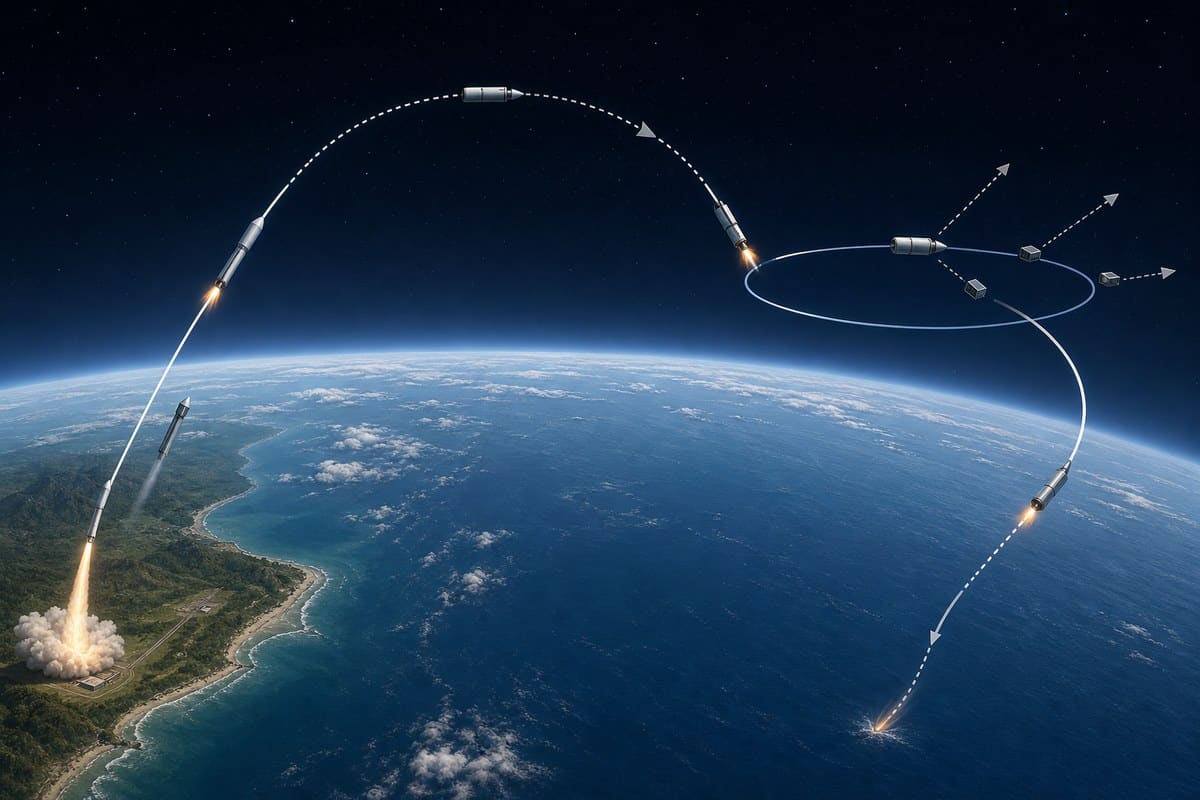
Flight 14’s proposed profile was designed to preserve an off-ramp early in the mission. ABC News reported that Starship would first follow a passively safe, suborbital free-return trajectory. In that arrangement, the spacecraft is not initially committed to remain in orbit; if it does not make a later maneuver, its trajectory is intended to bring it back toward Earth.
Only after the spacecraft passed health checks would it attempt a circularization burn, the engine firing needed to raise the low point of its path enough to avoid reentering Earth’s atmosphere on that first pass. That sequencing separates two tests: getting the large vehicle through ascent and demonstrating that it can operate well enough to attempt sustained orbital flight.
Previous Starship tests have used paths that ended with atmospheric reentry rather than an attempt to settle into a stable Earth orbit. SpaceX has said those earlier suborbital trajectories were designed to be passively safe, according to Mashable’s pre-launch report. Flight 14 would therefore be a change in mission design, not merely a longer version of an earlier test.
If the circularization burn succeeded, the mission was expected to last just under 10 hours and complete roughly six orbits, according to ABC News and Mashable. Six circuits in that span would amount to an average of less than 100 minutes per orbit, broadly consistent with the rapid pace of low-Earth-orbit operations, though the reports did not specify a final orbital altitude or exact period. Those figures remained targets rather than results.
Satellite deployment adds an operational objective
The planned payload gives the flight a second purpose. Several outlets, including CNBC, reported that Flight 14 was to deploy 26 Starlink V3 satellites. ABC News described them as the first Starlink satellites that Starship was intended to place into orbit for ongoing service; past Starship payload demonstrations involved simulators or objects expected to reenter.
That distinction is important when assessing the test. A satellite deployment would require the spacecraft not only to reach the needed trajectory but also to open its payload system and release spacecraft safely. It would not, by itself, establish that the satellites reached their final operating configuration, began providing service or performed as designed. None of those outcomes is confirmed in the available coverage.
The mission plan also included a controlled deorbit and Pacific Ocean splashdown after the orbital phase, according to ABC News and Mashable. Such a return would be another planned milestone, not evidence yet of rapid reusability. Recovering a vehicle after a single test is different from demonstrating that it can be refurbished and flown repeatedly on an operational schedule.
What the schedule confirms — and what it does not
There were differing public accounts of the day’s precise liftoff time. The FAA advisory’s 1215Z opening converts to 8:15 a.m. Eastern daylight time, and CNBC reported the same opening time while also saying the FAA had authorized Flight 14 launch and reentry operations on Sept. 26. ABC News and WKMG later reported a revised 8:48 a.m. EDT target. One local report cited a conflicting earlier opening time.
The FAA listing is the strongest available record of the operational window, while the later 8:48 a.m. target was reported by news outlets rather than shown in the advisory. Launch-day targets can shift for weather, technical reviews, range coordination or other operational reasons. The published schedule should not be treated as proof that a launch occurred at any particular minute.
The test has implications for SpaceX’s plans to use Starship as a heavy-lift launch vehicle and for NASA’s lunar-landing architecture, which relies on a Starship-derived lander. But a single orbital test, even if all objectives were met, would not demonstrate the reliability, repeated reuse, propellant-transfer capability or crew-safety performance needed for a lunar mission. Flight 14 was structured to gather evidence about several of those broader development challenges, beginning with whether Starship could safely make the transition from a free-return path to orbit.