


Sony is expanding its open-ear lineup with the LinkBuds Clip, a new clip-style true wireless set that abandons the original donut-shaped in-ear approach for a more secure, over-ear wrap. Priced at $229.99 and available in lavender, black, green, and greige, the LinkBuds Clip aim to blend all-day comfort with the ambient awareness that has defined the LinkBuds family since 2022.
A Clip Design Built for All-Day Wear and Comfort
The LinkBuds Clip use a U-shaped arm that hugs the outer ear, with a soft, flexible band connecting the speaker pod to a compact battery module behind the ear. The approach mirrors what rivals like Bose and Shokz have popularized, but with Sony’s emphasis on lightweight feel and stability for movement-heavy routines.
- A Clip Design Built for All-Day Wear and Comfort
- Battery Life and Charging Details for LinkBuds Clip
- Audio Features Tuned For Open-Ear Listening
- Call Quality Gets a Bigger Upgrade for Clearer Voice
- Connectivity and Controls for Daily Use and Multipoint
- Why Sony Switched to a Clip Design for Open Earbuds
- Early Take on LinkBuds Clip Strengths and Trade-offs
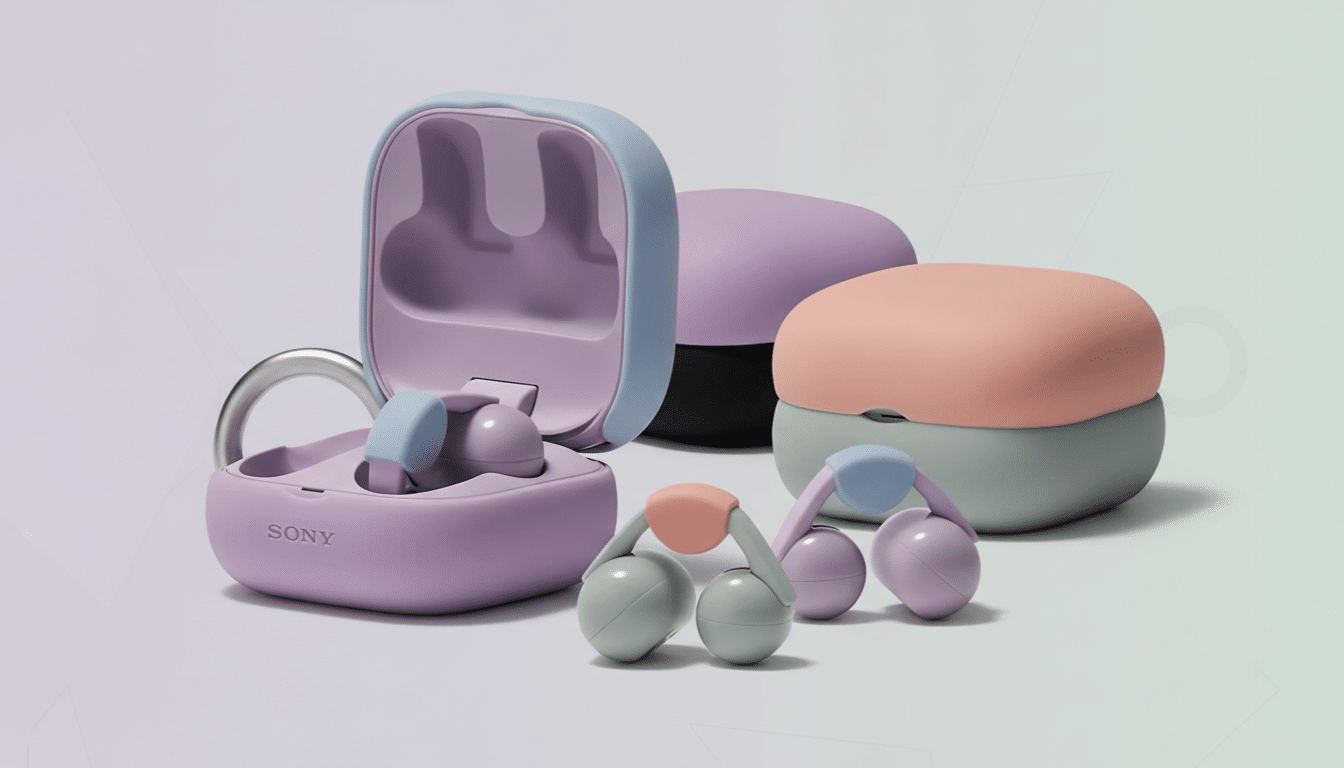
To help small-ear users, Sony includes silicone “air fitting cushions” that subtly increase contact for a more secure hold without sealing the ear canal. As with prior LinkBuds, these are rated IPX4 for splash resistance, making them suitable for sweat and light rain.
Battery Life and Charging Details for LinkBuds Clip
Sony claims up to 9 hours on a single charge, with 37 hours total including the case—an uptick over the LinkBuds Open and, by Sony’s math, roughly 20–30% longer playtime than many open-ear competitors that typically advertise around 6–7 hours. A quick-charge feature adds about an hour of listening from just three minutes on the cable.
The clamshell case is nearly identical in size to the LinkBuds Open case, but still omits wireless charging. Sony will sell optional silicone top and bottom case covers—complete with color-matched cushions and ring carabiners—for $24.99 on its site, letting buyers mix and match looks.
Audio Features Tuned For Open-Ear Listening
Open-ear designs trade isolation for awareness, so keeping voices and podcasts intelligible in noisy environments is critical. Sony adds a voice mode intended to lift mids and dialogue clarity for talk-heavy audio without over-brightening music. A sound leakage mode helps reduce audio spill so people around you hear less of your content—useful in offices and quiet commutes.
A forthcoming firmware update will bring adaptive volume control that raises or lowers volume automatically based on ambient noise. It’s a sensible fit: city soundscapes can swing widely from sub-60 dB side streets to well above 80 dB on busy avenues, and automation reduces the need to constantly adjust levels.
Call Quality Gets a Bigger Upgrade for Clearer Voice
Call performance is a frequent pain point for open earbuds, which struggle to isolate your voice. Sony tackles this with AI-powered noise reduction and a bone-conduction sensor that captures jaw vibrations to better separate speech from background noise. In demos, the approach materially cut ambient clatter and wind artifacts; if it holds up outside the lab, the LinkBuds Clip should be a strong pick for heavy callers.

Connectivity and Controls for Daily Use and Multipoint
The LinkBuds Clip support Bluetooth Multipoint for easy switching between a laptop and phone, and they work with SBC and AAC codecs. Unlike LinkBuds Open, there’s no LC3 at launch and Sony says Auracast isn’t planned—worth noting as broadcasters, venues, and the Bluetooth SIG continue to build momentum around broadcast audio.
Controls are tap-based on the earbuds, but Sony’s “wide-area tap” from the Open model—where you tap near your ear—doesn’t carry over. Customization in the companion Sony Headphones Connect app is limited to predefined control groups, so power users may find fewer remapping options than on over-ear Sony models.
Why Sony Switched to a Clip Design for Open Earbuds
Sony’s original LinkBuds made a splash with their ring driver, but fit proved polarizing: some users loved the barely-there feel, while others couldn’t achieve a stable seal-free placement. The clip format acknowledges that breadth of ears. It also squarely answers competitors: Bose’s clip-style open earbuds and Shokz’s earhook designs have raised the bar for comfort and stability during workouts, commuting, and long meetings.
Industry analysts have highlighted a steady shift toward open designs as people seek audio that coexists with everyday life—situational awareness for runners, easier collaboration in offices, and less ear fatigue during long wear. Sony’s move brings its acoustic tuning and mic expertise to a form factor more buyers already recognize.
Early Take on LinkBuds Clip Strengths and Trade-offs
The LinkBuds Clip look like Sony’s most mainstream open-ear attempt yet: more secure than the donut design, longer battery life than many peers, and a credible push on call quality. Trade-offs remain—no wireless charging, no LC3, and no Auracast—but the package is coherent for commuters, hybrid workers, and fitness-minded listeners who need awareness without sacrificing comfort.
If you bounced off the original LinkBuds fit or found other open-ear models lacking in mic performance, Sony’s clip-style pivot could be the Goldilocks option. The real test will be how the AI noise reduction and voice mode perform beyond demos, but on paper, this is the most convincing evolution of LinkBuds to date.