


SLB has agreed to acquire thermal-management supplier Kelvion in a transaction valued at about $4.1 billion, extending the energy-technology company’s push into the equipment needed to cool data centers. The proposed purchase combines $3.4 billion of cash consideration with roughly $700 million of debt that SLB would take on.
The transaction, announced Aug. 31, is not yet complete. SLB said it expects to close in the first half of 2027 after customary conditions and regulatory approvals. If completed, the deal would bring a major maker of heat exchangers and cooling systems into a business SLB is positioning around data-center infrastructure as well as its traditional energy markets.

Cash price and total deal value are different measures
The two values attached to the deal describe different parts of the same transaction, rather than competing price reports. SLB would pay approximately $3.4 billion to Kelvion’s owners, Apollo-managed funds and Triton-advised funds. It would also assume about $700 million of Kelvion debt, lifting the implied enterprise value to approximately $4.1 billion.
SLB disclosed the agreement and its consideration structure in an Aug. 31 Form 8-K. The filing is important because it distinguishes the cash payment from enterprise value, a difference that can materially affect comparisons of acquisition prices and leverage. Apollo, which said its funds became invested in Kelvion in January 2026, separately confirmed the planned sale and its continuing role as the target’s majority owner before closing in its transaction announcement.
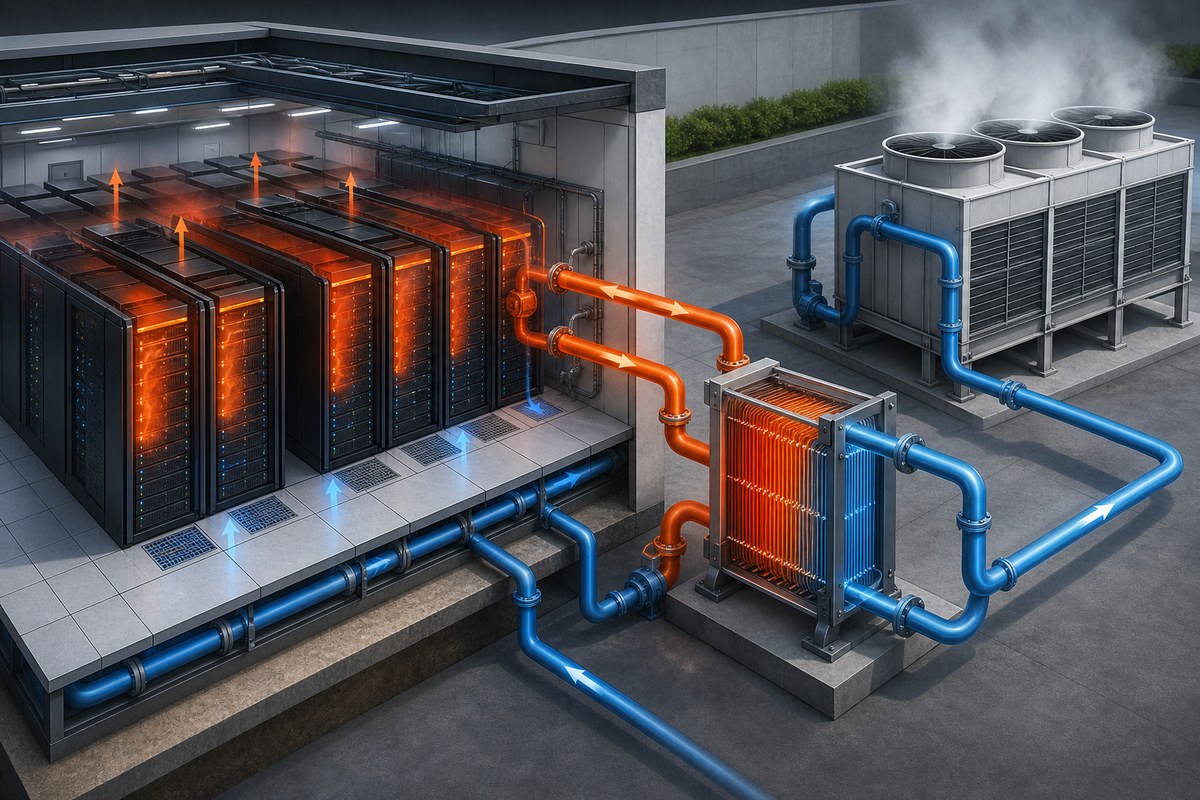
Kelvion sells thermal-management and heat-exchange equipment into data-center, energy and industrial customers. The purchase gives SLB a more direct presence in cooling hardware, where the operational challenge is to remove heat generated by servers and related electrical equipment. Such systems can use air, liquids or other heat-transfer arrangements, depending on a facility’s design and computing density.
SLB’s data-center case rests on aggressive forecasts
SLB projects that Kelvion will produce $2.3 billion to $2.4 billion of 2026 revenue and $350 million to $400 million of adjusted EBITDA. It further forecasts that data centers will account for $1.2 billion to $1.3 billion of Kelvion’s revenue this year, making the segment both its largest and fastest-growing end market. Those are company estimates, not reported results.
The buyer’s announcement puts the scale of its ambition in sharper terms. SLB expects the combined operations to exceed $2 billion in pro forma 2026 data-center revenue and generate about $300 million in adjusted EBITDA. By 2028, it is targeting $4.5 billion to $5 billion of revenue and $700 million to $800 million of adjusted EBITDA for the combined data-center solutions operation.
The figures imply that Kelvion would supply a large portion of the combined unit’s immediate data-center revenue base. At Kelvion’s midpoint forecast of $1.25 billion, the target would represent roughly 62.5% of a $2 billion combined revenue figure. But the comparison is directional: SLB describes the combined number as “more than” $2 billion, while Kelvion’s estimate is a range, and both are forecasts for 2026.
SLB also said its existing Data Center Solutions revenue is expected to expand at a compound annual rate above 90% from 2024 through 2026, with cumulative delivered capacity exceeding 2 gigawatts by year-end 2026. The Kelvion agreement would add cooling technology to that developing platform, rather than simply adding another energy-services asset.
Synergies and accretion remain execution targets
SLB expects about $120 million in annual EBITDA synergies within three years of closing, citing operating efficiencies and additional revenue opportunities. Relative to Kelvion’s projected adjusted EBITDA range, that target equals roughly 30% to 34% of the target’s standalone EBITDA at the range’s endpoints. It is a meaningful integration objective, though it is not a contractual outcome or a completed saving.
The company also says the acquisition should add to earnings per share and free cash flow per share during the first 12 months after closing. Those expectations depend first on the deal receiving approvals and closing, then on SLB’s ability to integrate Kelvion and realize the anticipated cost and revenue benefits. The announced agreement does not eliminate those execution steps.
For Apollo and Triton, the sale would mark a relatively quick exit following Apollo’s January investment completion. For SLB, the longer timetable means the transaction’s financial contribution would not begin until after a first-half 2027 close, assuming the required conditions are met.