


Engineering teams deploying automated media workflows face severe operational drag when individual generative video models require dedicated client wrappers and separate platform accounts. When an infrastructure desk attempts to connect directly with isolated model labs, developers spend dozens of sprint hours maintaining divergent payload schemas and custom authentication tokens. Routing these disparate generative requests through an enterprise gateway like APIPod resolves this fragmentation by exposing a standardized, OpenAI-compatible interface backed by automated upstream load balancing.
Consolidating video infrastructure under a single control plane becomes essential once an enterprise transitions to continuous client-facing output. Rather than exposing raw provider secrets across multiple vendor portals, engineering teams direct media synthesis through unified endpoints enforcing strict polling, idempotency safeguards, and billing telemetry, preserving full programmatic access to underlying model parameters.
The Operational Drag Of Disconnected Model Integrations
Connecting software applications directly to individual foundation model laboratories introduces technical debt that rarely surfaces during sandbox prototyping. On our desk, engineering maintained four separate microservices to handle authentication formatting and dimension normalizations across three video vendors. When one laboratory adjusted its asynchronous webhook contract, downstream ingestion stalled, creating a backlog of twelve hundred unrendered video requests that required manual queue draining.
Financial management introduces parallel administrative friction. Each standalone provider enforces minimum monthly credit deposits and distinct invoicing schedules. In our quarterly infrastructure audit, we discovered thirty-four hundred dollars in orphaned monthly balances sitting idle across discontinued developer seats. Standardizing across APIPod replaces scattered credit commitments with a consolidated balance that deducts tokens strictly for completed inference jobs.
Network reliability represents the third critical failure point. Video synthesis jobs require heavy GPU allocation, meaning requests spend significant time in upstream queues. When an unmanaged HTTP request encounters a timeout after four minutes of silent processing, standard retry scripts often trigger duplicate tasks, deducting double credits from company balances. Eliminating this risk requires robust server-side idempotency keys and unified polling contracts.
Three Distinct Route Contracts For Seedance Inference
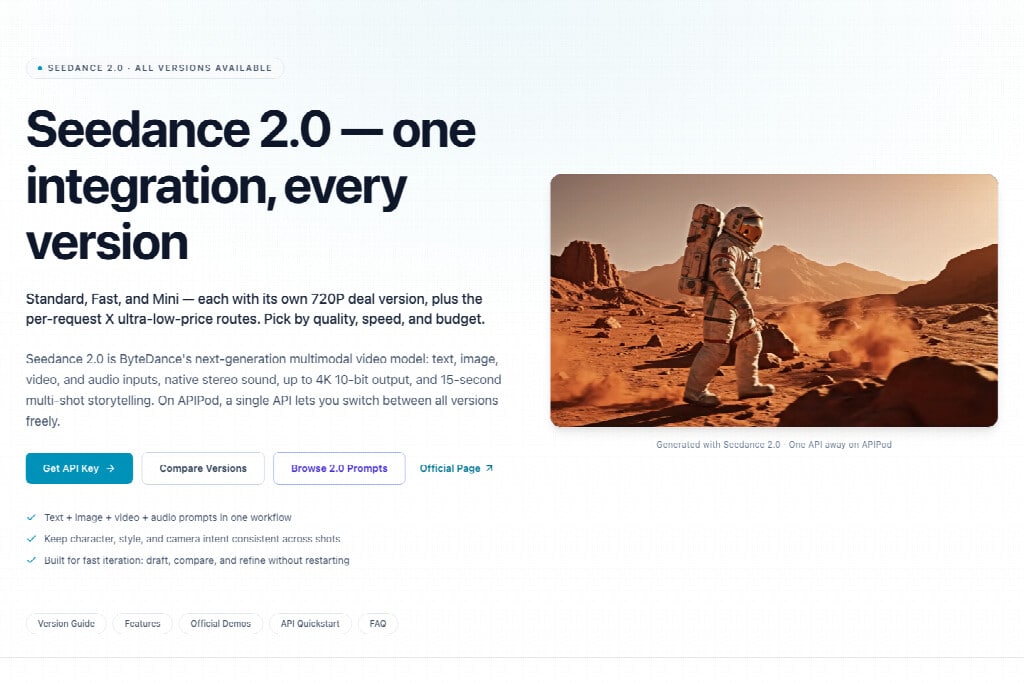
Rather than treating every generation request identically, production media architectures require distinct service tiers tailored to specific delivery standards. The Seedance API catalog on APIPod structures the ByteDance Seedance 2.5 model family into three operational channels: the official discount route, the special-offer route, and the X ultra-low-price channel. Each channel defines explicit parameter ceilings, queue priorities, and billing rates, allowing backend systems to route tasks programmatically.
The Enterprise Channel For Broadcast Deliverables
The official discount route provides enterprise-tier access to full model capabilities at five percent below baseline token list pricing. Operating under identifiers like seedance-2.5-t2v and seedance-2.5-i2v, this channel supports resolutions up to native 1080P across durations from 4 to 30 seconds. Crucially, this tier provides complete native audiovisual synthesis via the generate_audio parameter, producing synchronized spoken dialogue, environmental acoustics, and contextual ambient soundscapes.
The Cost Optimized Channel For High Volume Drafts
For internal concepting and synthetic training datasets, the X ultra-low-price channel offers an aggressive cost-optimized alternative billed strictly per output second. Designated by identifiers like seedance-2.5-x-t2v, this route locks resolution at 720P across duration windows from 5 to 30 seconds. Under a test protocol evaluating one hundred storyboard runs, the X channel recorded an average queue latency of 42 seconds compared to 11 seconds on the discount tier. In our production logs, prompt adherence drifted around second 3 in preliminary explorations, causing roughly 15 / 100 drafts to be discarded before scene seeds advanced to full rendering.
Comparing Route Specifications Across Production Parameters
Selecting the optimal model configuration requires balancing rendering fidelity, processing speed, and financial expenditure. The technical matrix below compares functional parameters across primary Seedance routes:
| Architectural Metric | Official Discount Route | Special-Offer Route | X Ultra-Low-Price Route |
| Model Identifier Prefix | seedance-2.5-t2v / i2v | seedance-2.5-lite-t2v | seedance-2.5-x-t2v |
| Resolution Maximum | Up to 1080P | 720P Maximum | 720P Maximum |
| Supported Durations | 4 to 30 Seconds | 4 to 30 Seconds | 5 to 30 Seconds |
| Native Synchronized Audio | Supported via parameter toggle | Supported via parameter toggle | Not supported on channel |
| Billing Methodology | Token-based (5% off list) | Discounted token billing | Metered per output second |
Production workflows deploy a hybrid architecture. Exploratory generative passes and internal concept reviews route through the per-second X channel to preserve operating capital. Once stakeholders approve visual motion, the approved scene metadata submits to the official discount channel for full 1080P rendering with synchronized audio.
Asynchronous Status Polling And Request Idempotency
Generative video synthesis is inherently asynchronous. When an engineering client submits a payload to the video endpoint, the server validates JSON schemas, reserves credit allotments, and returns an immediate HTTP 200 payload containing a distinct task_id. Backend polling routines monitor job progress by querying the status endpoint at /v1/videos/status/{task_id} every two to five seconds, avoiding unnecessary network overhead while tracking completion.

Task Lifecycle And Automated Credit Protection
To guard against duplicate billing caused by network retries, APIPod enforces strict idempotency through optional Idempotency-Key headers supporting strings up to 255 characters. When an upstream GPU node encounters a CUDA memory fault or timeout threshold during rendering, the task transitions to failed with an explicit error code. The gateway immediately reverses the initial credit reservation, preventing wasted spend where total spend would otherwise accumulate on unrendered tasks.
Building Long Term Infrastructure Stability In Video Generation
Building resilient generative video pipelines requires establishing clean architectural boundaries between core business logic and underlying foundation models. Directly embedding proprietary lab SDKs into production codebases creates technical debt, vendor lock-in, and unpredictable financial exposure as endpoint specifications evolve.
Consolidating multi-model video generation through APIPod equips engineering teams with the stability, observability, and cost control required to scale automated production environments. By implementing explicit route contracts, automated credit protection, and standardized asynchronous task polling, organizations deploy generative video features while keeping operating budgets predictable and sustainable.