


Indian AI startup Sarvam is taking on-device intelligence beyond premium smartphones, outlining plans to run its compact models on Nokia-branded feature phones, in-car systems, and a new pair of smart glasses. The company previewed the push at the India AI Impact Summit in New Delhi, framing it as a practical path to “sovereign AI” that works privately and reliably on everyday hardware.
Backed by Lightspeed, Peak XV, and Khosla Ventures, Sarvam says its edge models occupy only megabytes, execute on existing processors, and can operate without a network connection. After building voice-first systems for enterprise support desks, the company is now steering its technology toward mass-market consumer experiences.

Edge AI Sized for the Real World of Everyday Devices
Running AI locally promises three immediate gains:
- Lower latency
- Stronger privacy
- Reduced connectivity costs
Sarvam’s head of Edge AI, Tushar Goswamy, argued that small, tuned models can bring intelligence to “every device”—from basic handsets to laptops and cars—by meeting the compute and power limits those products impose.
The bet is tailored to India’s realities. The country recognizes 22 official languages and many more dialects, and World Bank data shows roughly 65% of Indians live outside major cities, where mobile coverage and data affordability can vary. Analysts at Counterpoint Research note that feature phones still serve a substantial user base in India, making offline-capable assistants in local languages more than a novelty—they could be a bridge to critical services.
Partnerships Point to Consumer Scale Across Devices
Sarvam is collaborating with HMD to bring a conversational assistant to Nokia and HMD phones. A demo showed a dedicated AI button on a feature phone, enabling voice guidance in local languages for tasks such as understanding government schemes or checking market prices. The company did not clarify which capabilities will function entirely offline, a key detail for rural usage.
The startup has also worked with Qualcomm to optimize its models for the latter’s chipsets. Qualcomm, for its part, has been promoting a Sovereign AI Experience Suite meant to run across phones, PCs, cars, and IoT devices. Sarvam’s leadership says the tuning work should speed up deployment and keep more data at the edge, reducing the need to ship voice and context to the cloud.
This strategy mirrors a wider industry shift toward on-device assistants from global players, yet Sarvam’s angle is India-first: ultra-light models and multilingual voice that can serve users who aren’t carrying a flagship smartphone or traveling with reliable 5G.
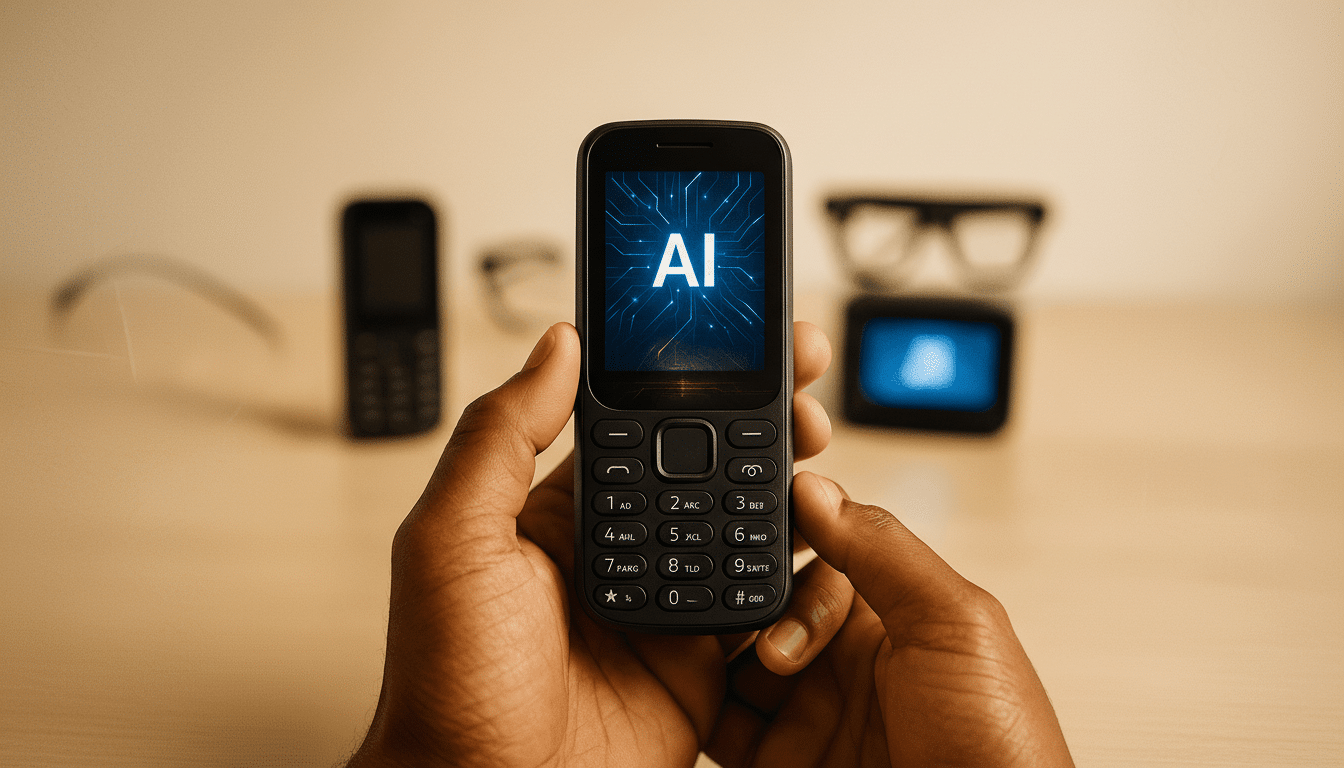
From Dashboards to Wearables: Sarvam’s On-device AI
In automotive, Sarvam is partnering with Bosch to embed AI assistants in cars. Low-latency, on-board models could handle voice commands, in-cabin control, and contextual prompts even when signals drop—useful for navigation handoffs, quick diagnostics, or hands-free help on the road. The direction aligns with automakers’ broader migration to embedded generative assistants as they reduce dependence on data links.
On the wearable front, Sarvam unveiled its own smart glasses, Sarvam Kaze, designed and manufactured in India. Co-founder Pratyush Kumar described Kaze as a “builders’ device,” slated for availability in May. Expect a voice-first interface, discreet prompts, and developer-focused features aimed at prototyping hands-free AI experiences without leaning on a persistent cloud connection.
Why It Matters for India’s Connectivity and Access
For a large base of users who still rely on basic handsets, a local-language assistant that works when the network does not is a practical upgrade, not a party trick. It could make information about subsidies, health services, or market rates more accessible and bring AI utility to drivers, field workers, and first-time internet users.
It also underscores Sarvam’s pivot from enterprise voice models—often used in call centers and support workflows—to consumer-grade products. If the HMD integration and Bosch rollout go smoothly, the company could establish a blueprint for frugal, multilingual, and privacy-preserving AI across device tiers.
What to Watch Next: Offline Limits and Rollout Details
Key details remain open:
- The precise device list
- How much of the assistant runs fully offline
- Model sizes by language
- Memory footprints on feature phones
- Battery impact in cars and wearables
- Pricing that can scale
Still, with capital from marquee investors and ties to Qualcomm and Bosch, Sarvam is positioning edge AI as an Indian export as well as a domestic equalizer. If it delivers, AI won’t just live in cloud demos and premium phones—it will ride in budget handsets, everyday cars, and a pair of homegrown glasses.