


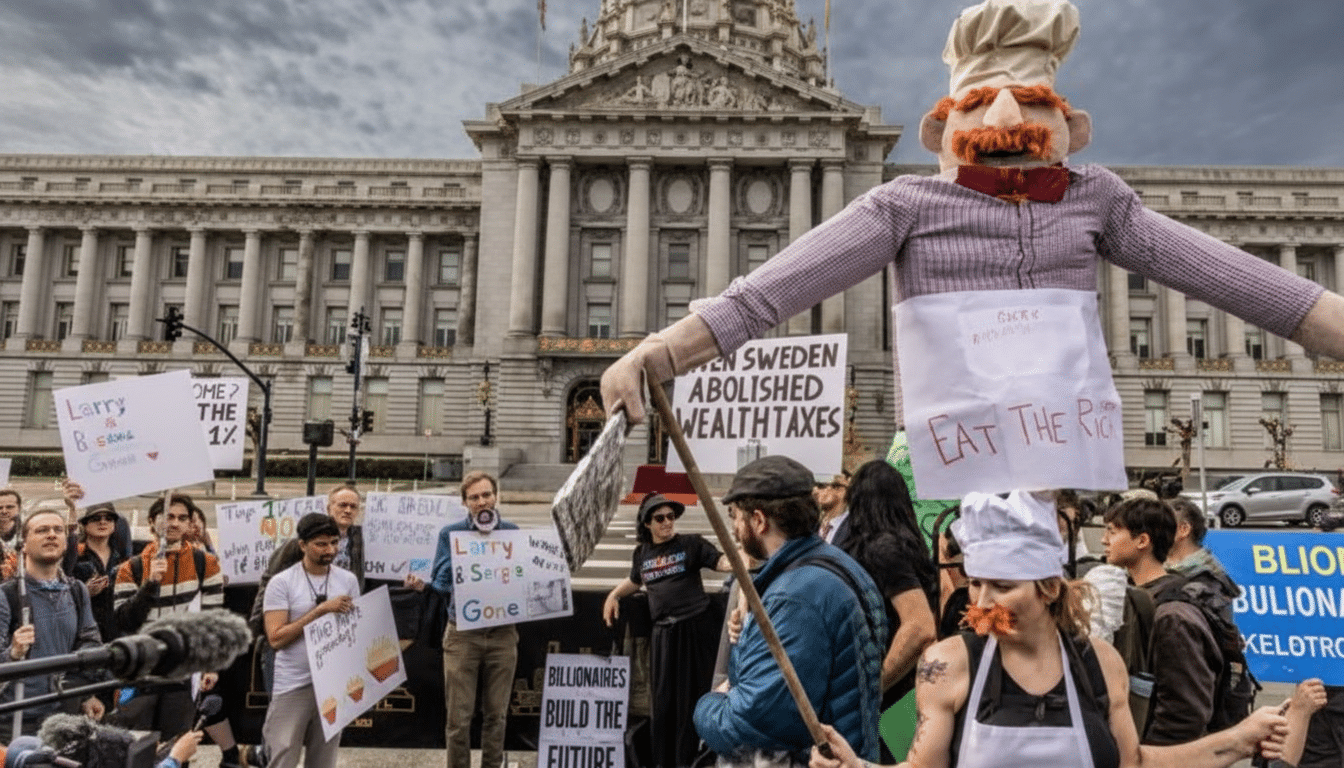
A rally billed as the March for Billionaires brought a small but attention-grabbing crowd to downtown San Francisco, drawing roughly three dozen participants and about a dozen counterprotesters, according to the San Francisco Chronicle. Reporters and photographers nearly matched the turnout, Mission Local observed, underscoring how an offbeat concept can outsize its footprint in the city’s public square.
What Sparked the Demonstration in San Francisco
Organizers said they were protesting the Billionaire Tax Act, a proposed measure aimed at Californians with net worth above $1 billion. The plan would levy a one-time 5% tax on total wealth. Supporters cast it as a fairness reset; critics counter that wealth taxes are difficult to administer, vulnerable to legal challenges, and could drive high-net-worth residents to relocate.
- What Sparked the Demonstration in San Francisco
- Small Crowd, Big Online Noise After San Francisco March
- Policy Context and California’s Fiscal Stakes
- Fact-checking a rally claim on immigrant health coverage
- Tech wealth, politics, and perception in the Bay Area
- What comes next in California’s wealth tax debate

Governor Gavin Newsom has signaled opposition to a billionaire wealth tax, saying he would veto such a move and urging caution about policies that could erode California’s tax base. Business groups have echoed that concern, while progressive advocates argue that extreme wealth should carry greater responsibility for funding public services.
Small Crowd, Big Online Noise After San Francisco March
Despite the modest turnout, the optics ricocheted across social platforms. Hand-lettered signs declaring “We ❤️ You Jeffrey Bezos” and quips about the limits of sign-making lent the event a surreal edge. That was likely part of the point: organizer Derik Kauffman, an AI founder who predicted only a few dozen attendees, leaned into provocation to spark a conversation that far exceeded the sidewalk headcount.
San Francisco, where iconic tech fortunes share a skyline with a stubborn housing and homelessness crisis, has long been a stage for stark juxtapositions. In that context, a pro-billionaire rally was bound to attract cameras, comments, and counterprogramming—no matter the size.
Policy Context and California’s Fiscal Stakes
California’s finances are unusually exposed to swings among top earners. The state Legislative Analyst’s Office has repeatedly noted that the top 1% of taxpayers account for a disproportionate share of personal income tax revenue, making budgets sensitive to stock market cycles and capital gains. That volatility shapes every debate about taxing wealth, income, and investment.
Wealth taxes also raise practical questions: valuing private assets, handling illiquidity, and complying with constitutional constraints. Prior efforts in Sacramento to tax extreme wealth have stumbled on those details. Proponents argue that a one-time 5% levy could be structured to minimize disruption, but skeptics warn that any aggressive new tax could amplify the very volatility the state is trying to tame.
Fact-checking a rally claim on immigrant health coverage
At the march, Kauffman criticized California’s approach to health coverage for undocumented residents. California has indeed expanded Medi-Cal to offer full-scope coverage to income-eligible adults regardless of immigration status, according to the Department of Health Care Services—an expansive policy notable even among immigrant-friendly states. However, research from immigration policy groups shows several other states provide limited or categorical coverage, such as for children and pregnant people, underscoring that the national landscape is more nuanced than a simple “only state” framing.
Tech wealth, politics, and perception in the Bay Area
The event also highlighted a familiar Bay Area tension: the tech sector’s global influence versus its uneasy local reputation. Philanthropic commitments from major fortunes—think health research, climate funding, and education initiatives—regularly make headlines. Yet critics argue that private giving cannot substitute for robust, predictable public revenue, and that the concentration of wealth has exacerbated affordability gaps.
For supporters of the march, elevating success stories is a civic good that encourages innovation, jobs, and tax receipts. For opponents, staging a rally for billionaires in a city grappling with inequity felt like a misread of the moment. The dueling narratives explain why a small gathering could generate such an oversized cultural response.
What comes next in California’s wealth tax debate
Backers of the Billionaire Tax Act are pursuing the ballot route as business and taxpayer groups prepare counter-campaigns. Even if the march was numerically minor, it foreshadowed the messaging to come: warnings about capital flight on one side, and arguments about shared prosperity on the other. With California’s revenue model tethered to the fortunes of a few, the stakes of that debate remain high—no matter how many people show up to the next rally.