


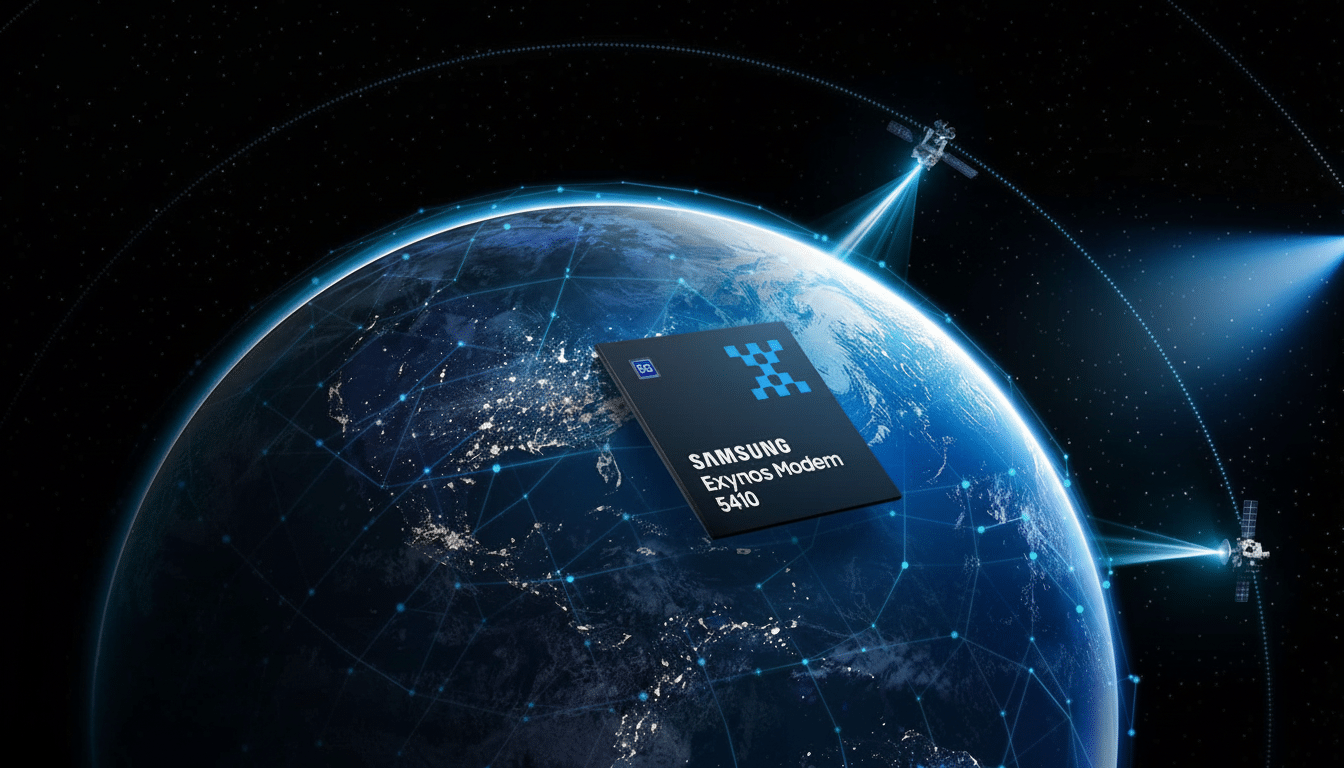
Samsung has quietly launched the Exynos Modem 5410, a next‑gen 5G piece of silicon we already know will feature in some flavors of the Galaxy S26 alongside this architecture’s AP chip: the Exynos 2600.
It’s not just about speed, because the 5410 also aims at three fronts that actually make a difference in phones: power efficiency, satellite connectivity, and possible end‑to‑end security.

What the Exynos Modem 5410 Offers for 5G Devices
Based on Samsung Semiconductor’s product brief, the Exynos Modem 5410 is manufactured using a 4nm process and is designed to support 3GPP Release 17 functionalities that enable theoretical downlink peaks of up to 14.79 Gbps. It still supports low bands (e.g., NB‑IoT) and advanced 5G carrier aggregation so that use cases can run on existing networks around the world while preparing for 5G‑Advanced.
The company claims the 5410 increases efficiency and reduces standby power over the 5400. That might sound incremental, but it’s significant: independent lab testing and operator field data have repeatedly shown that the radio subsystem can be one of the biggest power draws during heavy data use. Even single‑digit efficiency improvements can result in significantly more screen‑on time in high‑throughput use cases such as cloud gaming and 4K streaming.
Direct-to-cell and NTN readiness for satellite messaging
A notable update comes in the form of native support for NB‑NTN, NR‑NTN, and direct‑to‑cell (D2C) standards. The previous Exynos Modem 5400 had only preliminary support for these satellite‑based capabilities. In practical terms, the 5410 is built for phones that are able to connect with low Earth orbit satellites for messaging or basic data when on‑ground coverage isn’t available.
This dovetails with the broader ecosystem push. The 3GPP’s Release 17 brought Non‑Terrestrial Networks into the fold, and operators such as AT&T with AST SpaceMobile and T‑Mobile with SpaceX have announced (and conducted public trials) to convert direct‑to‑cell links into terrestrial ones. Apple’s SOS satellite messaging has prepared consumers for the idea, and Android silicon is now playing catch‑up with standards‑based NTN in hardware rather than bolt‑on fixes.
Security moves to post-quantum standards in hardware
Samsung touts the “first hardware‑based post‑quantum cryptography chip” in a cellular modem, as it looks to future‑proof over‑the‑air security. With NIST moving algorithms like CRYSTALS‑Kyber and CRYSTALS‑Dilithium toward standardization, hardware acceleration will be essential to ensuring latency and power don’t get away from you as carriers and OEMs harden connections against the threats of tomorrow.
For users, this move is mostly invisible but significant. Secure signaling, authentication, and key exchange take place constantly in the background — writing to your data array in flash or IC is a wake‑up call; making those operations quantum‑resistant without sucking the battery dry is the sort of behind‑the‑scenes advance that improves resilience without adding another round of friction.
How it fits into Samsung Galaxy S26 plans and variants
Samsung has already confirmed that Exynos 2600 will use an external modem, and the 5410 is the obvious match. If Samsung once again follows its split‑SoC regional strategy, some Galaxy S26 models will end up with the Exynos 2600 and Modem 5410 solution, while others could be partly offset by buying Snapdragon chips, which constitute a substantial competitive feature set, like, for example, Qualcomm’s X75.
Real‑world impact should come in three major categories: steadier connectivity from the cell edge, longer battery life during idle and mixed use, and wider coverage options once carriers start lighting up NTN services at scale. That doesn’t change the day‑to‑day fundamentals of 5G, but it can cut down on dropouts, stretch out your uptime, and serve as a safety net when you’re off the grid.
Spec sheet versus strategic updates that truly matter
On a spec sheet, the 5410 seems to be evolutionary — same node class, same Release 17 baseline, and similar peak speeds. It’s the strategic leaps that matter: not to overwhelm you with acronyms, but integrated Non‑Terrestrial Networks (NTN) support, quantified power savings, and dedicated post‑quantum security hardware. Those are the kinds of changes that permeate through a product stack and can benefit millions of devices without marketing flash.
If the Exynos Modem 5410 does indeed make the cut for Galaxy S26 models, then it’s a great place to start with 5G‑Advanced features and to solve some of those persistent pain points for users when it comes to battery life and connectivity reliability. That’s a silent‑but‑deadly upgrade for 2025‑era flagships.