


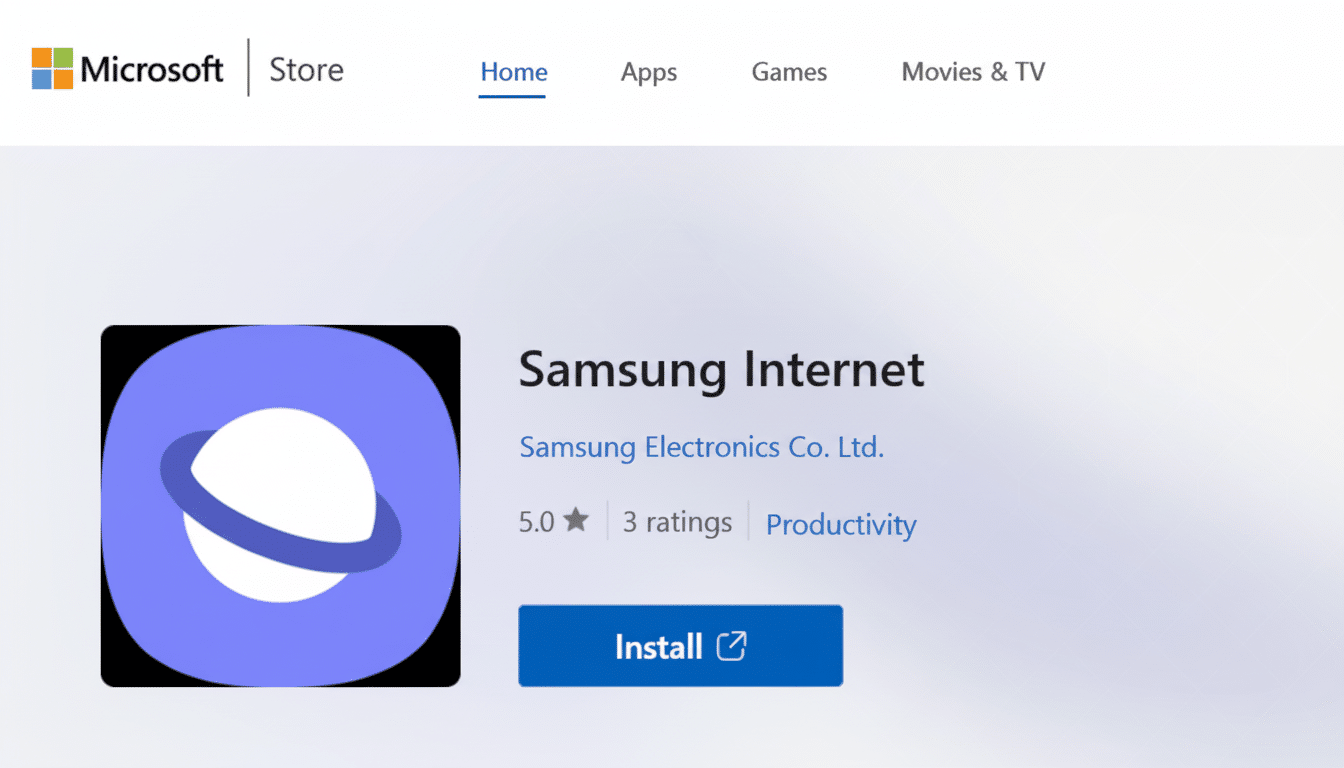
Samsung has taken its in-house browser to the desktop, formally releasing Samsung Browser for Windows after a public beta. The pitch is straightforward: deliver a Galaxy-first experience on PCs, stitch phone and laptop browsing into one continuous flow, and layer on agentic AI so the browser actively helps rather than just renders pages. It’s a direct shot at the habits that keep most people glued to Chrome.
Why Samsung Is Bringing Its Browser To Windows
Chrome dominates desktop browsing with roughly 65% share, according to StatCounter, while Microsoft Edge hovers near the low teens. Any newcomer must justify the switch. Samsung’s answer is ecosystem gravity: if your phone is a Galaxy and your laptop runs Windows, the company wants its browser to be the connective tissue, not an afterthought competing on raw speed alone.
It’s a strategic play seen across the industry. Google is infusing Chrome with Gemini, Microsoft pushes Copilot and Edge, and now Samsung is extending a familiar mobile experience into the PC realm. Winning the moments between devices may matter more than any single feature toggle.
Seamless Continuity Between Galaxy And PC
The headline continuity feature goes beyond traditional bookmark or tab syncing. Samsung Browser for Windows can resume the exact page you were viewing on your Galaxy phone, state and all, so you pick up mid-article or mid-form without hunting through history. In practice, it feels closer to a live handoff than a generic “open tab elsewhere.”
This relies on Samsung Account and the company’s continuity services installed on the PC. Samsung says it works today on Galaxy Book 3, 4, 5, and 6 series and will expand to additional devices. That’s a notable constraint at launch, but it mirrors how many ecosystem features roll out: start with flagship hardware, then widen support as services mature.
Samsung Pass integration is also built in, bringing passwords and autofill data to Windows so credentials saved on your phone are ready on your PC. For users already living in Samsung’s password vault and biometric sign-in on Galaxy phones, this reduces one of the biggest frictions of switching browsers on desktop.
Agentic AI in Samsung’s Browser Tries to Outthink Chrome
Samsung is embedding an AI assistant powered by Perplexity to make the browser context-aware. The assistant can summarize what’s on your screen, digest long articles into key points, and even parse videos to answer questions about the content. The goal is action over searching—less tab-hopping, more getting to the answer from where you already are.
Conceptually, this lands in the same zone as Chrome’s Gemini experiments and Edge’s Copilot sidebar, but Samsung’s framing emphasizes “agentic” behavior that understands open tabs and page context. Early availability is limited to select regions including South Korea and the US, with a wider rollout promised. As with all AI inside productivity tools, privacy and data handling will be under the microscope; Samsung will need clear controls and enterprise-friendly policies to win cautious adopters.
If executed well, AI that acts on the page you’re reading could shave minutes off daily workflows—think summarizing a dense research PDF or extracting steps from a how-to video without leaving the current tab. The competitive bar is rising quickly, though, with established players iterating weekly.
Can Samsung’s Windows Browser Really Replace Chrome?
Replacing Chrome means overcoming three hurdles: habit, compatibility, and trust. Habit is the biggest. People default to whatever opens first. Samsung can counter by bundling its browser on Galaxy Books and smoothing the first-run experience, including imports for bookmarks, history, and passwords via Samsung Pass.
Compatibility typically comes down to rendering engines and extensions. Samsung’s mobile browser has long been built on Chromium foundations, and the Windows version shows the same modern web compatibility in early use. The extension story will be crucial for power users; ad blockers, password managers, and developer tools are table stakes on desktop. Samsung has not detailed a full extension ecosystem yet, so this is one to watch.
Trust intersects with performance and privacy. Users have been trained to watch memory use, tracking protections, and crash resilience. On mobile, Samsung’s browser is known for anti-tracking and content-blocker support; bringing comparable controls to Windows—and communicating them simply—could help differentiate from rivals that tie features to accounts or ads. Independent benchmarks from organizations like AV-TEST or NSS Labs often shape perception here; third-party validation will matter.
For Galaxy owners, the handoff experience may be the wedge. Picture reading a long-form piece on a Galaxy S24 during a commute, then sitting down at a Windows PC and resuming the same paragraph instantly, with saved passwords and payments ready via Samsung Pass. That’s a clear, repeatable benefit—precisely the kind that nudges people away from entrenched defaults.
Availability and what to watch next for Galaxy users
Samsung Browser for Windows is rolling out now on Windows 10 (version 1809 and later) and Windows 11. The AI assistant is limited at launch to select regions, including South Korea and the US, with broader expansion planned.
Key milestones to monitor: wider continuity support beyond Galaxy Book 3–6, a clear stance on privacy controls, and the depth of extension support. If Samsung can pair reliable, low-friction cross-device sync with credible AI that saves time in the flow of work, it won’t need to beat Chrome everywhere—just in the moments that matter most to Galaxy users.