


Samsung’s new S95H OLED offers a deceptively simple pledge: go wireless for the neatest setup, or use HDMI to get the lowest latency. It’s the first of the company’s flagship OLED models that will offer optional wireless video through a separate Wireless One Connect box but with full-fledged ports on the TV itself. For home theaters where gaming, streaming, and design all merge, that choice is the real headline.
Optional wireless video arrives without lock-in requirements
The S95H can accept video over Samsung’s Wireless One Connect system, meaning you can stash your sources — streamers, a Blu-ray player, even a sound system with HDMI pass-through — in a cabinet up to roughly 30 feet distant. That’s one single slim power cord to the display and a living room free from the clutter of cable spaghetti. Critically, the wireless gear is an add-on, not a requirement.
- Optional wireless video arrives without lock-in requirements
- Why gamers should care about latency and smooth play
- Picture quality and brightness upgrades for S95H OLED
- Design refinements and stronger OLED burn-in safeguards
- How Samsung’s S95H stacks up against current rivals
- Pricing expectations and early outlook for Samsung S95H
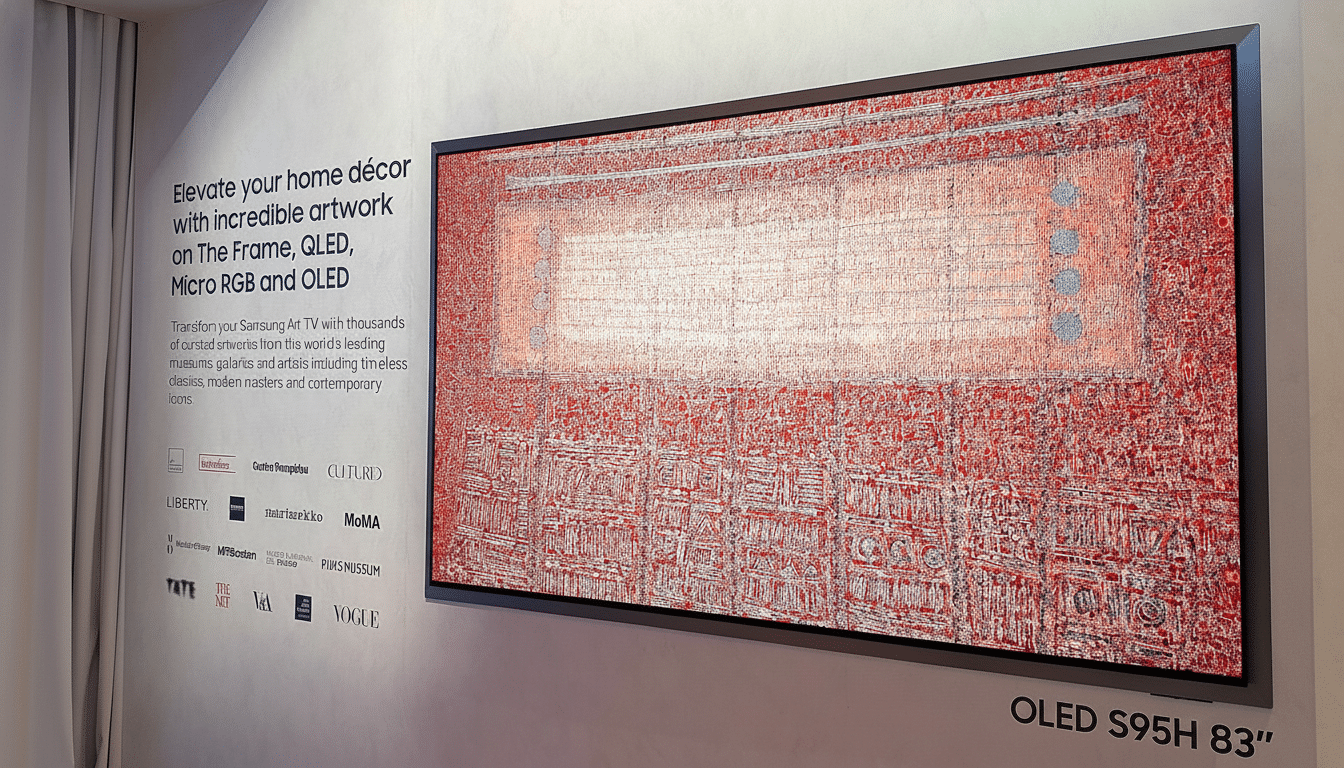
The TV still has its own HDMI inputs, so you can mix and match connections. Need a console or gaming PC hardwired to ensure low latency, while everything else runs wirelessly? The S95H is built for that. Power users can even connect via both the TV’s onboard ports and the Wireless One Connect box for a maximum of eight HDMI devices connected at the same time.
Why gamers should care about latency and smooth play
Wireless video is a suave son of a gun, but it has always come with latency. In hands-on measurements of previous wireless Samsung models, input lag clocked in at 24ms with a 1080p120 signal and as high as 37ms when fed a 4K60 one — or around three frames either way — while their wired equivalents dipped below frame-level figures. That distinction can be life or death in fast-twitch shooters or fighters whose timing windows are expressed in milliseconds.
The S95H won’t make you compromise between a clean setup and responsive play. Go direct to the TV for minimal lag with your console, and keep cable boxes or streamers on the wireless box. Samsung isn’t skimping on PC-grade smoothness, either: the panel supports variable refresh rates up to 165Hz and is compatible with AMD’s FreeSync Premium Pro and Nvidia G-Sync — a spec sheet that appears tailor-made for high-frame-rate gaming. The HDMI Forum’s 2.1 feature set is now widely adopted in premium TVs, but support for 165Hz is still rare outside of gaming monitors.
Picture quality and brightness upgrades for S95H OLED
According to Samsung, the S95H is 35% brighter than its predecessor last year, the S95F, which was already one of the more luminous OLEDs last year. That bump should help HDR highlights pop in daylight and raise specular detail in those most demanding titles mastered for high-nit peaks. (And it’s worth noting that Samsung isn’t saying it’s achieved BT.2020 coverage like it does for its Micro RGB concept sets; in independent testing, the S95F surpassed the DCI-P3 color space with remarkable accuracy, and now the S95H is poised to at least match that performance.)
Expect the typical OLED benefits — infinite black levels, pixel-level contrast control with adaptive brightness for both LCD and OLED, nearly instantaneous pixel response time, and no blooming or uniformity issues — now expanded by higher peak light output that allows it to compete more directly against the best mini-LED-based LCDs in bright rooms. For cinephiles, that formula usually brings loftier claims about more convincing HDR without a negative impact on OLED’s shadow detail.
Design refinements and stronger OLED burn-in safeguards
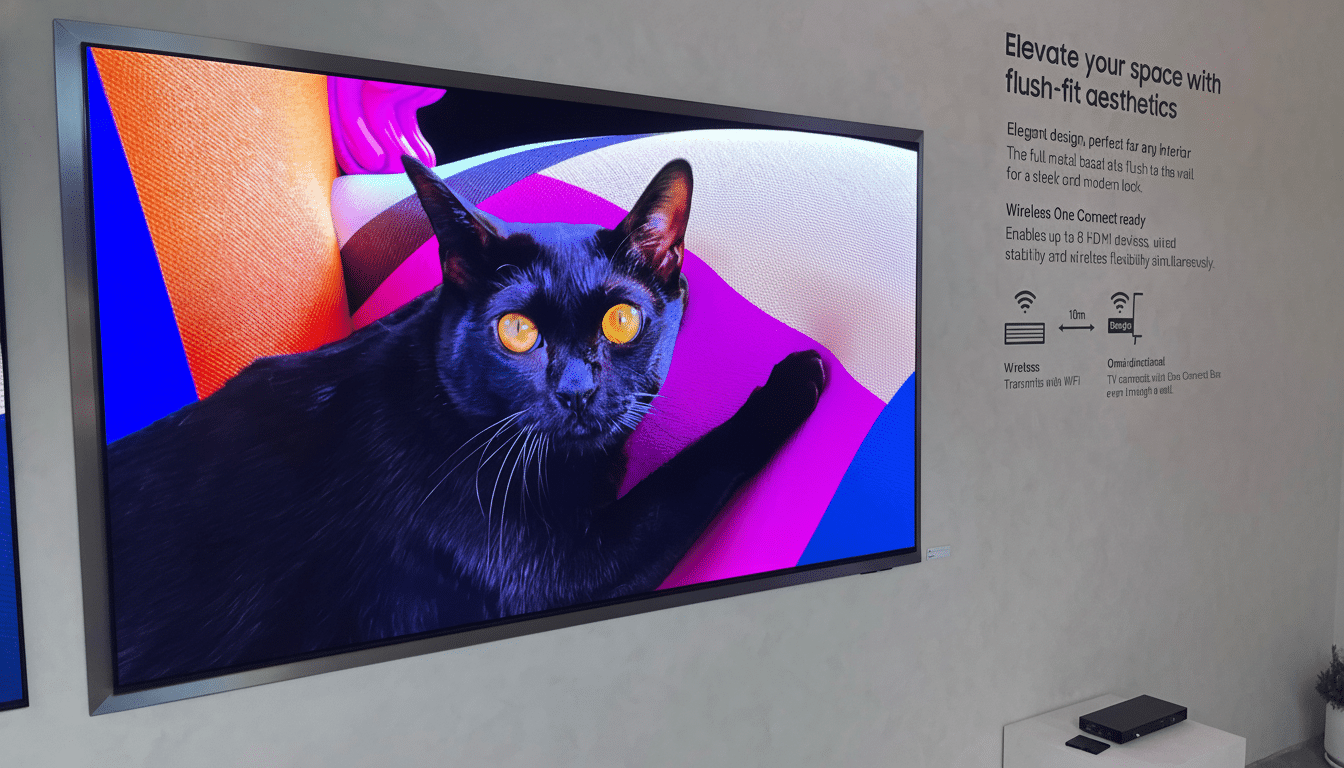
In a stylistic departure, the S95H exchanges last year’s practically invisible borders for an intentional all-metal frame that echoes the brand’s art-oriented models.
With Samsung’s Zero Gap Wall Mount, it is flush as a picture, a reminder to put artwork on the screen when you are not watching TV.
And OLED burn-in is always a concern with static images. The S95H is said to bring in new burn-in-combating mechanisms, Samsung announces, on top of the usual pixel-shift and screen optimization routines everyone else in the industry already deploys. That should mean long art displays or news tickers are less anxiety-provoking without requiring owners to micromanage settings. Calibration pros like to remind that your best bets are still responsible brightness management and varied content, but smarter algorithms can nudge a TV in the right direction.
How Samsung’s S95H stacks up against current rivals
Competitors are working toward a similar vision, but with different trade-offs. Some installs — LG’s new wireless OLEDs, the W6 for instance — hold the box at a default distance. Samsung’s own high-end ranges, such as The Frame Pro and the 8K QN990F, also adopted Wireless One Connect. The S95H is notable for having wireless as an option, rather than a requirement; that should make the set more attractive to homes where viewing alternates between style-first watching and lag-sensitive gaming.
Pricing expectations and early outlook for Samsung S95H
Samsung has yet to reveal pricing or shipping details, but figure on it being positioned around last year’s S95F, which started at about $3,200 for 65 inches, with the wireless hardware as an extra. That approach makes the base TV look competitive (competitively priced) while providing a route for buyers who care about design to get a clean install without bringing in covetous custom integrators.
The broader story is strategic: the S95H treats wireless as a feature, rather than a limitation. In most living rooms, that’s likely the best of both worlds — a minimalist layout for movie night and a hardwired lane for serious play. If Samsung’s claims about brightness are true, and you can trust in the anti-burn-in measures being effective, this might be the QD-OLED that makes going (mostly) wireless a viable option for something other than showrooms.