


New imagery brings us our clearest look yet at Samsung’s next-generation mainstream earbuds, which appears to show the Galaxy Buds 4 will continue the company’s new stem-style aesthetic while ditching silicone ear tips altogether.
The design brings the standard model on par with Samsung’s two-tier strategy, where one leans toward in-ear isolation (namely the Pro), while the other prefers a more open-fit approach (namely the base).
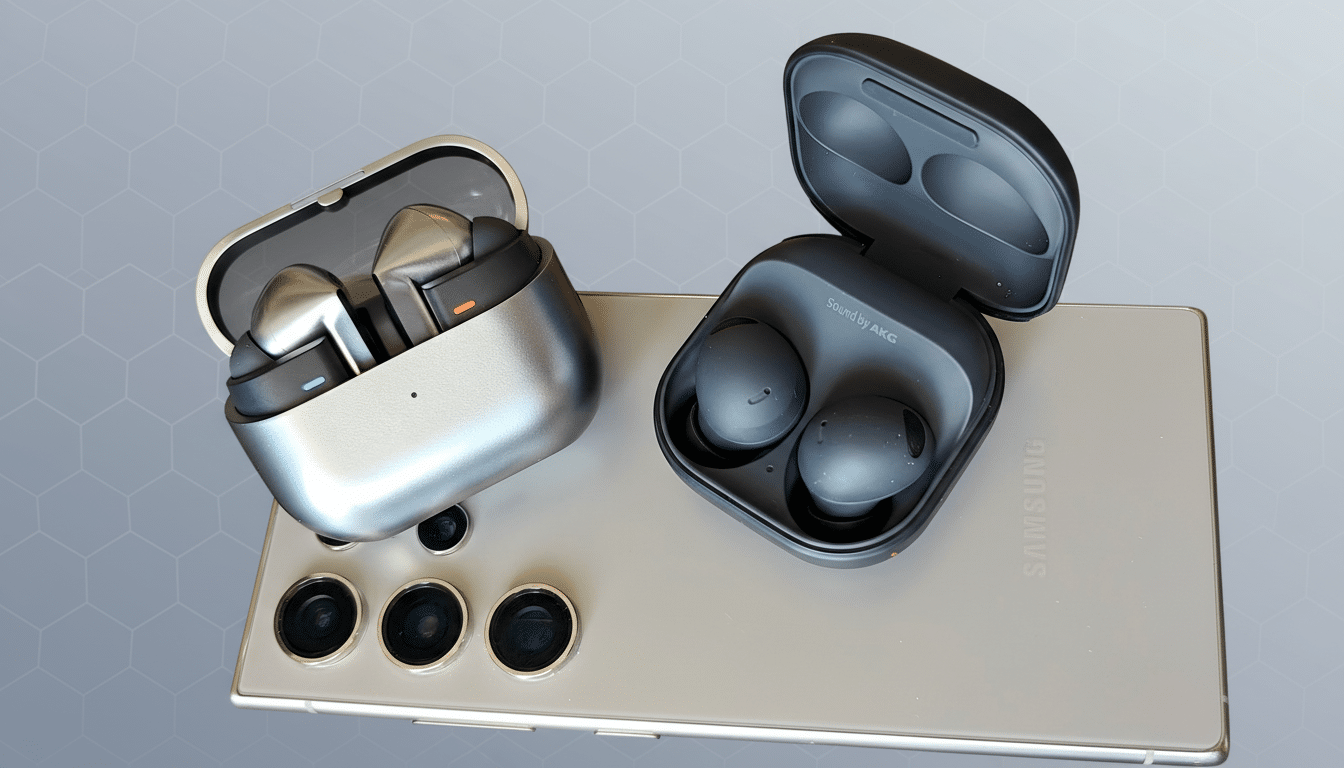
A closer look at the Samsung Galaxy Buds 4 design
The Buds 4 have a sculpted, polished blade design that’s reminiscent of the stems found on Samsung’s most recent feature drop, and a pad of ol’ wire grilles on the outer edge as well. Those grilles? They’re a dead giveaway of acoustic and airflow tuning — we’re pretty sure they serve as both a vent and microphone intake to aid with voice pickup and wind-noise reduction. Their lack of silicone tips suggests these buds are more about all-day comfort and easy on-and-off use than maximum isolation.
The look is very similar to what we’ve seen from the more premium sibling already, though it will likely be slimmer and less obtrusive in form factor here. Early indications of the Buds 4 family appeared in iconography discovered within One UI 8.5 builds, and the new imagery — emerging via trusted mobile tipster circles — now reveals how Samsung is distinguishing between them.
Open-fit design means different priorities for Buds 4
Open-fit earbuds sacrifice passive isolation for comfort and awareness. That’s why they are popular with commuters and office workers who like to keep one ear on their surroundings. You have to expect less low-frequency punch than a sealed, tip-based design, but if the driver has been carefully tuned you can still get lively mids and clear vocals. Should Samsung follow its most recent script, however, the Buds 4 might draw on beamforming mics (which can capture sound coming from a few chosen sources), wind filters, and adaptive EQ to keep clarity in step with what’s overheard.
So don’t expect active noise cancellation, if it exists on the base model at all, to work nearly as well as an in-ear seal. That approach reflects the broader market: Apple’s AirPods and AirPods Pro split use into a similar dichotomy, as do offerings from Huawei and Xiaomi. The goal isn’t to outdo a Pro model when it comes to isolation; it’s to make listening in normal life conditions seamless.
Gestures and smart controls at hand for Galaxy Buds 4
Alongside the design, breadcrumbs of early software indicate additional and refined gesture work. With stems, Samsung has room for more reliable pinch or squeeze actions, more delicate volume-control swipes, and contextual shortcuts — think quickly switching devices or calling up a voice assistant. As the wider Galaxy ecosystem has embarked on a journey to work more closely together, thanks to features like Auto Switch, SmartThings Find, and prompts from the device’s AI functionality, we might expect some closer ties at this point. You’ll have to wait for more of an overview once launch firmware hits, though.

Positioning Galaxy Buds 4 within a crowded earbud market
Samsung’s earbuds strategy is increasingly looking like the smartphone playbook: a mainstream model that targets the common user, along with Pro versions for enthusiasts. That’s significant in a category that ships north of 400 million units worldwide annually, according to trackers like Canalys and Counterpoint Research. Those companies often rank Samsung in the high single-digit to low double-digit share globally, behind Apple but a robust competitor across Android markets.
The transparency of design here is a sign that Samsung has faith in the stem-based communication it recently introduced. But it also suggests that the company plans to maintain open-fit buds as a first-class selection rather than a budget option as an afterthought — increasingly important as rivals’ midrange earbuds keep getting better at mic performance and battery life.
What we don’t know yet about Galaxy Buds 4 features
Key features are yet to be disclosed: driver configuration, battery capacity, codec support, and IP rating will determine just how exciting the Buds 4 will be in real-life use.
Samsung has lately been pushing improved call quality and multipoint convenience with its recent models, and the Buds 4 will have to match those strengths. Pricing will be a huge factor, too; the sharp gulf in price from the Pro model usually brings aboard the casual listener crowd who want an easy daily carry without breaking the bank.
For now, the takeaway is simple: the Buds 4 are looking to be the sleek, open-fit buddies that further deliver on comfort and minimalist controls, all with a cleaner look — positioning comfortably below the in-ear Pro version. Now that the design picture is in focus, the next wave of leaks and certifications will hopefully put some meat on the performance bones.