


New evidence about the Samsung Galaxy Buds 4 and Buds 4 Pro suggests small but important changes to battery life. Preliminary capacity signs, meanwhile, indicate that the Buds 4 base may take a shallow drop in cell size (the Pro looks to go in reverse with a bigger battery). The charging case, for its part, apparently only sees a very slight bump. Here’s what that probably means for your real-world listening time.
What the New Leaks Indicate About Battery Changes
Battery references in pre-release One UI 8.5 code suggest a mixed strategy: the standard Galaxy Buds 4 trending slightly lower on earbud capacity, and its Pro edition higher. Crucially, the year-over-year delta in capacity for the base model looks much less extreme than it did immediately before. While the progression from Buds 2 to Buds 3 cut average earbud capacity by about 21%, the Buds 4 decline is estimated at just over 12.5%.
- What the New Leaks Indicate About Battery Changes
- Anticipated ANC On and Off Listening Hours and Impact
- Charging Case Outlook Points to Only Minor Capacity Gains
- How They Compare on Paper Against Major Rival Earbuds
- Real-World Variables to Consider for Everyday Battery Life
- The Bottom Line on Buds 4 Endurance and Expected Stamina
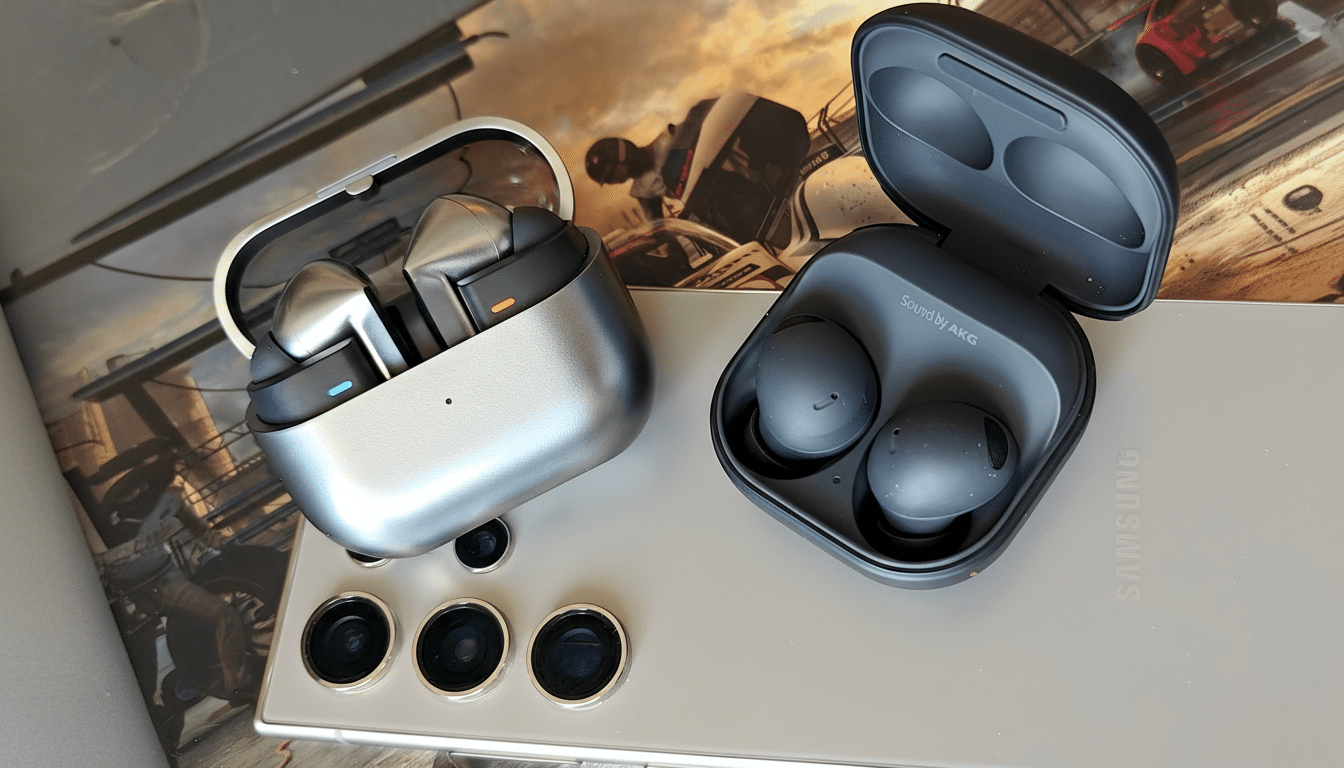
That doesn’t necessarily equate to worse endurance. In lab testing from SoundGuys, the non-Pro Buds 2 and Buds 3 had very similar playtime — around five hours on a charge — regardless of the decreased capacity. Efficiency gains in chipsets, ANC algorithms, and Bluetooth stacks might go toward mitigating smaller cells, and Samsung has played those optimizations to the hilt previously.
Anticipated ANC On and Off Listening Hours and Impact
If Samsung follows its recent playbook, the regular Buds 4 would land somewhere in that same ballpark as the Buds 3 for active noise cancelling usage — so long as you’re good with a workday’s commute and a gym session on a charge. Without ANC, you usually get a decent bump. The Pro model’s bigger cell could buy you an additional cushion of endurance, with more aggressive ANC and/or higher-level audio features switched on.
It’s also important to remember that codec choice is a factor, as are features. High-bitrate modes, 24-bit streaming pipes, spatial audio, or gaming low-latency toggles may all nudge the needle for battery draw. On the other hand, adaptive ANC that pulls back on attenuation when you’re in a calmer environment can help conserve energy just at the point when there’s more chance of having to stretch out listening time.
Charging Case Outlook Points to Only Minor Capacity Gains
On the case-clear side, a report from Galaxy Club suggests an increase in capacity that isn’t all that much higher — around 3%. In practice, that means about the same total “all-in” endurance as its predecessor, as you get a similar number of full earbud charges. Samsung usually goes big on charging speeds, so a quick stint back in the case should give you plenty of juice to take and make those last-minute calls on your way home.
Unless Samsung implements a new case design that’s necessarily larger in footprint too — which there’s no strong evidence for at this time — expect incremental gains, not radical ones, in total hours.
How They Compare on Paper Against Major Rival Earbuds
The best test will come from controlled endurance trials, but some context helps set expectations. The latest AirPods Pro from Apple are estimated to last as long as six hours with ANC, and about 30 hours total with the case. Sony’s WF-1000XM5 stretch ratings to around eight hours with ANC; Google’s Pixel Buds Pro usually hover around seven hours with ANC. Samsung’s most recent non-Pro buds have lasted just under five hours per charge in independent testing, with the case providing several top-offs for a day or two of moderate use.
Assuming the 4 Pros have more battery than last year’s Pros or last year’s Samsung offerings, it’s probably status quo for the base model and a modest but not unnoticeable bump in capacity for the Pro.
That’s Samsung keeping up, leveraging software optimizations to narrow any raw capacity deficit with top-bracket marathon-ratings rivals.
Real-World Variables to Consider for Everyday Battery Life
Volume is still the big swing factor — cranking it well past 70% sucks up charge a lot quicker than those spec sheets suggest. Tasks with heavy microphone use, like long calls and ANC in winds, are also a battery drain. Temperature counts, too; colder climates reduce the effective capacity. If Samsung’s firmware clamps down on idle drain and starts squeezing more from minuscule cell sizes, users in these situations will see more consistent results regardless of the nominal cell size.
The Bottom Line on Buds 4 Endurance and Expected Stamina
Early indicators suggest the Galaxy Buds 4 will carry on like before for battery life and a slight stamina bump for the Buds 4 Pro, with the case providing a lean capacity increase. Samsung has proved in the past that it can wring solid runtime out of smaller cells, so what we have is continuity, not concern. As always, definitive numbers will have to wait for independent testing — but these buds ought to be capable of covering most listeners’ daily routine without requiring a change in charging habits.