


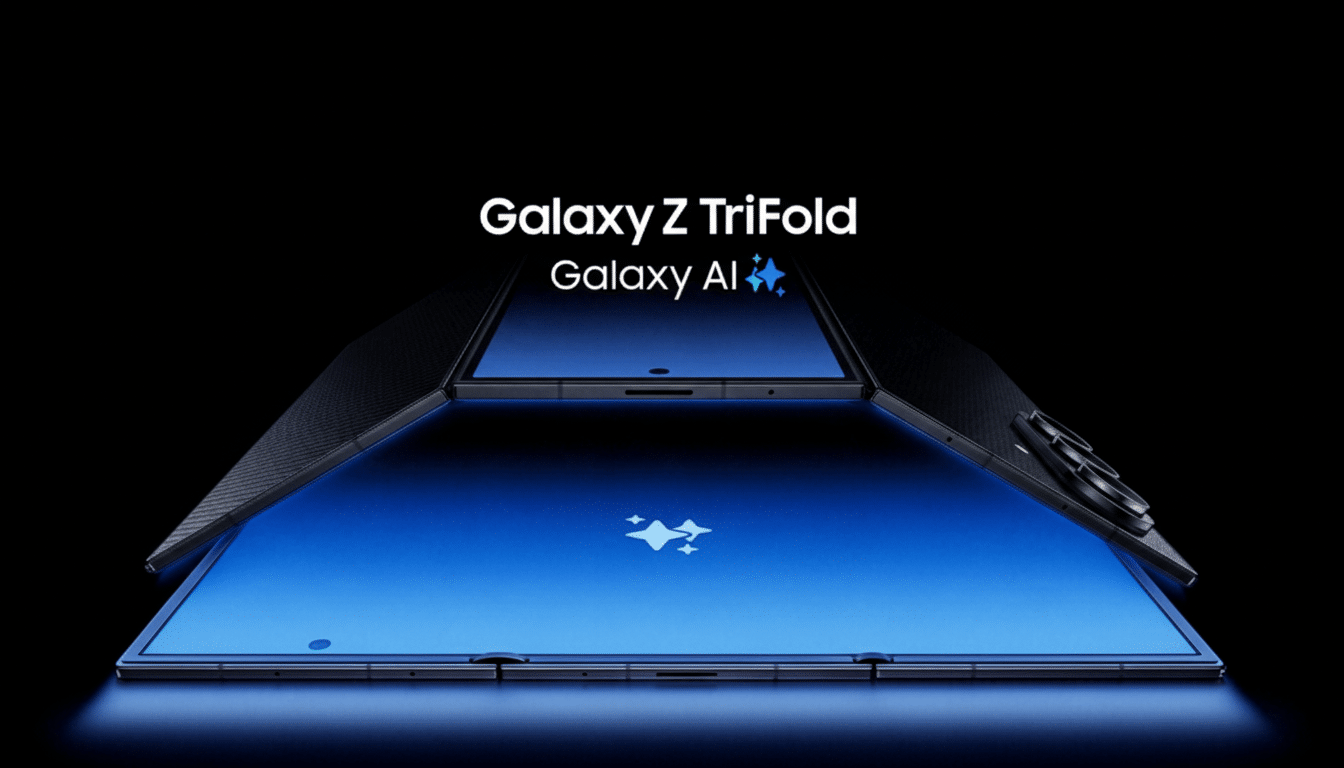
Samsung has unveiled the Galaxy Z TriFold, a triple-folding flagship that comes with two hinges and an inward-folding main display. The company confirmed a US release target in the first quarter of 2026, with pricing remaining under wraps, and is billing the TriFold as its most radical evolution yet in its foldable lineup.
A New Three-Panel Design and Closing Guidance
The TriFold folds in three and has magnets to snap shut, protecting an interior screen that’s the size of a tablet. Samsung says the device employs haptic feedback and notifications to assist users in learning how to close it properly — a smart set of guardrails that comes with a new form factor where hinge direction and panel order can be sources of real-world confusion.

Samsung’s engineering focus is evident in the shape. Its thickest point when unfolded? 3.9 mm, an ultra-sleek number that merely nudges ahead of the previous (the already svelte) Galaxy Z Fold 7 stating it was 4.2 mm… but what are three-tenths of a millimeter between friends, right? That’s an impressive achievement for a device with an extra hinge and layer stack. Durability: While none of the reports disclosed durability ratings, the switch to just two hinges will shift scrutiny onto torsional rigidity, crease visibility, and the condition after prolonged wear — the three areas with which earlier foldables were found wanting, with third-party stress tests likely to tell.
Specs That Target Laptop-Like Multitasking
That inner display measures 10 inches and runs at a resolution of 2160×1584 with a refresh rate that can adapt to 120Hz, which turns the whole thing into a small tablet. One of those is a 6.5-inch cover screen at 2520×1080 and 120Hz, which makes the TriFold practical for one-handed use without unfolding it.
Under the hood, you’ll find a Snapdragon 8 Elite for Galaxy, paired with 16GB of RAM and either 512GB or 1TB of storage. Power is provided by a 5,600 mAh battery, which makes sense for the larger canvas. On the back there’s a triple camera system made up of 200MP wide, 12MP ultra-wide, and 10MP telephoto with 3x optical zoom — specs that should keep the device at least in the conversation for mainstream flagships but allow computational photography some room to breathe.
Samsung claims the TriFold can display three apps at once, side by side, each having what it calls “layout parity” with a 6.5-inch phone display. For productivity, that’s a significant step up: imagine if email, a browser tab, and a notes app behaved like three full phones in one. Samsung’s existing AI arsenal is in tow, and the company points out that support for Gemini Live suggests there will be an increased emphasis on voice-centric workflows and real-time aid throughout this larger canvas.
Availability And What We Still Don’t Know
The TriFold is due to reach the US in Q1 2026, after an initial release in Korea. There is no information on pricing, how fast its charging is, what the official durability cycle rating is, or its ingress protection. Accessory support — specifically for styluses — is still an open question, and it’s likely to matter if you’re a note-taker or creative professional eyeing that larger inner display.
Why This Is Relevant to the Future of Foldables
Triple-fold phones have been floating around as a concept for years — TCL’s prototypes suggest the potential — but shipping them at scale is an altogether different challenge. If Samsung’s hinge tolerances, adhesive stacks, and ultra-thin glass stay the course, the TriFold could redefine what sits in a pocket while drawing heavy, knock-on use cases from tablets.
Market-wise, more screen leads to time spent and task completion. According to data from Counterpoint Research, global foldable shipments are on the rise and should reach nearly 20M units, led by Samsung, who is a leader worldwide but faces mounting competition in China. Fellow research analyst firm IDC has also noted foldables as a growth outlier in an otherwise stagnant smartphone market. That tri-fold that can credibly replace a small tablet would also provide Samsung with a defensible reason to differentiate — and another excuse (other than adding 5G) to push ASPs up in the only premium tier currently growing faster than the market.
Real-world examples illustrate the attraction:
- A finance dashboard split view
- Code and documentation side by side
- A canvas with reference images and a tool palette
When you’re on the road, that cover screen does light work, but the full spread instantly becomes an in-flight workstation. If Samsung’s able to smooth that transition between phone, two-panel, and full-panel modes without any UI wonkiness, the TriFold might feel less like a gimmick and more like an era-defining new norm for its power users.
Bottom Line: Big Promise, But Questions Remain in 2026
The Galaxy Z TriFold is Samsung’s most ambitious play yet in the game of versatile mobile screens: a two-hinge, three-panel device that promises to go beyond simply juggling your apps without blowing up your pocket space. But with US availability targeted for early 2026 and key details not yet in focus, the focus now turns to hands-on validation — especially on durability, software flow, and battery life — before this design can stake its claim as a chapter in foldables.