


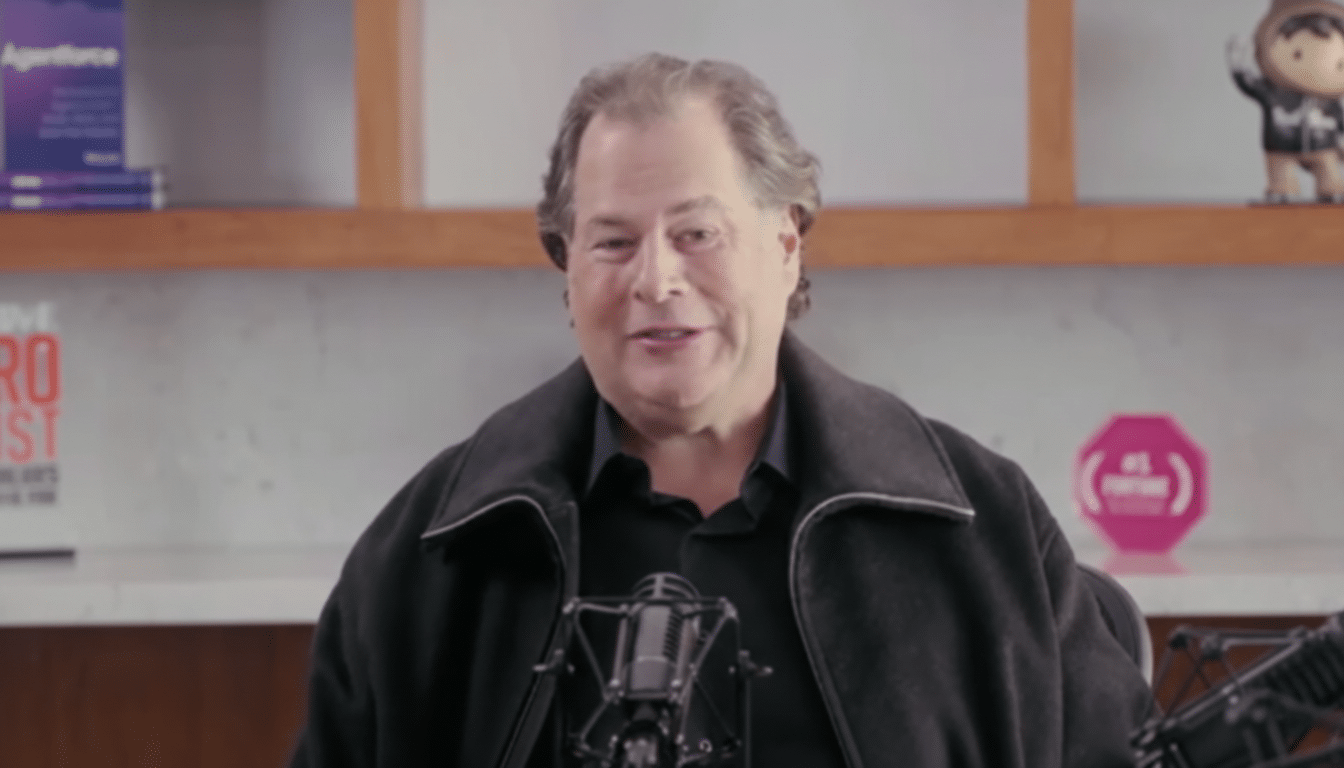
Salesforce set out to prove that the age of AI agents doesn’t spell doom for software-as-a-service. On its latest earnings call, CEO Marc Benioff leaned into investor anxiety over a so-called “SaaSpocalypse,” arguing that this downturn narrative isn’t new—and that Salesforce has navigated similar cycles before. Backing that message were sturdy results, a supersized capital return plan, and a new way to measure AI-driven work that aims squarely at enterprise value, not novelty.
Benioff’s case that AI agents lift and enhance SaaS platforms
Benioff repeatedly invoked the term “SaaSpocalypse” only to dismiss it, contending that agentic software will augment, not erase, the core utility of established platforms. To underline adoption, Salesforce retooled the call into a customer showcase, bringing on leaders from SharkNinja, Wyndham Hotels and Resorts, and SaaStr to describe how agent use cases are moving from pilots to production. The message: agents are most valuable when they sit atop trusted systems of record that already power sales, service, marketing, and data governance.
- Benioff’s case that AI agents lift and enhance SaaS platforms
- Key financial numbers aimed at AI and SaaS skeptics
- From Seats To Outcomes With Agentic Work Units
- The stack war with OpenAI over enterprise AI agents
- This is not the first panic in SaaS and cloud markets
- What to watch next as Salesforce leans into AI agents
Key financial numbers aimed at AI and SaaS skeptics
Salesforce reported $10.7 billion in quarterly revenue, up 13% year over year, and $41.5 billion for the full year, up 10%. Net income reached $7.46 billion. Guidance called for $45.8 billion to $46.2 billion in revenue, or 10% to 11% growth, and remaining performance obligation topped $72 billion, signaling strong multi-year visibility. Results were aided by last May’s $8 billion Informatica acquisition, folding deeper data management into the stack.
To fortify shareholder confidence, Salesforce lifted its dividend nearly 6% to $0.44 per share and unveiled a $50 billion buyback—an emphatic move in a market where cloud valuations have wobbled. The Bessemer Nasdaq Emerging Cloud Index fell more than 40% at one point during the 2022 reset, a reminder that cash generation and capital returns can matter as much as growth narratives when multiples compress.
From Seats To Outcomes With Agentic Work Units
Salesforce introduced “agentic work units” (AWU), a metric designed to capture when an AI agent completes a verifiable task—such as updating a CRM record—rather than just generating text. The company also disclosed 19 trillion tokens processed last quarter but emphasized that tokens alone don’t equate to business value. AWU is an attempt to align AI pricing and reporting with outcomes, a familiar enterprise demand that helped usage-based leaders like Snowflake thrive while pushing collaboration vendors to adopt active-user and tiered models.
The strategic subtext is pricing flexibility. Traditional seat-based licensing remains powerful for predictability, but AI introduces spiky, event-driven workloads. A hybrid model—seats for access and governance, usage or AWU for measurable output—can make agents easier to justify to CFOs who want ROI per automated task, not just per user login.
The stack war with OpenAI over enterprise AI agents
Salesforce also laid out a reference architecture positioning SaaS systems of record at the center, with foundation models as interchangeable engines underneath. That vision counters OpenAI’s enterprise agent push, where the model provider’s platform anchors the workflow and business apps risk becoming commoditized data sources. The battle isn’t just technical; it’s about who owns the user experience, the audit trail, and the billing relationship.
Salesforce’s edge is data gravity and compliance. Enterprises already rely on its role-based access, security, and metadata frameworks. Agents that execute inside that perimeter can inherit policies for privacy, retention, and approvals—capabilities auditors require. Gartner has projected rapid enterprise uptake of agentic workflows through the mid-2020s, but the winners will be those that prove both control and measurable productivity, not merely model prowess.
This is not the first panic in SaaS and cloud markets
Benioff’s “we’ve seen this movie” stance resonates because SaaS has endured multiple reckonings: the dot-com bust, the 2008 credit crunch, the 2016 multiple compression, and the 2022 repricing. In each, durable platforms leaned on multi-year contracts, high gross margins, and land-and-expand motion to emerge stronger. Salesforce’s RPO above $72 billion fits that playbook, creating a buffer against sentiment swings.
Longer term, AI remains a tailwind. IDC has forecast that worldwide AI spending would surpass $300 billion by 2026, and board-level directives now tie transformation budgets to automation targets. Across the enterprise stack, leaders like Microsoft and ServiceNow are bundling copilots and agents with core workflows, reinforcing the notion that AI is a feature of trusted platforms more than a standalone destination.
What to watch next as Salesforce leans into AI agents
Investors will look for proof that AWU correlates with revenue and margin. Key signals include growth in agent attach rates across Sales, Service, and Data Cloud; gross margin stability amid inference and orchestration costs; and evidence that outcome-based pricing expands accounts without cannibalizing seats. Watch also how Salesforce integrates Informatica’s data pipelines to feed agents higher-quality context—accuracy and actionability will determine whether agent tasks replace, not just supplement, human steps.
Benioff’s bet is clear: AI agents will be most valuable where governance and data reside, and that remains inside systems of record. If AWU becomes a standard KPI and customers continue to operationalize agents inside core workflows, the latest SaaS panic could look like the last ones—loud, but ultimately short-lived.