


Roborock released a cryptic teaser ahead of the big show that suggests its next robot may try to do what’s long been the holy grail of home robots: climb stairs.
The short video clip itself, which features a morphing ball tumbling down steps before jumping to a shadowy product silhouette, heavily hints at something brand new for locomotion. Very subtly, you’ll also see a faint badge with “VertiBeam” on the chassis — VertiBeam refers to the company’s object-avoiding tech — suggesting this is more than just an accessory.

A Teaser That Points Up the Stairs, Literally
Roborock isn’t new to aggressive mechanics. Its latest flagship model with an articulated pickup arm was an indication that the company was willing to reconsider what a robot vacuum can do, beyond simple suction and mopping. This new teaser leans even deeper into robotics, with outline hints of an arm-and-wheel combination that might be able to pitch the body up, plant a contact point, and let the vacuum lever itself onto the next tread.
That idea is significant because not a single mainstream consumer robot vacuum today can navigate a staircase on its own. Most models, from iRobot’s “Roomba” range to premium mapping bots from Ecovacs and Dreame, consider stairs as obstacles to avoid. Third-party concepts — like eufy’s MarsWalker platform — are exploring stair-capable external frames, but these require the vacuum to ride onboard another device. Roborock’s teaser hints at an integrated solution.
If true, that would be an impressive step up in a category that already has self-emptying, self-washing docks and AI obstacle avoidance. It would also set higher hopes for whole-home automation, beyond the current “one robot per floor” world of today.
Why Stairs Are the Last Frontier for Home Robots
Stairs reveal the fundamental trade-offs of mobile robotics: stability, energy, and control. According to the International Residential Code, a domestic riser should be up to 7.75 in., with different-sized nosing overhangs and material friction. That’s a steep vertical obstacle for squat robots built around wafer-thin, circular bodies and two driven wheels.
IEEE Spectrum has written before about how legged and hybrid robots burn orders of magnitude more energy while climbing than they do when rolling around on a flat surface. For vacuums, that translates to bigger batteries, more powerful motors, and smarter weight distribution — all without bloating noise levels, size, or prices. Today’s best-selling floor robots tend to rely on 5,000–6,000 mAh batteries; adding the ability to travel between levels may require more such capacity or quicker top-ups at the dock.
Safety is a question of equal magnitude. If you wanted to avoid sharp edges and falls, a stair-suitable vacuum would’ve required even more advanced edge detection and depth-sensing technology, as well as real-time traction monitoring. Roborock’s “VertiBeam” branding seems to imply structured-light or IR-based sensing coupled with LiDAR mapping that would allow the robot to profile step geometry before attempting to conquer them.
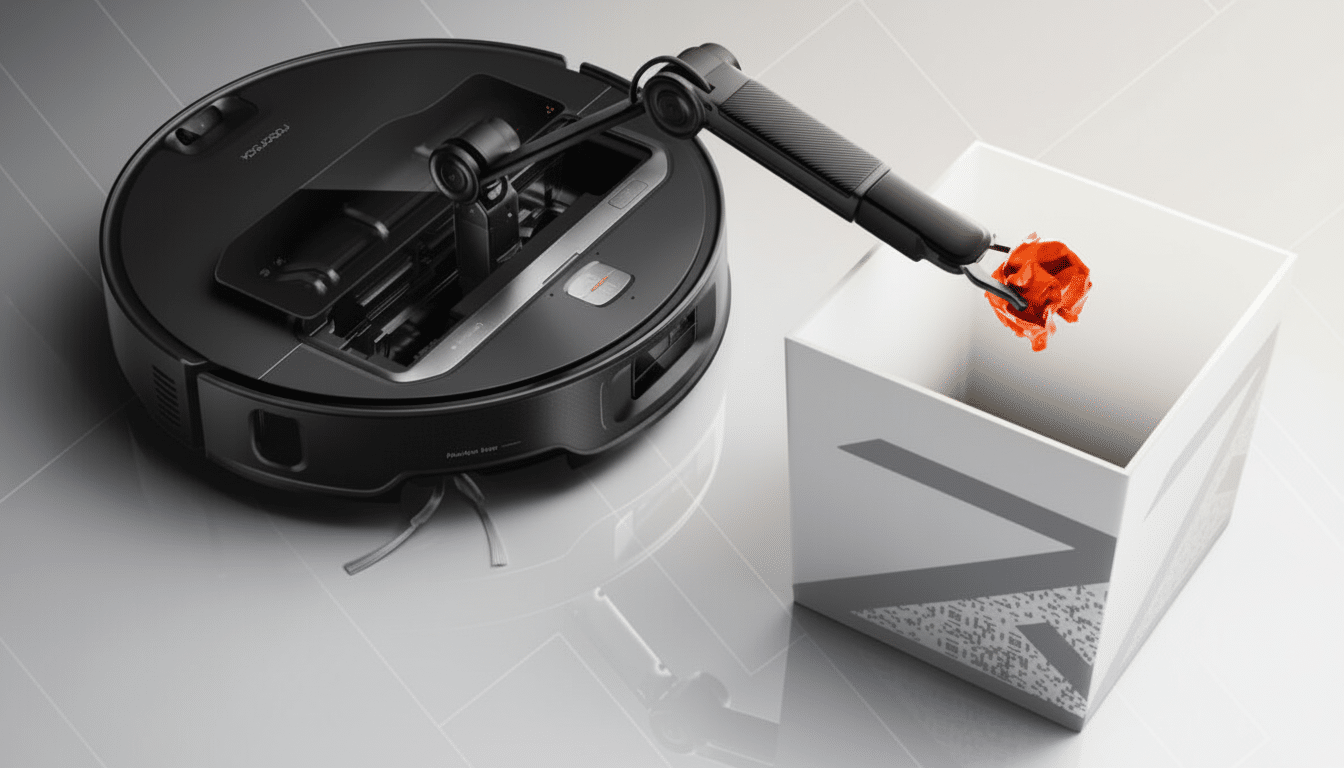
How a Combination Arm and Wheel System Might Work
Based on the teaser’s silhouetted frames, my guess for the most likely design is a combination of conventional wheels for efficient navigation across flat floors and a powered arm or flipper that can anchor against a riser and raise the center of mass.
Consider it a scaled-down version of the “flippers” on tracked rescue robots, but tuned for carpet and hardwood without chewing up finishes.
Key engineering concerns would no doubt be a low-profile nose to slip under tread overhangs, high-torque yet soundless drive, and compliant materials on the contact arms to protect wood and tile edges. For uninterrupted cleaning performance during climbing operations, the robot would temporarily turn off the suction and start it back up as soon as fully positioned on the next step so that dust extraction is maintained without affecting stability.
Docking logistics are another puzzle. A truly self-sufficient model might have to be smart enough to sense which floor it may be on and plan its elevations accordingly. Or a dual-dock system that allows the robot to clean multiple floors and charge at either station, which is already quite common in commercial cleaning robots.
What This Could Mean for the Robot Vacuum Market
Analyst firms following smart home devices have observed that adoption of robot vacuums has been steadily climbing as prices run the gamut between entry-level and ultra-premium. A reliable stair-capable solution would assuredly err on the high side of that range, at least for a period of time after launch. High-end models with self-emptying, self-washing docks are routinely $1,000-plus, and so a dependable design in this category is bound to land at the top of the scale.
More than price, the greater influence will be convenience. Many households share the cleaning between floors or physically tote robots up and down stairs — a manual workaround that defeats the purpose of automation. If Roborock does provide safe, repeatable stair navigation, it resets the bar for whole-home coverage and forces competitors to counter with their own advancements in mobility.
Naturally, it’s just a teaser and the company provides no details. But the trajectory is clear: After docks and AI navigation, mobility is the next frontier. Whether Roborock reveals a production-ready model or near-future prototype, the message to industry is clear — the floor no longer marks the end.