


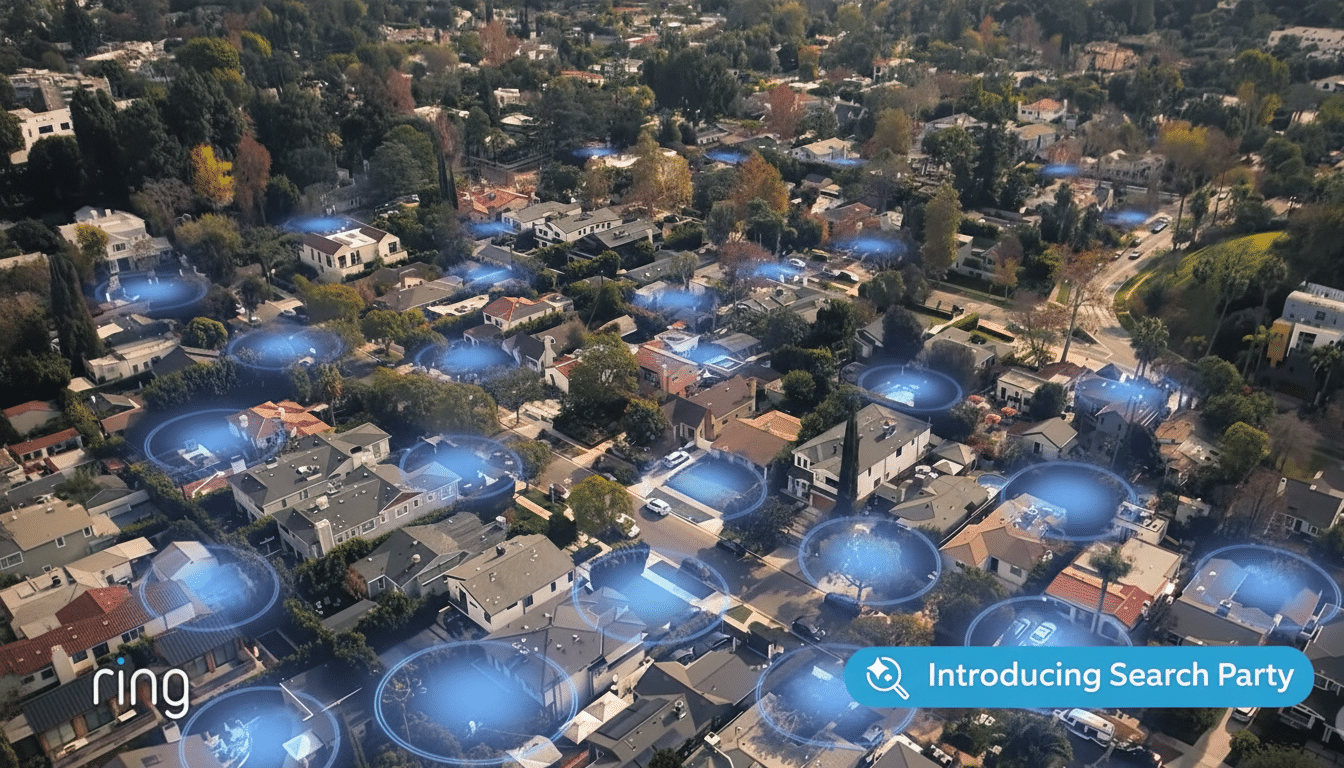
Amazon’s Ring is positioning its AI-powered Search Party as more than a feel-good way to reunite owners with runaway dogs. A leaked internal email suggests the company envisions the default-on camera network as a broader public-safety tool, intensifying long-standing concerns about surveillance creep and consent.
The shift landed in the public eye after a high-profile Super Bowl ad showcased the feature’s pet-finding prowess. Behind the scenes, however, company leadership reportedly framed the same technology as a building block for driving neighborhood crime toward zero—an ambition that carries significant ethical and legal baggage.

What the Internal Leak Reveals About Ring’s Plans
An email attributed to Ring founder and CEO Jamie Siminoff, reported by 404 Media, points to goals far beyond animal recovery. The message characterizes Search Party as “first for dogs,” but ultimately part of a strategy to reduce crime through a network of AI-enabled doorbells that can coordinate around community incidents.
That framing matters. It suggests the feature is less a standalone pet tool and more a test case for scaling automated detection across neighborhoods. With Search Party reportedly enabled by default, the prospect of repurposing its capabilities—whether for identifying stolen vehicles, package theft, or missing persons—raises urgent questions about consent, oversight, and mission drift.
How Ring’s Search Party Works for Lost Pets Today
Search Party currently links nearby Ring cameras when a lost pet is reported through the Neighbors app. Ring’s AI scans recent clips for matches and notifies camera owners, who can choose whether to share footage. The company says the system does not track people or process biometric data for this feature.
Ring has been layering on other AI tools, including Familiar Faces on select devices to help identify known visitors, and a Fire Watch alert that flags potential fires. Each capability by itself may seem narrow, but together they form a maturing sensing stack that can recognize objects, infer events, and—if policy permits—connect dots across homes and streets.
From Pet Finder to a Broader Public Safety Toolset
The logical next steps are easy to imagine. The same pipeline that detects a golden retriever could be tuned to look for a specific car model after a hit-and-run, or to flag a package theft sequence across multiple porches. In emergencies, aggregated alerts could help locate a missing child or an at-risk elder who wanders.
Those scenarios intersect with law enforcement access. Ring’s broader ecosystem already supports Community Requests, enabling agencies to ask residents for footage tied to investigations. Public records collected by digital rights groups show the company previously forged relationships with more than 2,000 police and fire departments nationwide, a scale that has drawn scrutiny from civil liberties organizations.
Amazon has acknowledged that, in rare “emergency” circumstances, it provided videos to police without user consent—11 times in one year, according to a letter the company sent to a U.S. senator. Any expansion of automated detection into crime-related use cases will likely revive debates over when, how, and by whom neighborhood video should be analyzed and shared.
Privacy Stakes and Growing Legal Scrutiny for Ring
Default-on participation is the flashpoint. If your doorbell is opt-out by design, your street could become part of a quasi-public sensor grid without explicit buy-in from each household—or from the people who pass by. The American Civil Liberties Union and the Electronic Frontier Foundation have repeatedly warned that such systems can normalize dragnet surveillance under the banner of safety.
Accuracy and bias add risk. The National Institute of Standards and Technology has documented that face recognition accuracy varies by algorithm and conditions, with demographic performance gaps in some systems. While Ring says Search Party isn’t using biometrics to find pets, adjacent features like Familiar Faces, if expanded or combined with other analytics, would heighten compliance obligations under laws such as Illinois’ Biometric Information Privacy Act.
Regulators are already watching. In a 2023 settlement, the Federal Trade Commission required Ring to pay penalties and delete certain data and algorithms tied to past privacy violations, while mandating stricter access controls. Any pivot toward broader crime-fighting aims will be measured against that backdrop, including data minimization, encryption defaults, and auditability.
What to Watch Next as Ring’s Search Party Evolves
Three signals will reveal where this is headed: whether Ring keeps Search Party strictly opt-in by clear, prominent choice; how it documents and limits data retention for clips analyzed by AI; and if independent auditors can verify that features marketed for pets are not quietly scanning for people or vehicles without consent.
Used transparently and with strong guardrails, a community detection network could help reunite families with pets and assist in urgent, time-sensitive cases. Without those protections—and with defaults that pull users in by inertia—it risks becoming one more layer of always-on surveillance. The leaked memo shows the ambition; the next product decisions will show the company’s judgment.