


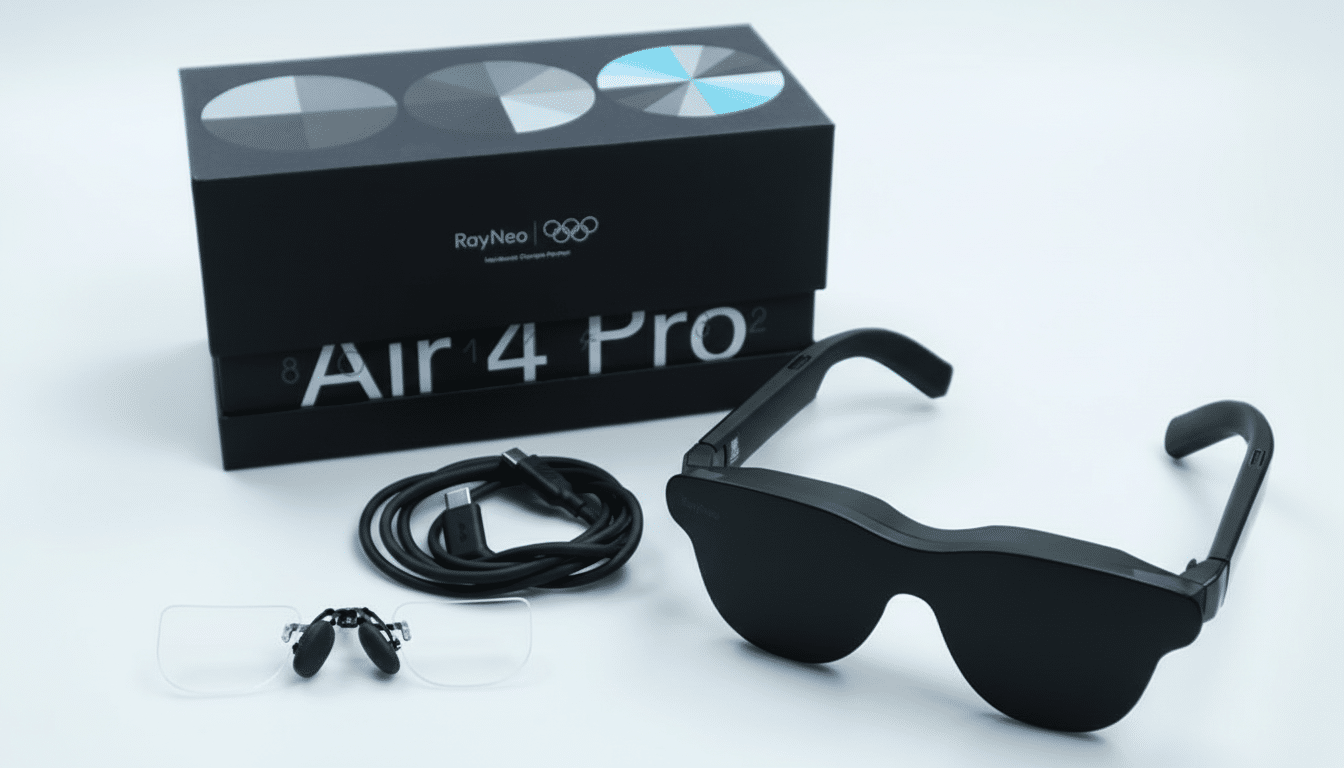
RayNeo is driving wearable displays forward with the Air 4 Pro: a pair of AR glasses that are lighter than ever and come with what it claims is the world’s first HDR10-capable AR display.
The headline promise couldn’t be more straightforward or brash: a cinematic level of dynamic range, strapped to your face with none of the bulk of a headset.
- Why HDR10 in AR is important for visual fidelity
- Micro‑OLED hardware and processing pipeline details
- Audio co-designed with Bang & Olufsen for clarity
- Design, weight, and daily use considerations
- Connectivity and compatibility across devices
- Price and availability at launch and early reports
- How it fits into the evolving AR viewer landscape
- A look into standalone connectivity and prototypes
Why HDR10 in AR is important for visual fidelity
HDR10 provides a far wider dynamic range with more powerful brights, deeper blacks, and richer grays compared to standard dynamic range. That extra headroom in near-eye optics helps retain detail in both dark and bright scenes, where traditional AR viewers can appear flat. Static metadata is at the heart of HDR10, and with such, it becomes crucial to have consistent tone mapping; Air 4 Pro’s pipeline relies on a Pixelworks-customized Vision 4000 processor for real-time tone mapping and color management in an attempt to minimize clipped highlights and crushed shadows from ruining immersion.
Micro‑OLED hardware and processing pipeline details
The Air 4 Pro is based on a pair of 0.6-inch micro‑OLED FHD panels with a 120Hz refresh, claimed peak brightness of 1,200 nits and operating using PWM dimming up to a frequency of 3,840Hz. The native contrast of micro‑OLED provides black levels that are a challenge for traditional LCD-based viewers to compete with, and the high PWM frequency is intended to minimize flicker perception in those who are susceptible. RayNeo says the optics provide an experience like that of watching a 201-inch screen from about six meters away, a helpful mental model for movie watching and gaming.
Outside of the panels, the Vision 4000 chip does other things beyond HDR. It upconverts SDR (standard dynamic range) video to HDR on the fly and can take 2D content and convert it to 3D, which may help make streaming libraries and older games feel more new sooner rather than waiting for native formats. The 120Hz panel drive should increase motion clarity for 24–60fps content, but also keep latency low enough for gaming with handhelds and PCs.
Audio co-designed with Bang & Olufsen for clarity
Audio on viewer-style glasses is a common weak spot. RayNeo addresses that with four precisely tuned speakers co-developed with Bang & Olufsen. The idea is for an immersive, more complete sound stage with steered leakage so you hear your movie or game without blasting it to fellow passengers. As here, it’s about bespoke direction of tuning and enclosure design as much as driver count, so collaborating with a hi‑fi brand suggests that priorities lie not in sheer loudness but timbre and clarity.
Design, weight, and daily use considerations
Coming in at 76g, the Air 4 Pro falls pretty comfortably within modern AR viewers and is likely more comfortable for extended use than some sort of mixed reality headset. Key, too: the lightweight frame and balanced optics for neck comfort, plus a modest thermal footprint for streaming marathons. Though billed as AR glasses, the feature set and optical stack appear aimed squarely at personal cinema, cloud gaming, and productivity displays instead of passthrough-heavy mixed reality.
Connectivity and compatibility across devices
Plug and play is still the key to mass acceptance. The Air 4 Pro connects via USB‑C to devices with display output capabilities, such as a wide range of Android phones, PCs, Macs, and handheld consoles. That portability could be beneficial for quick sessions on a flight with a laptop, a larger “screen” to play your Steam Deck games, or even streaming from your phone without any extra dongles. Like all viewers, the experience will be determined by the video output capabilities of your source device and power delivery.
Price and availability at launch and early reports
There was no official pricing within the launch materials, but reporting from Mashable suggests we’re looking at the Air 4 Pro being priced at $299. If that proves to be true, RayNeo is undercutting several competitors while bringing HDR10—something usually kept for larger headsets—to a more affordable place.
How it fits into the evolving AR viewer landscape
Viewer-style AR glasses from the likes of Xreal, TCL, and Rokid have popularized the “giant virtual screen” pitch, but without HDR support there’s been a gap. With RayNeo enabling HDR10 for micro‑OLED near‑eye displays, the startup takes one of those “quality jumps as soon as you see it” for just-purchased VR users: that specular highlight reflecting on the water, neon signs in night scenes, and fine shadow detail within a dark game. Analysts at IDC and CCS Insight have pointed to consistent interest from consumers in light glasses as a companion product for phones or PCs — the Air 4 Pro’s spec sheet serves those trends while advancing image fidelity further downfield.
A look into standalone connectivity and prototypes
Along with the Air 4 Pro, RayNeo displayed a concept eSIM version of its X3 Pro eyewear, considering standalone connectivity without any tether. While just a prototype, it offers a hint at where the category might be headed next: lightweight viewers that can stream or message on their own, closing the distance with bulkier headsets while maintaining comfort and portability as a top priority.
If RayNeo’s HDR10 implementation lives up to its potential, the Air 4 Pro might set a new sleight-of-hand standard for portable big-screen viewing — where we come to expect not just resolution and refresh rate but actual cinematic dynamic range in our everyday carry.