


Proton is launching its most significant update to Proton Mail yet, with a new redesign, substantial performance improvements, and—crucially—full offline capabilities.
Presented as the seventh major version of the app, the update also consolidates iOS and Android codebases to have both platforms ship together on features and fixes.
Offline Email Shows Up With Privacy for Me
Offline is the headline feature and, for a privacy-first service, it’s a big one. Proton Mail now also includes full support for disconnected operation (reading, composing, and sorting of messages work without connectivity as you would expect; outgoing email queues up in the background and will be sent when connectivity resumes). Under the hood, this means careful local caching and key management to ensure that even if content is stored on-device, it remains locked up.
The model behind Proton Mail is based on end-to-end encryption and zero-access architecture, which ensures that message contents stay unreadable to the service provider itself. Adding offline access to that framework is a significant engineering lift, especially compared to more typical email. It brings Proton much closer in functionality to typical email clients that have had offline support for years, without compromising the privacy features that set it apart from traditional inboxes.
For travelers, itinerant workers, and anyone wrestling with spotty connectivity, the practical payoff is instantaneous: triage your inbox on a flight, draft replies aboard a train, and reorganize labels while on the move to sync in a snap once you’re back online.
A Faster, Cleaner Mobile Interface With Streamlined Navigation
Proton Mail gets a new paint job and offline mode. The interface favors a cleaner design with streamlined navigation such that core actions — reply, archive, label, search — are always at your fingertips. It’s not purely cosmetic either: Proton notes that routine actions like scrolling long threads, archiving messages, and sending replies now render anywhere from 2 to 4 times faster than its previous builds.
Speed matters in email. Even small delays add up across dozens of daily tasks. A significantly improved feel reduces drag for power users who process a lot of mail and speeds the journey from notification to done for everyone else.
One Codebase for iOS and Android to Speed Feature Updates
The update is based on a shared architecture that brings the iOS and Android apps into near lockstep, with roughly 80% of the code between the apps being shared, Proton said. That change is more than an internal milestone. It should lead to features being released simultaneously, security patches slipping through the pipeline faster, and fewer odd issues when jumping from one device to another.
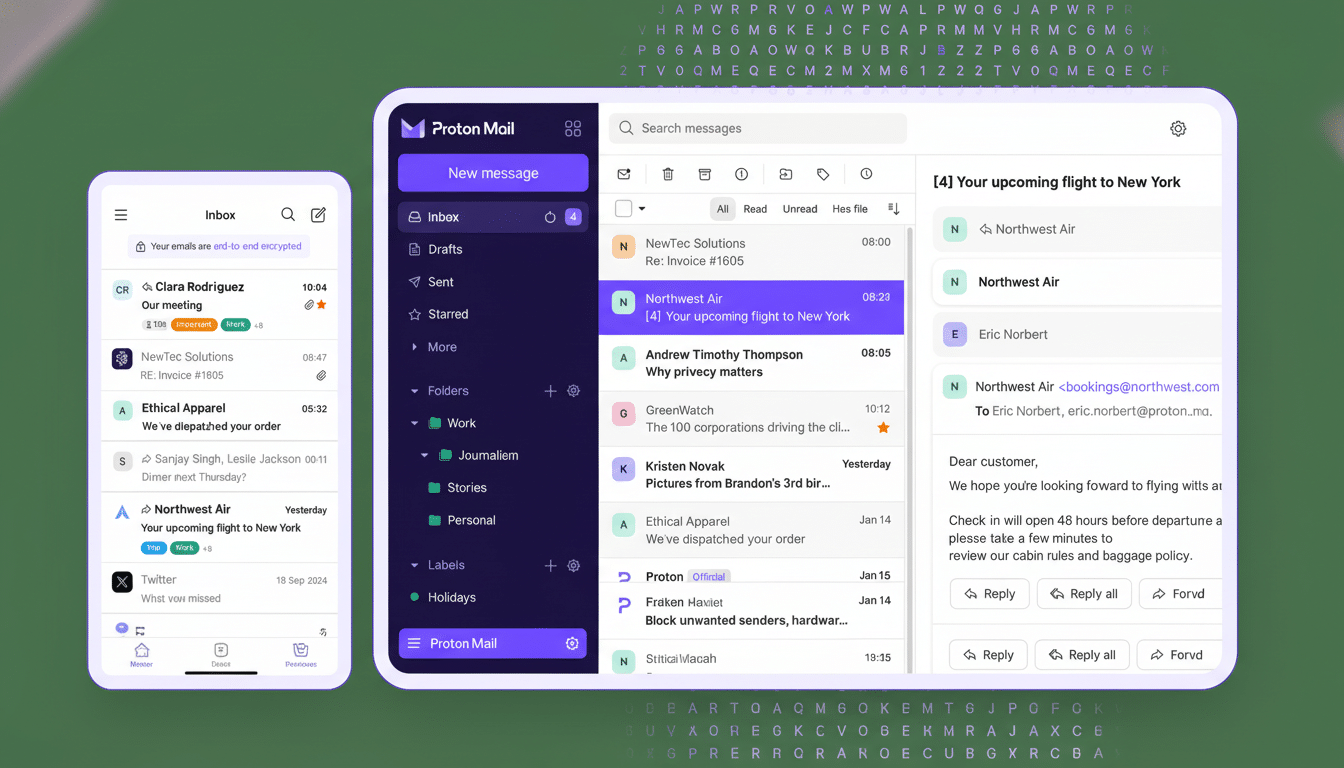
Email clients are infamously complicated, with the juggling of sync logic, background jobs, notifications, and encryption workflows. As well as reducing fragmentation and the testing burden, unifying logic between form factors allows Proton to consistently behave across phones and tablets. For users, it means “parity” is the norm, not the exception.
Why This Release Matters for Privacy-Focused Email Users
Proton now has a user base of well over 100 million accounts for its services, and many of those users pick Proton specifically because they care about privacy and security. By bringing offline mode to that audience, we’ve eliminated one of the last workflow compromises compared to traditional email providers yet maintained strict encryption fundamentals.
From a security standpoint, the single codebase can also close the window between vulnerability disclosure and patch availability on mobile. Less variance in code paths translates to quicker triage and connected updates, a benefit that will surely be welcomed by privacy-conscious users and organizations.
Availability and What’s Next for Proton Mail on Mobile
Proton says the release will be staged, so it may take some time to reach every device. When it does land, you can also expect the Android and iOS apps to be on a par feature-wise, shipping updates at or around the same time and, most of all, feeling quite a lot faster from end to end.
The company also says that its calendar apps are next in line to get the same cross-platform treatment. If Proton Calendar sticks to the playbook outlined here—quick performance, robust offline functionality, and synchronized updates—Proton becomes more woven together across its ecosystem.
Bottom line: Proton Mail’s new version narrows the convenience gap with mainstream email apps without conceding on privacy.
Offline mode, faster speeds, and unified development make this a noteworthy update for existing users as well as anyone who’s thought of making the leap to a more secure inbox.