


Proton Mail’s Android and iOS apps were just given a major redesign that includes long-requested offline features, better performance and an architecture refresh meant to accelerate the pace of rolling out new features in the future. The privacy-first provider has announced that day-to-day actions on the new apps feel faster, though you should also see an offline mode that lets users read, organize, and compose messages sans connection — they’ll sync once they have internet access again.
That’s a big update for a service built on end-to-end encryption. However, enabling offline access to an encrypted inbox involves handling local storage, keys, and sync logic with a lot of care — all areas in which Proton has traditionally taken something of a conservative approach. The email service, based in Switzerland, serves tens of millions of accounts and is positioning the changes as a quality-of-life upgrade rather than one that sacrifices its privacy model.
Hey, Your Encrypted Email Is Now Even Safer
Offline mode provides the basics: You can read messages that have already been synchronized, manage your inbox with labels and folders, open drafts of responses or new emails to type while offline. When your device is back online, the app also automatically sends any waiting messages and syncs any updates. You can attach files to drafts offline and they will be uploaded when you’re back online.
For travelers, commuters and anyone with spotty coverage, this fills in a gap compared to mainstream email apps — yet retains Proton’s zero-access end-to-end encrypted design. Data in the device cache is still protected by device and app security. Privacy advocates, including the Electronic Frontier Foundation (EFF), have long argued that device-side encryption is a best practice; adding offline access in an E2EE context complies with such attitudes without retrograding to weaker models.
A Faster App And A Faster Cadence For Updates
Proton claims that with the redesign, performance improvements of up to 2x are possible in common tasks such as scrolling through large inboxes and composing and replying. It’s a noticeable improvement, especially on older devices where UI jank and long thread loads could make heavy inboxes feel sluggish.
And under the hood, Proton rebuilt a big chunk of its mobile code so that now more than 80% of what you see on iOS has been repurposed for Android and vice versa. That parity reduces duplication, and should help streamline feature work, bug fixes and security updates across the two platforms. Theoretically, that means shorter release windows for users, less platform-specific strangeness, and quicker responses to feedback.
It’s a tactic that has the ring of what other privacy-first developers have done to speed up delivery without giving up native feel. Rather than cling to a single cross-platform UI, Proton set an explicit goal to try and align shared core logic and services better, lower the abstraction as much as possible between the two apps but still respect platform conventions.
Design Tweaks Center on Usability and Speed
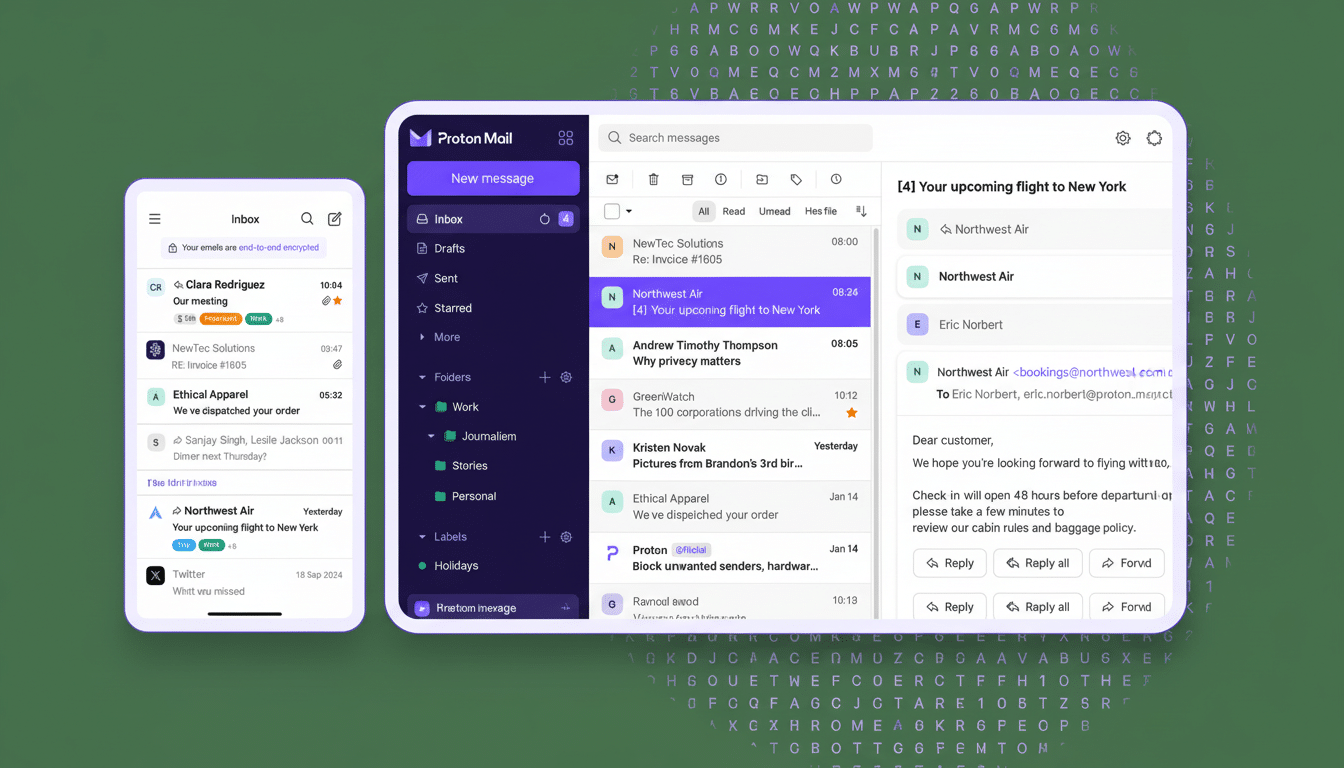
The new look declutters navigation and places the compose button within easier reach, an essential ergonomic adjustment for larger phones. Proton has also polished the message view, threading and quick actions to cut down on taps when triaging your regular correspondence. The result is a less cluttered, more predictable workflow that feels uniform across iOS and Android without obliterating each platform’s gesture memories.
For people coming from traditional providers, the new layout reduces the learning curve, and for existing Proton users, it cuts down on friction when working with high-volume inboxes. It’s a cosmetic redesign, not a bombastic rebranding, and the focus is strictly on speedier throughput and fewer distractions.
What It Means For Privacy-Centric Users Today
End-to-end encrypted email encrypts message content so that the provider can no longer see it, but it complicates features like offline access and search. Proton’s model enables its users to keep sensitive data local, and synced only when necessary, and controlled by keys linked to the user — not advertisers. The company’s products are open-source and have been reviewed by outside security experts throughout its ecosystem, a stance of transparency that has become table stakes for trusted privacy tools.
Proton’s offline addition makes it that much easier to use, narrowing the convenience gap compared with mainstream offerings from Google and Microsoft while maintaining a no-ads, no-tracking business model. For companies with stringent compliance standards, or people wary about surveillance capitalism, this is the type of feature parity that makes a migration feel less like a trade-off.
Rollout Timeline And What’s Next For Proton Mail Users
The update is being pushed in stages through the App Store and Google Play, so it may not yet be available for everyone in your region or device. Proton’s other services will also benefit from this architectural work, according to Proton, so expect Proton Calendar to receive similar improvements. As with previous releases, feedback from end-users collected via the company’s community forums and public roadmaps will be used to refine features.
Bottom line: Offline mode and improved performance are significant steps for an encrypted email app. Together with a single codebase that will enable faster iteration, Proton is signaling that privacy-first email can iterate quickly without bending its core promise.