


Port, the Israeli startup working on agent-based orchestration and internal developer portals, has doubled down on its push against Spotify’s open-source technology for helping businesses adopt DevOps best practices: The company today announced that it picked up $100 million in Series C funding at an $800 million valuation.
The round further stokes a rapidly developing race to be the control plane for platform engineering and the governance layer for AI agents inside large software organizations.
Funding and strategic aims for Port’s expansion
The new funding round was led by General Atlantic and included additional investment from Accel, Bessemer Venture Partners and Team8. It brings the company’s to-date funding to $158 million, including a $35 million Series B earlier this year. Founded in 2022, the company said it will use the funding to speed up product development across its portal and agent orchestration stack as well as grow its go-to-market and customer success teams.
Port’s argument is simple: development at scale requires an opinionated, enterprise-class layer that will define services, surface golden paths and now — critically — contain and coordinate AI agents. With cash on hand and a roster of marquee customers like GitHub, British Telecom and LG, Port is positioning itself as a packaged alternative to the assemble-it-yourself approach made popular by Backstage.
Addressing Backstage and the IDP movement
Backstage is under the wing of the Cloud Native Computing Foundation and serves as a reference architecture for IDPs. Its essential appeal is flexibility: Teams can string together catalogs, templates and plugins in order to mirror their engineering workflow. This complexity comes at a cost — getting a production-grade portal into place and keeping it running usually requires flexing (platform) engineering muscle.
Port’s backend is a managed platform, configurable to accelerate time-to-value. It does not just categorize services and assets but also focuses on policy, security and out-of-the-box workflows. The company’s pitch has appealed to platform teams that find themselves with a backlog of integrations, compliance obligations and developer experiences. Gartner and the CNCF have also both observed the emergence of IDPs as a fundamental building block of platform engineering — a development accelerated by the rapidly expanding GitHub ecosystem, which has surpassed 100 million developers.
From portals to agentic orchestration at scale
The quantum jump in Port’s roadmap is AI agent management. As companies evolve from code recommendations to autonomous workflows — think change requests, incident triage, provisioning and guardrail-driven automation — the problem transforms from “use an assistant” to “safely run a fleet of agents.” That includes discoverability, standard policies, auditability and performance metrics; not just prompts.
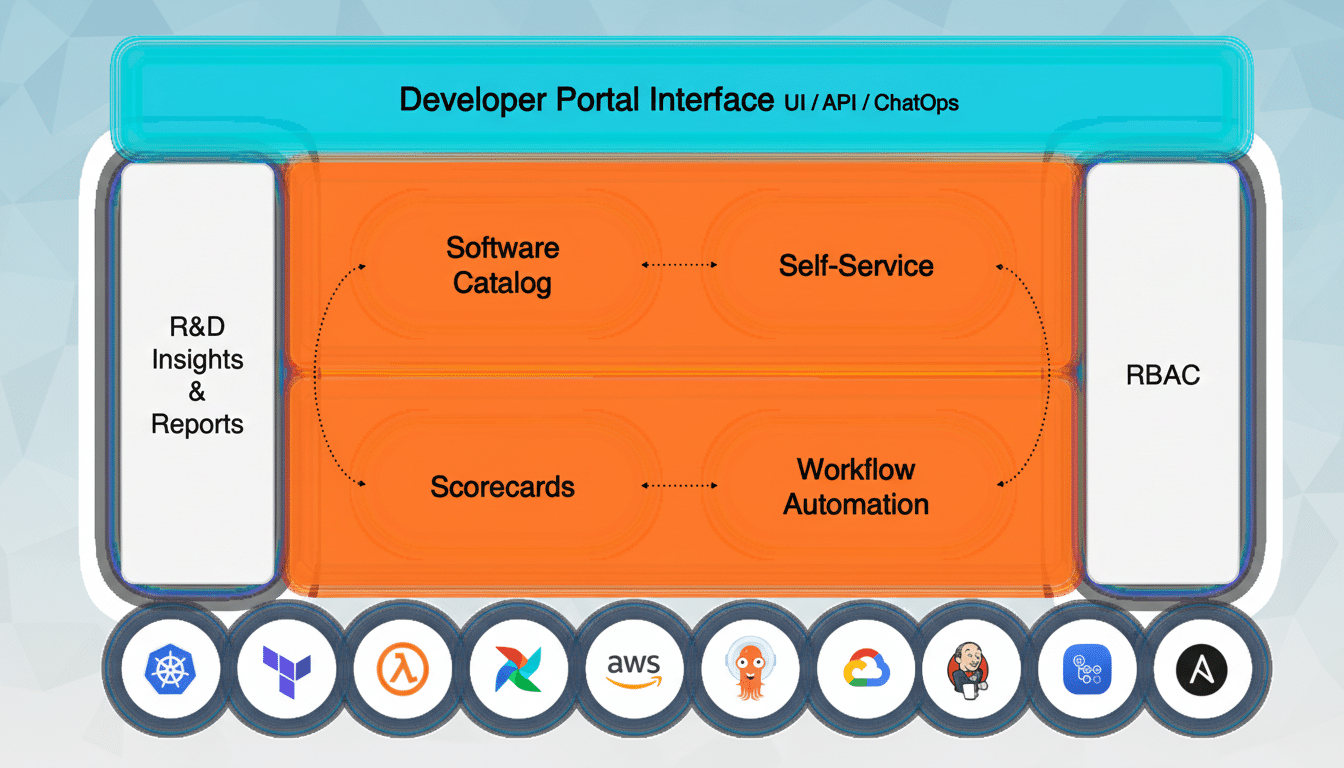
Port now offers a catalog for developer tools and agents, instrumentation to monitor the performance of agents and human-in-the-loop controls so teams can mandate approvals for sensitive changes. A feature it dubs a “context lake” standardizes what agents can know and do, prescribing where to pull in data; the memory they can use at one time; and guardrails. This is done in order to avoid shadow agents, lessen drift between environments, and ensure automation remains aligned with company standards.
Besides onboarding agents developed outside Port, it supports prebuilt agents for popular use cases, including help desk ticket resolution and infrastructure provisioning. Its pitch for its value is essentially tackling “the other 90%” of engineering work that involves some aspect of not writing code — workflow coordination, compliance and operations — where autonomous and semi-autonomous agents can deliver measurable gains when orchestrated safely.
Crowded field and risks of execution for Port
Port enters a crowded arena. Backstage continues to serve as the de facto open-source standard for IDPs, with commercial distributions and offerings from vendors like Roadie. On the agent stack, developer framework vendors such as LangChain will dip into governance while players like automation leader UiPath and IDP leaders Cortex and OpsLevel are broadening out from their early customer bases. Big cloud providers and enterprise platforms are also building AI operations into their toolchains.
Success will depend on the breadth of integrations and evidence of operational impact — such as reduced mean time to recovery, improved change failure rates and faster service onboarding — compared against DORA metrics. Enterprises will want tight hooks into GitHub, GitLab, Jira, ServiceNow, Kubernetes and cloud providers plus strong RBAC, policy-as-code and audit logs to appease security teams. Early adopters are asking more and more for a single interface to codify golden paths, while providing teams with independence — and Port is betting it can offer both.
The raise indicates that developer experience groups are moving away from static portals to living control planes where code and agents work together under the same shared governance. If Port can make that sprawl a managed layer where platform teams go to get what they need, it’s not just going to challenge Backstage by virtue of being more convenient — it will redefine the job that an internal developer portal is supposed to accomplish.