


Millions of UK internet users are set to lose access to Pornhub and several sister sites after parent company Aylo said it will restrict its platforms in Britain rather than comply with new age checks under the Online Safety Act. Only UK users who have already verified their age and identity will retain access, meaning most visitors are likely to hit a block page.
Aylo’s UK Block: Rationale and Actions Explained
Aylo said it will switch off access to Pornhub and other properties in the UK, arguing that the current regulatory framework is failing to keep minors away from adult content and is pushing traffic toward unregulated sites. The company also claims mandated age checks risk exposing sensitive personal data, a flashpoint in privacy debates around the world.
- Aylo’s UK Block: Rationale and Actions Explained
- UK Regulator Ofcom Pushes Back on Aylo’s Claims
- What UK Users Should Expect as Pornhub Limits Access
- The Global Fight Over Age Verification and Enforcement
- Privacy and Security Risks in Focus for Age Checks
- What Comes Next for Enforcement, Privacy, and Access
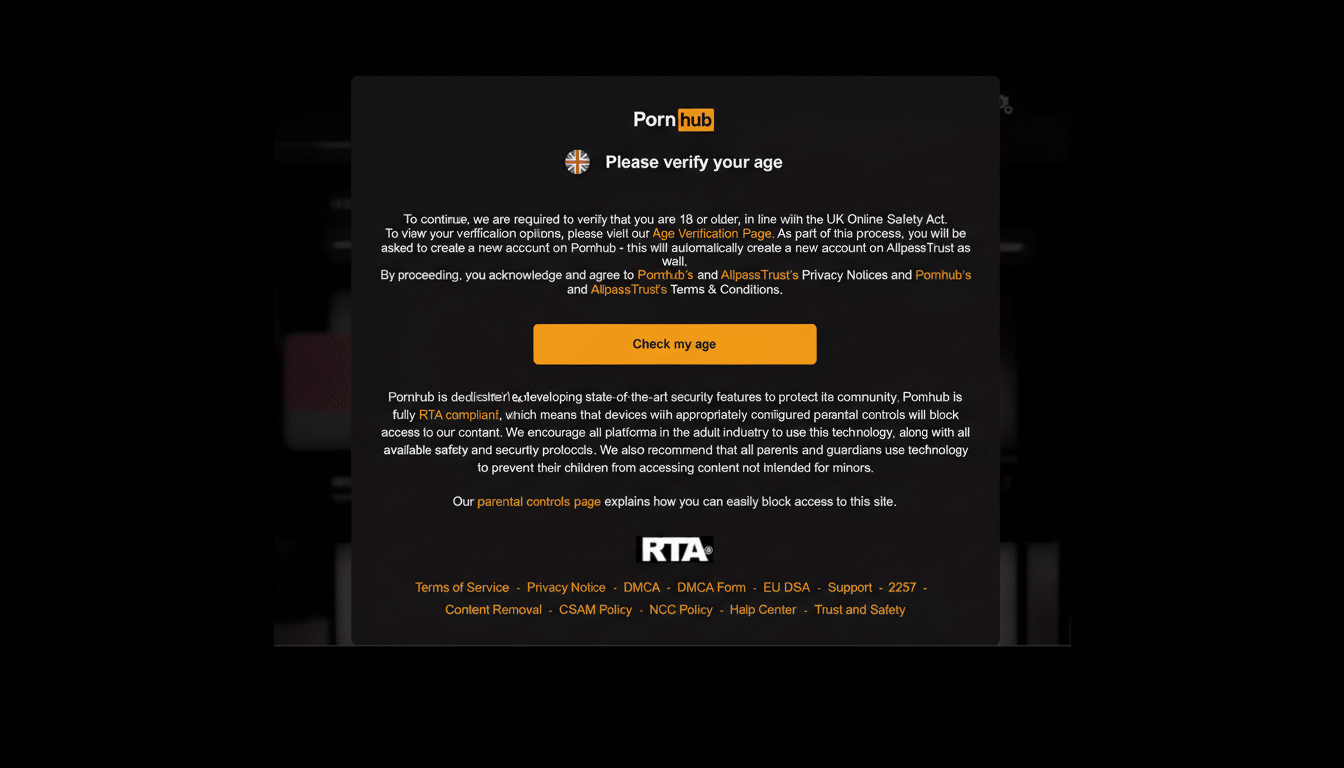
In a statement, Aylo said months of experience under the new regime suggest the law is not hitting its core objective. The company maintains that compliance funnels users to platforms that ignore the rules and that centralized identity checks create data honeypots that could be misused or breached.
UK Regulator Ofcom Pushes Back on Aylo’s Claims
Ofcom, the UK regulator tasked with enforcing the Online Safety Act, disputes Aylo’s claims. The watchdog says it has opened investigations into more than 80 porn sites and has already levied a £1 million fine against a provider, with further enforcement to follow. Its position is that robust age assurance is both achievable and necessary, and that providers can adopt privacy-preserving methods without retaining passport scans or other sensitive data.
Ofcom’s guidance emphasizes outcomes over specific technologies, allowing options such as third-party age estimation, payment card checks, or attribute-based credentials. The Information Commissioner’s Office has similarly urged a privacy-by-design approach, making clear that unnecessary data collection should be minimized.
What UK Users Should Expect as Pornhub Limits Access
For most people in the UK, attempting to visit Pornhub will likely result in a notice explaining that access is restricted. Users who previously completed Aylo’s verification process should still be able to log in and view content. The company has taken similar steps in several US states with age-verification mandates, opting to block access rather than adopt state-specific verification flows.
Industry analysts expect traffic to redistribute to competitors, as seen in past regional blocks where compliant platforms saw declines while non-compliant or offshore sites picked up visitors. That substitution effect is central to the policy debate: regulators argue that consistent, cross-platform enforcement will close those gaps, while platforms say uneven enforcement creates perverse incentives.
The Global Fight Over Age Verification and Enforcement
Age checks for adult content are proliferating. In the United States, a patchwork of state laws has produced geoblocks, compliance tools, and multiple legal challenges from digital rights and industry groups. France’s regulator has also pressed for stronger age assurance, triggering court battles over technical standards and proportionality. The UK now sits at the center of this debate, with one of the most expansive online safety regimes and a powerful enforcement mandate.
Privacy and Security Risks in Focus for Age Checks
Aylo’s stance is informed by security incidents across the broader ecosystem. A breach at an analytics vendor previously exposed information tied to premium adult content subscribers, including email addresses, locations, and viewing metadata. Privacy advocates warn that any system linking real-world identity to intimate browsing habits carries outsized harm in the event of compromise.
Security researchers often describe centralized identity stores as “honeypots” for attackers. Independent studies, such as the widely cited Cost of a Data Breach Report from IBM, have consistently shown rising breach costs across sectors, underscoring the stakes for platforms that collect sensitive attributes. Regulators counter that privacy-preserving age estimation, cryptographic credentials, and strict data minimization can mitigate those risks while still protecting children.
What Comes Next for Enforcement, Privacy, and Access
Expect tighter enforcement from Ofcom and more legal and technical sparring over what constitutes “proportionate” age assurance. Platforms face a strategic choice: adopt privacy-first verification tools now emerging from specialist vendors, or continue geoblocking and risk user flight to competitors. The ultimate outcome will hinge on whether enforcement becomes sufficiently broad and consistent to eliminate loopholes without creating new privacy hazards.
For UK users, the near-term reality is straightforward: unless already verified, access to Pornhub is likely to be cut off. How quickly rival sites fall into line—or are forced to—will reveal whether the Online Safety Act can curb underage exposure to adult content without compromising the privacy of everyone else.