


If the Pixel Weather app told you to expect a light dusting and a mild day, only for a blizzard and deep freeze to arrive, you were in crowded company. After the latest North American snowstorm, Pixel owners across the U.S. and Canada reported glaring inaccuracies in the app’s temperature, snowfall, and descriptive summaries—some seeing readings off by dozens of degrees and snowfall projections that missed by a wide margin. One viral screenshot even showed the app’s AI summary inventing the word “flurzy.”
The complaints present a serious trust problem for a utility that launched in 2024 with promises of clear, helpful forecasts and context. When conditions turn dangerous, reliability is not a nice-to-have—it’s the product.
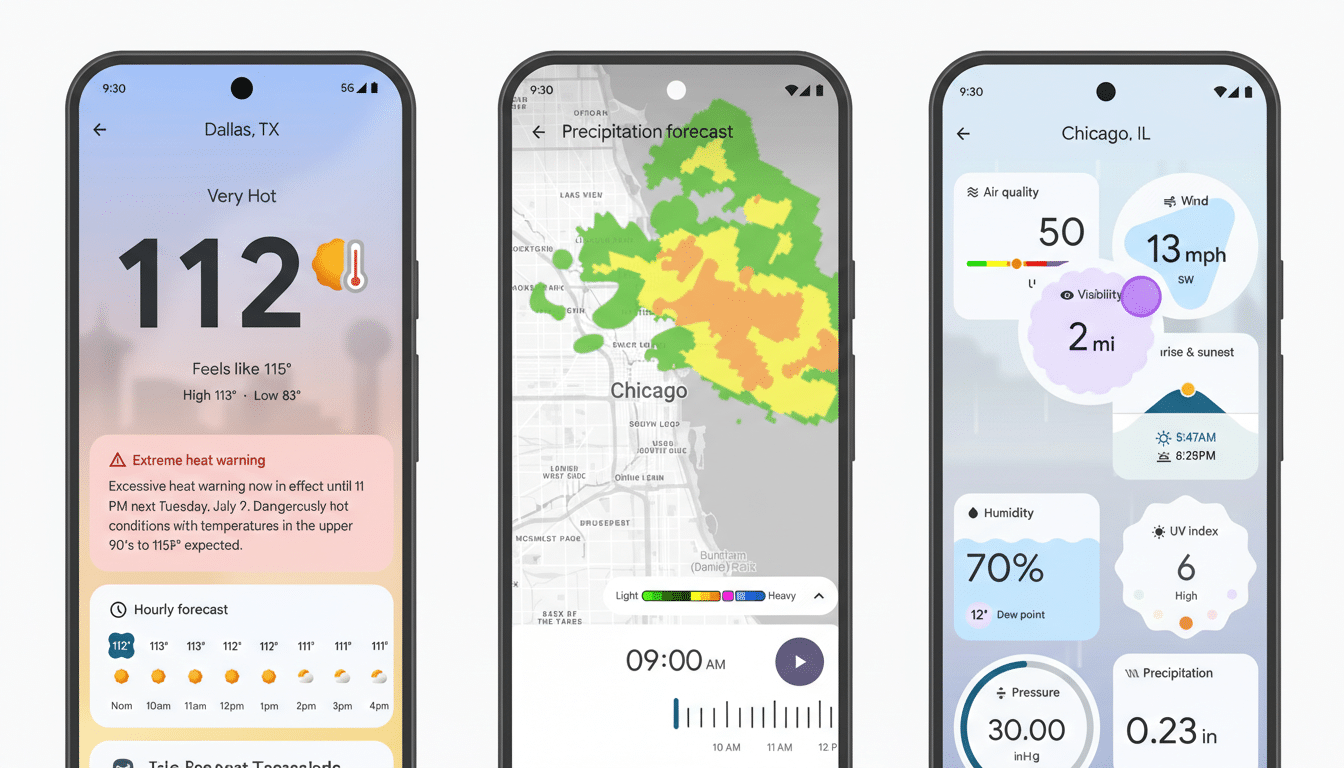
Reports of Big Misses Across the Map Emerge
Multiple Reddit threads detail the same pattern: Pixel Weather indicating “chilly” or “light snow” while users looked out at whiteout conditions and double-digit negatives. In one widely shared example, the app displayed mid-40s Fahrenheit as snow fell and thermometers read single digits. Others said the app lowballed snowfall totals that ultimately snarled commutes and shut schools.
These were not isolated hiccups from a single city. Posts spanned the Upper Midwest, the Northeast, and parts of Canada—areas where lake-effect bands and fast-moving Arctic fronts punish any forecasting system that is slow, stale, or poorly localized. Some users, to be fair, reported that Pixel Weather performed fine, which complicates the picture and points to variability in data sourcing or location handling.
The AI-generated phrasing raised separate alarms. The now-notorious “flurzy” descriptor isn’t just a typo; it signals that the summarization layer can produce nonstandard language when it should err on clarity and caution, especially around hazardous weather.
Why Pixel Weather May Have Missed the Mark
Heavy snow events stress every link in the forecasting chain. Short-range “nowcasts” depend on recent radar, satellite, and surface station updates. If a phone app lags on refreshes, maps a user to the wrong observation site, or blends model guidance that underestimates snow band intensity, the result can be wildly off for a specific block or neighborhood.
Authoritative agencies acknowledge the challenge. The National Weather Service notes that temperature forecasts are typically accurate to within a few degrees on the day of, but predicting exact snowfall at neighborhood scale is far tougher. Environment and Climate Change Canada makes similar cautions, highlighting how rapidly shifting mesoscale features can bust totals. The “real feel” can veer even further from a headline temperature: NWS guidance warns that wind chills near -40°F can cause frostbite in minutes.
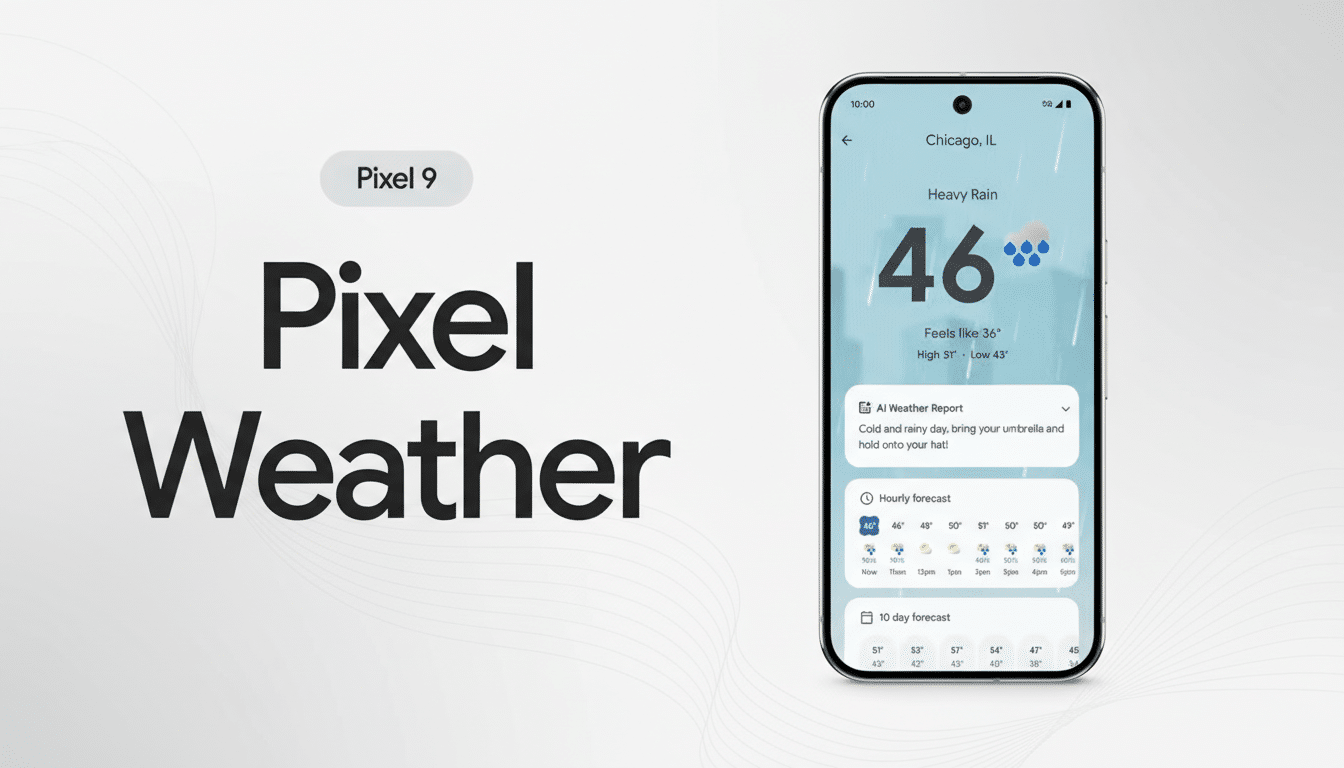
The AI layer adds another variable. Summaries that translate numbers into plain English can help non-experts—until they over-simplify or, in this case, hallucinate. Any generative system that turns structured weather data into prose needs strict guardrails, especially around severe conditions, to avoid cute language where clear warnings belong.
How Other Apps and Sources Stack Up in Storms
No consumer app is perfect in a blizzard, but transparency and redundancy matter. ForecastWatch, an independent auditor that compares providers, has repeatedly found meaningful differences in temperature and precipitation accuracy among major brands. Some apps blend multiple feeds or show “last updated” timestamps and confidence ranges, which help users judge risk.
During high-impact events, meteorologists consistently urge cross-checking with official outlets. In the U.S., the National Weather Service provides zone-specific forecasts, radar, and alerts. In Canada, Environment and Climate Change Canada and provincial agencies issue warnings and snowfall outlooks. Local TV meteorologists, who interpret model quirks and terrain effects, can also be invaluable when banded snow or sharp gradients are in play.
What Pixel Owners Can Do Right Now to Stay Safe
- Verify severe weather with the National Weather Service or Environment and Climate Change Canada, and enable wireless emergency alerts.
- Check multiple sources when forecasts diverge; look for measured observations, radar loops, and timestamps, not just icons.
- On your Pixel, ensure Location is set to high accuracy, grant precise location to the weather app, and refresh data. If readings look wrong, try clearing the app’s cache or reinstalling updates from the Play Store.
- Report issues through the app’s feedback option, including screenshots and your approximate location, so engineers can trace data-source or mapping problems.
What Google Needs to Address for Weather Trust
Trust hinges on clarity. Pixel Weather should expose data provenance, observation station or grid reference, and a visible “last updated” time. During active weather, the app should display confidence ranges or probabilities for snowfall and wind, and default to straightforward, standardized wording instead of generative creativity.
Redundancy is key: automatic failover to alternate feeds when one source lags, rapid nowcast updates during storms, and stronger QA on AI summaries to prevent nonstandard terms. Clear communication about any ongoing issues—and what’s being done to fix them—would go a long way toward restoring user confidence.
The bottom line: you were not alone. The snowstorm exposed weak points in Pixel Weather’s pipeline and presentation. Until those are fixed, treat the app as one input among several—especially when the stakes are measured in icy roads, school closures, and real safety risks.