


OpenAI is pushing deeper into the enterprise with Frontier, a platform designed to build, deploy, and manage AI agents that operate across a company’s data and tools. The move elevates OpenAI from a model provider to a systems orchestrator, positioning agents as “AI coworkers” that can be trained, supervised, and governed—potentially reshaping how businesses buy and use software.
Frontier’s pitch is simple and ambitious: give AI agents the context, feedback loops, and permissions they need to do real work in production. It’s a bet that the next era of enterprise computing won’t be defined by yet another app, but by an agent layer that sits above apps—and eventually makes many of them less visible to the end user.
What Frontier Promises for Enterprise AI Agents
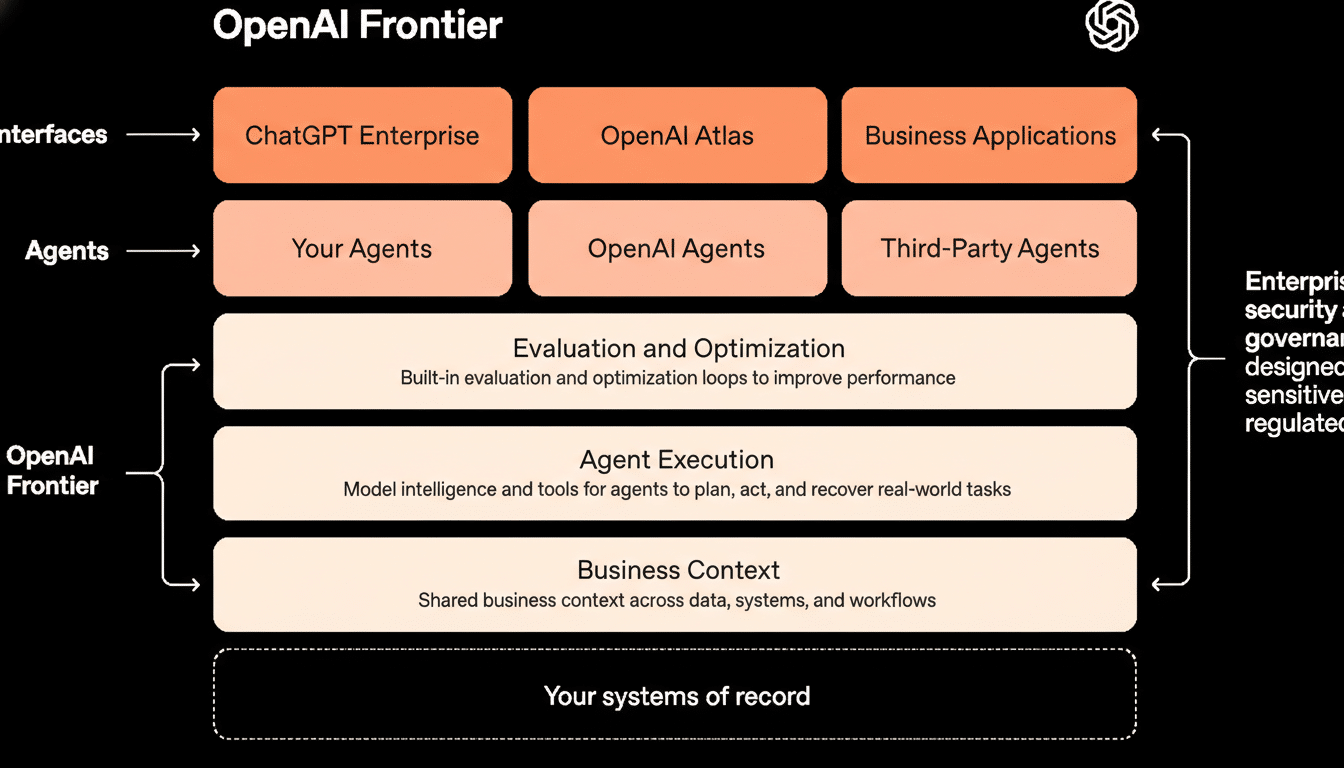
At its core, Frontier looks like an orchestration and governance layer for AI agents. OpenAI describes a shared “semantic” foundation that agents can reference to understand business concepts consistently—think of it as a common language tying together CRMs, ERPs, document stores, and proprietary knowledge. That semantic layer aims to reduce brittle prompt engineering and enable more reliable multi-step workflows.
OpenAI also highlights enterprise-grade controls: distinct agent identities, explicit permissions, and guardrails to constrain actions. Expect features like role-based access, audit logging, and approval workflows to be central. Those controls are the difference between a flashy demo and a tool auditors can live with, particularly in regulated sectors like healthcare and financial services.
Crucially, Frontier promises continuous learning in production. Agents get “onboarding” and feedback mechanisms to improve over time, creating a loop from deployment back to model research. If that loop works as advertised, it could boost accuracy and reduce costly human-in-the-loop overhead on repetitive tasks.
A Page From Palantir’s Playbook on Enterprise AI
OpenAI isn’t just shipping software—it’s adopting services muscle. Frontier deployments will be guided by forward-deployed engineers who sit with customer teams, adapt workflows, and route insights back to OpenAI’s researchers. That model mirrors how Palantir has long won complex accounts: embed engineers, extend the product, and make the software feel bespoke without forking it.
Palantir’s approach has proven sticky, and it’s scaling through partnerships, including a recent effort with Accenture to combine forward-deployed engineers with 2,000+ trained consultants on Palantir’s AI platform. OpenAI appears to be building a similar bridge between field implementation and core R&D. If successful, Frontier could compress the feedback cycle that typically separates pilot projects from durable, audited production systems.
Why This Threatens the SaaS Stack and Software UX
Agent platforms introduce a provocative idea: the large language model becomes the primary user interface, and software suites are invoked behind the scenes via APIs. That shift erodes the advantage of polished front ends and favors vendors that control orchestration, data context, and security. Anthropic’s Claude Cowork is pushing in a similar direction, hinting at a broader platform battle where the agent, not the app, owns the workflow.
Investors have taken notice. Concern that agent-first platforms could commoditize traditional interfaces has weighed on some software valuations, with Bloomberg dubbing the turbulence a “SaaSpocalypse.” Whether hyperbole or preview, the message is clear: if agents drive adoption, distribution moats may move from standalone apps to integration depth, data gravity, and safe automation at scale.
Security And Governance Are The Gatekeepers
Frontier’s emphasis on identities, permissions, and guardrails acknowledges a hard truth: enterprise AI rises or falls on governance. Cybersecurity and identity vendors—from Palo Alto Networks to Okta and Microsoft’s Entra—are racing to define standards for agent authentication, secret management, and action authorization. Expect alignment with frameworks such as the NIST AI Risk Management Framework and controls that support SOC 2, HIPAA, and financial compliance regimes.
Enterprises will demand traceability for every agent action, separation of duties for sensitive workflows, and human-visible explanations for decisions. Those requirements are not optional; they are purchase criteria. Platforms that can’t deliver reliable containment and audit trails won’t graduate from pilots.
Early Customers and the Road Ahead for Frontier
Frontier is in limited use with companies including HP, Intuit, Oracle, Thermo Fisher, and Uber. Early deployments are likely targeting high-volume tasks: customer support triage, finance close assistance, procurement intake, software operations runbooks, and supply chain incident response. These are domains where even small accuracy gains compound into measurable ROI.
The opportunity is large but execution-heavy. Recent enterprise surveys by firms like Deloitte and IDC suggest most organizations remain in pilot phases and cite integration, data quality, and risk management as top obstacles. Meanwhile, McKinsey estimates generative AI could add $2.6T to $4.4T in annual economic value, but capturing that upside requires moving from chat to controlled automation—precisely the gap Frontier aims to bridge.
OpenAI’s challenge is twofold: scale services without becoming a consulting company, and build a partner ecosystem strong enough to win regulated, industry-specific deals. That likely means collaborating with incumbents even as it competes with them, from systems integrators to security vendors and vertical software providers.
If Frontier can convert agent demos into audited, repeatable deployments, the center of gravity in enterprise software could shift. The winners will be the platforms that make agents trustworthy, measurable, and economically undeniable—and the vendors that embrace them rather than try to stand in their way.