


OpenAI has started introducing advertising inside ChatGPT, a pivotal shift for the widely used AI assistant and a sign that the company is moving toward a hybrid revenue model. Ads are being tested for logged-in users on the Free and Go tiers in the U.S., while paid plans such as Pro, Business, Enterprise, and Education remain ad-free. The company frames the rollout as a way to keep powerful AI accessible without requiring everyone to pay.
Early tests emphasize clarity and control. OpenAI says ads will be clearly labeled, appear outside the assistant’s generated answers, and will not alter how ChatGPT responds. Users can limit personalization or opt out entirely, though free users who decline ads may face stricter daily message limits unless they upgrade.
How the Ads Work in ChatGPT Without Changing Answers
OpenAI describes the units as “sponsored” placements that sit adjacent to the chat experience rather than embedded in the model’s replies. The goal is to keep the assistant’s output neutral while allowing relevant, clearly marked promotions to appear nearby—closer to a search results model than an in-stream influencer post.
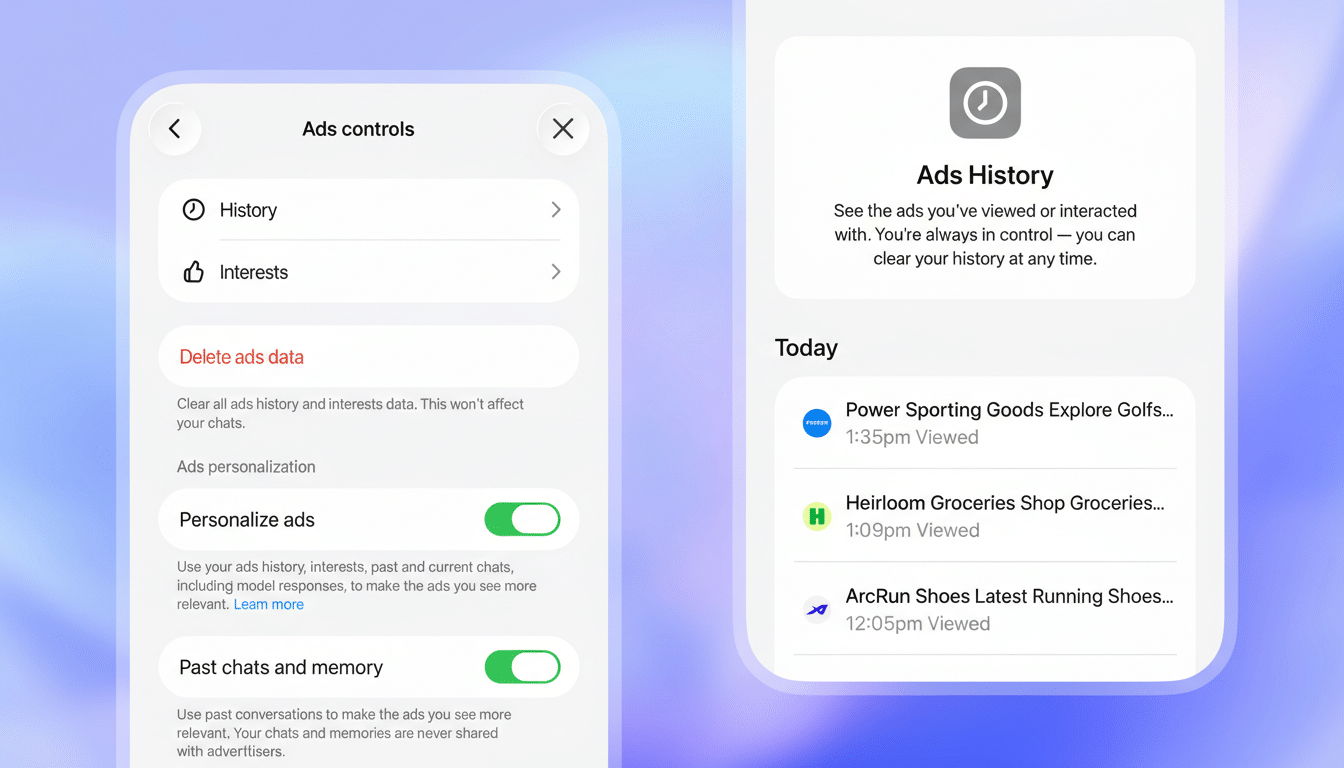
Targeting is based on broad conversation topics and user interactions with ads, not on sharing the content of specific chats with advertisers, according to OpenAI. The company says it is enforcing restrictions to avoid showing ads alongside sensitive subjects, including health, mental health, or politics. Users can also turn off ad personalization and erase their ad interaction history, giving them a straightforward privacy switch if they’re wary of profiling.
Crucially, OpenAI states ads do not change how the model reasons about a prompt or which sources it cites. That bright line is meant to preempt concerns that commercial incentives could bias outputs—an issue that has dogged other platforms where monetization shapes what users see.
Why OpenAI Is Turning to Advertising to Support Free Use
Inference—the cost of generating answers at scale—remains the most expensive part of running state-of-the-art AI systems. With usage in the hundreds of millions globally, even small per-chat costs add up. Advertising offers a familiar way to subsidize access for casual users while protecting premium tiers, a playbook pioneered by search and social platforms.
Industry reporting has charted OpenAI’s rapid revenue growth alongside rising infrastructure costs. In 2024, The Information and other outlets noted that OpenAI’s annualized revenue had climbed into the multi-billion-dollar range, driven by subscriptions, API usage, and enterprise deals. Ads add another lever—one that can scale with usage without forcing a blanket paywall.
User appetite is there, too. Pew Research Center reported in 2024 that roughly a quarter of U.S. adults had tried ChatGPT, with adoption significantly higher among younger adults and heavy internet users. For OpenAI, ads could convert that broad, exploratory audience into sustainable economics without undermining paid offerings.

What Users Can Control About Ads and Personalization Options
Free and Go users can choose among three paths: accept ads with personalization, accept ads without personalization, or reduce exposure by opting out in exchange for fewer daily free messages. Paid plans remain ad-free. Within settings, users can restrict the use of past chats for ad relevance, and they can delete their ad interaction data to reset how sponsored content is selected.
For example, a user researching travel gear might see a clearly labeled sponsor placement alongside their session. Turning off personalization would swap that targeted placement for more generic promotions, and opting out fully would prioritize message allotments over ads. The design deliberately ties controls to visible trade-offs so people can calibrate their experience.
Competitive and Regulatory Backdrop for ChatGPT Ads
OpenAI’s move lands amid a heated positioning battle in consumer AI. Rival Anthropic used a high-profile Super Bowl LX campaign to jab at the concept of ads inside chatbots, pitching Claude as an ad-free alternative. The contrast sets up a familiar tech debate: subsidized convenience versus subscription purity.
Regulators are also watching how commercial content blends into algorithmic experiences. The Federal Trade Commission has long required clear ad disclosures and warned against deceptive formats that blur ads with organic content. OpenAI’s choice to keep ads outside generated answers and to label them prominently mirrors guidance from the FTC and industry groups like the Interactive Advertising Bureau.
What to Watch Next as OpenAI Expands ChatGPT Advertising
The big questions now are load and relevance: how many ads appear, how often, and how well they match context without crossing into creepiness. Advertiser categories will matter, too—expect early activity from software, education, and productivity tools that map cleanly to ChatGPT’s use cases.
Expansion beyond the U.S., potential ad formats tailored to multimodal chats, and the potential for sponsor integrations with tools or third-party models will signal how far OpenAI intends to take monetization. If the company can keep ads useful, clearly separated, and optional, it could normalize an ad-supported tier for AI—much like search did two decades ago—while preserving an ad-free path for power users and enterprises.