


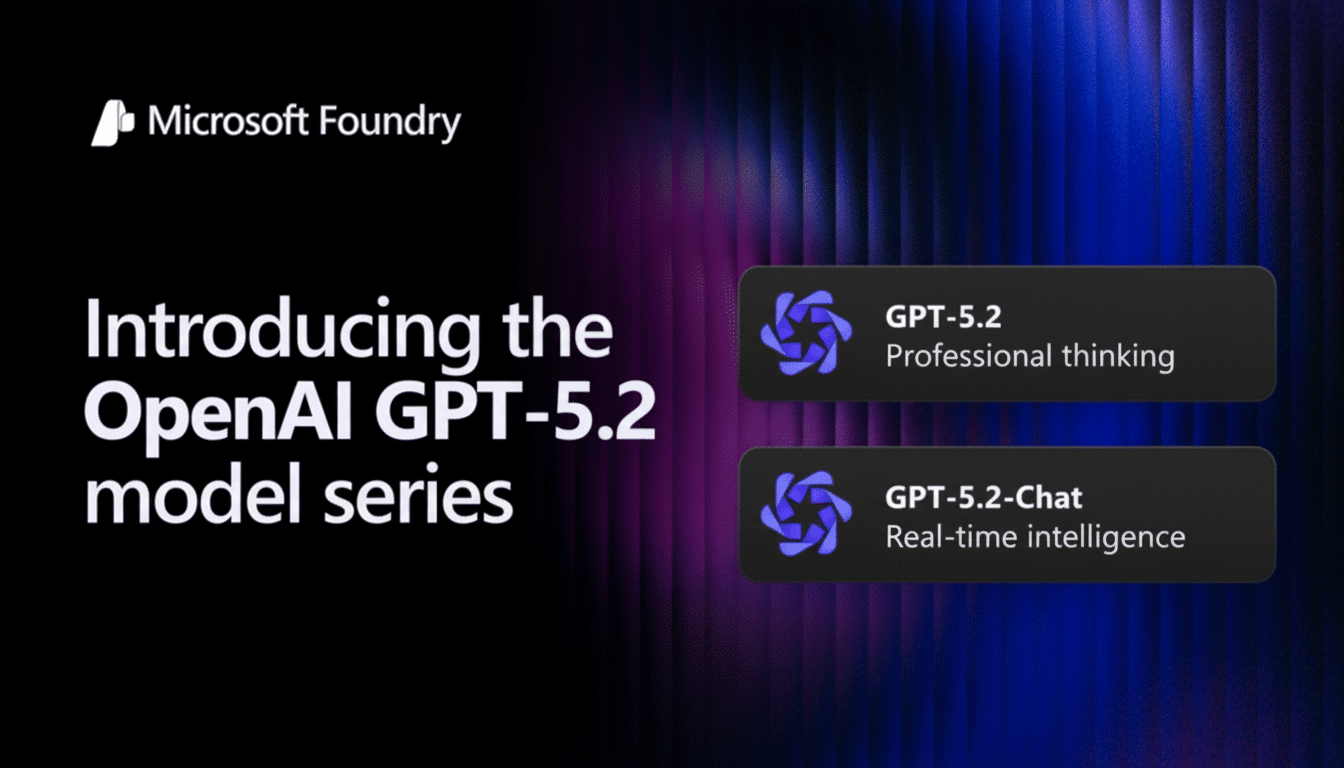
OpenAI’s latest flagship, GPT-5.2, debuts with sharper reasoning and faster response times, alongside better tooling. In everyday conversation, however, it feels uncannily familiar. For most, this is less a feature drop than a quiet tune-up — useful but objectively up.
GPT-5.2, which OpenAI now defaults to for both free and paid ChatGPT accounts in its Instant and Thinking versions (replacing GPT-5.1), is cast as an under-the-hood improvement: more effective at constructing presentations, working with longer contexts, seeing images, and orchestrating other tools. No shiny new buttons, just assertions that the engine under the hood revs a bit cleaner.
- What’s New Under the Hood of OpenAI’s GPT-5.2 Release
- What Stays the Same Day to Day for Typical Chat Users
- Early Signals and Warnings From GPT-5.2 Power Users
- Benchmarks and the Competitive Picture for GPT-5.2
- Pricing and Access for GPT-5.2 in ChatGPT and the API
- Bottom Line: A Meaningful Update That Feels Incremental
That casts into relief the other side of a story made by modern LLMs: progress you can measure in clicks, but not necessarily feel while planning a vacation or summarizing a novel or grousing to someone for help with their spreadsheet.
What’s New Under the Hood of OpenAI’s GPT-5.2 Release
OpenAI cites a number of areas where the company can get better. Using the tools, and engaging in “agentic” behaviors — deciding to search, call functions, or chain steps together — is supposedly more reliable. This is important for tasks such as complex workflows that require data pulls from CRMs, scripted research, or models built across multiple sheets without complicated instructions.
Image perception also gets attention. The model is described as being better at unpacking technical photographs and pulling out structured information. In practice, that might translate into more accurate takeaways from a whiteboard picture or an equipment photo (no pun intended), though with the same caveat regarding imperfect visual identification.
OpenAI also notes that this fine-tuned AI model provides longer-context understanding and smoother presentation-building. These are incremental improvements, not abilities that were absent, and they depend on consistency more than sudden bursts of capability.
What Stays the Same Day to Day for Typical Chat Users
Ask GPT-5.2 to write a short email, sketch out a report, or come up with a weekend itinerary, and it starts to act almost exactly like GPT-5.1. It’s still variance that calls the tune: you may get a great response and then a lousy one, repeat. That unpredictability is a feature of sampling-based systems; it hides small gains.
Some time-saving improvements may still be a bit subtle, even in tasks where we would expect them to show — for example, when trying to extract tables from a screenshot or build a very basic budget workbook. You might get a little fewer hallucinated values, or neater column titles, or a more succinct formula on the first pass, but very seldom will your work go from “good enough” to “clearly better.”
The upshot: if GPT-5.1 was already right where you wanted it, GPT-5.2 won’t change your routine. The ceiling may be a little higher; the floor feels pretty much the same.
Early Signals and Warnings From GPT-5.2 Power Users
Some operators and developers here say they see meaningful increases in special configurations. Jeff Wang, the CEO of Windsurf, called GPT-5.2 the greatest agentic coding advance since the GPT-5 series, pointing to smarter multi-step execution. AJ Orbach, CEO of Triple Whale, reported that latency is much lower and the tool calling has been strengthened so complex system prompts are no longer needed to ensure reliable actions.
That’s OpenAI promotion, so take it as anecdotal — but directionally consistent with what the company says it tuned: less prompt wrangling, more faithful execution, and a speed boost for tool-heavy flows.
If your workflows are heavily based on function calling, retrieval-augmented generation, or long, chained tasks, GPT-5.2 is worth further consideration using your own benchmark suite. The typical chat user won’t notice; a highly trained agent might.
Benchmarks and the Competitive Picture for GPT-5.2
OpenAI’s internal benchmarks indicate incremental gains over GPT-5.1 and baseline benchmarks by Google and Anthropic. As always, a note of caution: leaderboard deltas don’t neatly correspond to real work. Tests run by the community, like LMSYS Chatbot Arena, tend to demonstrate that minor version bumps don’t bring about significant change in the quality of a release but do offer marginal and sometimes even situational improvement.
The broader context matters. Rivals have focused on more effective image generation, long-context retention, and grounded tool use. Industry scuttlebutt has it that OpenAI had an intense internal drive to close these gaps as fast as possible, which could help explain the frenetic pace between GPT-5 and 5.1 and 5.2. The approach appears to be emphasizing incremental, regular improvements over splashy new features.
For those buying, the lesson is a pragmatic one: expect better averages but not entirely new categories of capability. If you need such a dramatic improvement that you can see it in moments, the improvements here are so subtle they couldn’t headline a slide.
Pricing and Access for GPT-5.2 in ChatGPT and the API
GPT-5.2 is now available for all ChatGPT users as the default, so free users will receive it automatically. For API customers, the math also includes cost: pricing per million tokens is said to be up 40% versus GPT-5.1. Such a premium may be reasonable for applications that achieve higher tool-call accuracy or lower prompt complexity.
If you are constructing agents, parsing complex documents, or running a high volume of automations, try GPT-5.2 1:1 against your current stack and measure outputs — latency, error rates, re-run rate, operator intervention. It is easy to justify higher unit costs based on diminishing retries or manual fixes.
Bottom Line: A Meaningful Update That Feels Incremental
GPT-5.2 is a milestone hidden as a maintenance release. It does so by locking down the screws pros care about — tooling, context handling, and performance concerns — while leaving casual users with a model that feels exactly the same as yesterday’s. That’s not a knock; it’s simply the nature of mature LLMs, where innovation frequently comes in the form of fewer stumbles rather than entirely new tricks.
If you’re paying for ChatGPT, there’s no downside to deploying it. If your business relies on agents or intricate tasks, there could be some real gains here. For everyone else, GPT-5.2 is the upgrade that you enjoy without knowing why — and that’s likely the point.