


OpenAI’s most affordable paid ChatGPT plan has landed in the US, bringing premium features to more users for $8 a month—roughly the cost of a decent sandwich. The plan, called ChatGPT Go, mirrors its lower-priced rollouts abroad and is now part of a global expansion that spans more than 170 countries.
The move widens the funnel for people who want more than the free tier but don’t need the full power or price of Plus or Pro. It also sets the stage for a new ad-supported experience at the lower tiers, a notable shift for one of the most-used AI products on the web.
- What ChatGPT Go includes in the new $8 US plan
- How the ChatGPT Go pricing stacks up in the US
- Ads are coming to the free and cheaper ChatGPT tiers
- Who should choose ChatGPT Go instead of Plus or Pro
- A global rollout of ChatGPT Go with local pricing nuance
- Bottom line on ChatGPT Go’s $8 US launch and impact
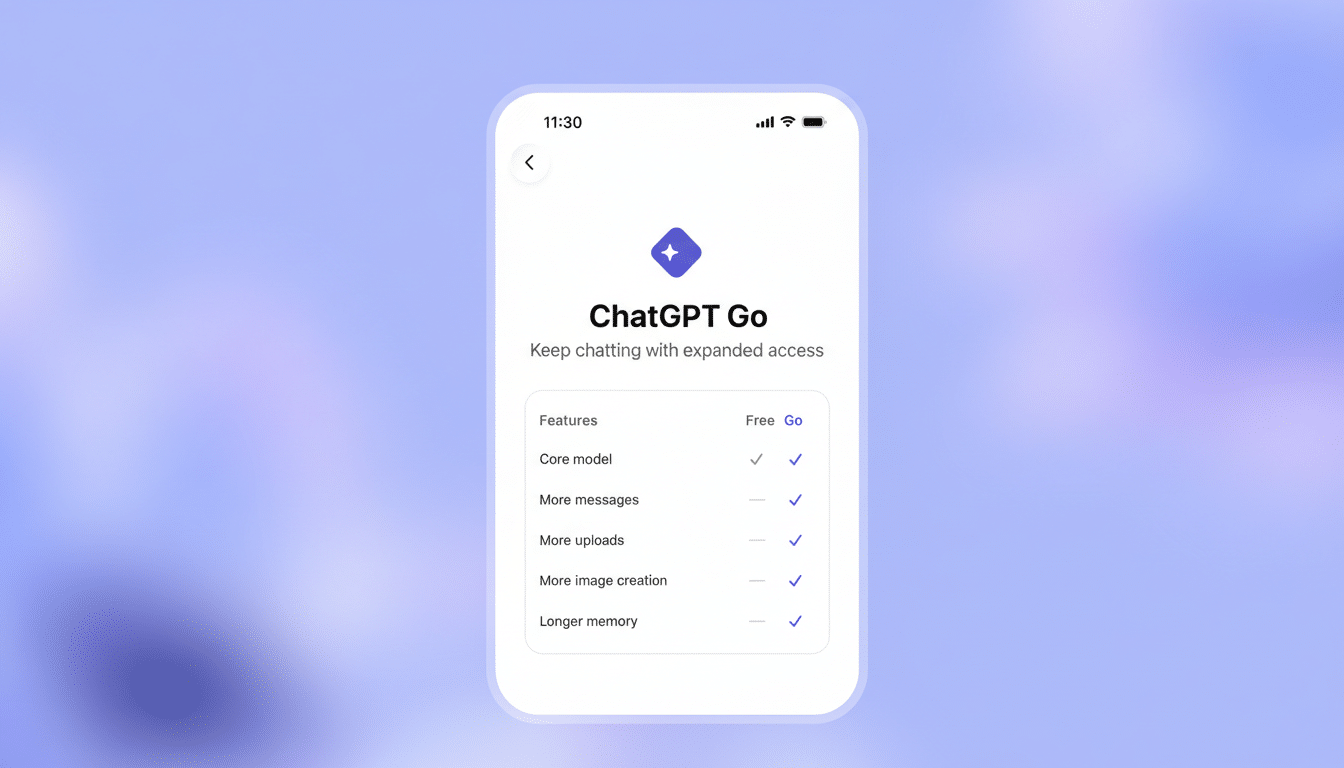
What ChatGPT Go includes in the new $8 US plan
OpenAI says Go includes access to its latest model along with capabilities not available on the free tier. In practice, that means more reliable performance during peak demand and broader functionality for everyday tasks like drafting, summarizing, and light research.
Early adopters in markets where Go debuted first praised it as the sweet spot between free and Plus, especially for students, freelancers, and small teams that need dependable access without enterprise-level commitments. Expect core features that make ChatGPT useful out of the box, without the higher rate limits, workspace tooling, or advanced controls reserved for Plus, Pro, Business, and Enterprise.
How the ChatGPT Go pricing stacks up in the US
At $8 in the US, ChatGPT Go undercuts the $20 Plus plan by 60% and the $200 Pro plan by 96%. That price sits slightly above the approximately $5 equivalent where Go first launched in India, but still positions the plan as an accessible entry point for paid AI assistance.
OpenAI’s tiered lineup now reaches a wider spectrum of needs: free for casual use, Go for regular personal use, Plus for power users, and Pro and above for professional workloads. In a market where competitors pitch $10 to $30 monthly plans for advanced AI access, Go is deliberately aggressive on value.
Industry analysts have noted that lowering the barrier to paid access can meaningfully expand conversion from free users, especially when paired with consistent model quality. Similarweb has repeatedly ranked ChatGPT among the most-visited AI destinations, and turning even a small slice of that audience into paying users at $8 could be significant for revenue diversification.
Ads are coming to the free and cheaper ChatGPT tiers
OpenAI also confirmed it will begin testing ads in the US for the free and Go tiers, while Plus, Pro, Business, and Enterprise remain ad-free. It’s a notable turn for an AI assistant and a pragmatic nod to the realities of running large-scale inference, which is compute-intensive and costly.
Advertising has long subsidized access to consumer software. Bringing that model to AI chatbots could help stabilize pricing at the entry level while funding ongoing model improvements. The execution will matter: ad load, relevance, and clear labeling will determine whether users view the shift as acceptable or intrusive.
Who should choose ChatGPT Go instead of Plus or Pro
If you outgrow the free tier—say you rely on ChatGPT to draft emails, summarize research, or brainstorm daily—Go offers a low-friction upgrade. It’s well-suited to students who need consistent access, creators who want reliable output without heavier tools, and solo operators who don’t need enterprise features.
Plus still makes sense for power users who hit limits frequently or want higher throughput, while Pro and business plans are geared toward teams, governance, and heavier workflows. With Go, OpenAI gives casual-but-regular users more stability at a price that feels reasonable for personal budgets.
A global rollout of ChatGPT Go with local pricing nuance
Go first appeared in India before expanding widely, and its global pricing reflects a balance of purchasing power and platform costs. That staggered launch provided useful feedback: a mid-tier plan can meaningfully reduce friction for users who need “just enough” capability without paying for surplus headroom.
For OpenAI, this also broadens the on-ramp to premium AI while preserving clear upgrade paths. As rivals refine their own entry-level offers, expect more experimentation with bundles, credits, and ad-supported options—especially as data center investments remain high, according to disclosures from major cloud providers.
Bottom line on ChatGPT Go’s $8 US launch and impact
ChatGPT Go arriving in the US at $8 reshapes the value equation for everyday AI use. It’s a deliberate middle ground: credible performance and modern features at a price that invites far more people to try paid AI—just as OpenAI prepares to support lower tiers with advertising.
For millions who live in the free tier today, Go is likely the easiest step up. And for OpenAI, it’s a way to expand revenue without pushing casual users into plans they don’t need.