


Every broiler grower faces the same question: when is the flock ready? Send birds to the processing plant too early and you leave kilograms on the table. Too late and you are paying for feed that produces fat instead of meat. The margin between the two is surprisingly narrow — and surprisingly expensive to get wrong.
Most operations still decide based on calendar days. Day 35. Day 42. Whatever the integrator’s standard schedule says. But birds do not read calendars. They grow according to genetics, feed quality, temperature, health status, and a dozen other variables that change from cycle to cycle.
The real answer to “when to slaughter” is not a date. It is a data point.
What Getting It Wrong Actually Costs
The economics of broiler production hinge on one curve: the relationship between daily weight gain and daily feed cost. Early in the grow-out, birds convert feed to muscle efficiently. The feed conversion ratio stays low. But as broilers approach market weight, that ratio climbs. Every additional day adds less meat and more cost.
Timing Error / What Happens / Financial Impact
| Timing Error | What Happens | Financial Impact |
| 2 days too early | Birds 100–150g under target; miss weight class | Lower price bracket; €0.03–0.05/kg revenue loss |
| 2 days too late | FCR spikes; excess fat; equipment calibration issues | 3–5 points worse FCR; more downgrades |
| Uneven flock at slaughter | Some birds on target, many over/under; processing line struggles | Combined losses from both scenarios above |
Uneven flock at slaughter / Some birds on target, many over/under; processing line struggles / Combined losses from both scenarios above
On a 30,000-bird house, two extra days of feed at the wrong end of the growth curve can cost €600–€1,200 per cycle in wasted feed alone. Add the processing downgrades from oversized birds and the real number climbs higher.
Why the Calendar Is a Bad Advisor
Fixed schedules assume every cycle performs the same way. They never do.
A summer flock dealing with heat stress will grow slower in weeks 3–5 and may need an extra day or two to hit target weight. A winter flock in a well-managed house might reach it a day early. Chick quality from the hatchery varies. A mild respiratory challenge in week 2 can delay growth by 48 hours without anyone noticing until it is too late.
The problem is not that growers do not know this. They do. The problem is that without accurate, frequent weight data, they cannot see it happening in time to adjust the plan. By the time a weekly manual weigh reveals the flock is behind, the processing slot is already booked. The birds go out at the wrong weight, and the settlement reflects it.
What Data-Driven Slaughter Timing Looks Like
The shift from calendar-based to weight-based scheduling requires one thing: reliable daily weight data.
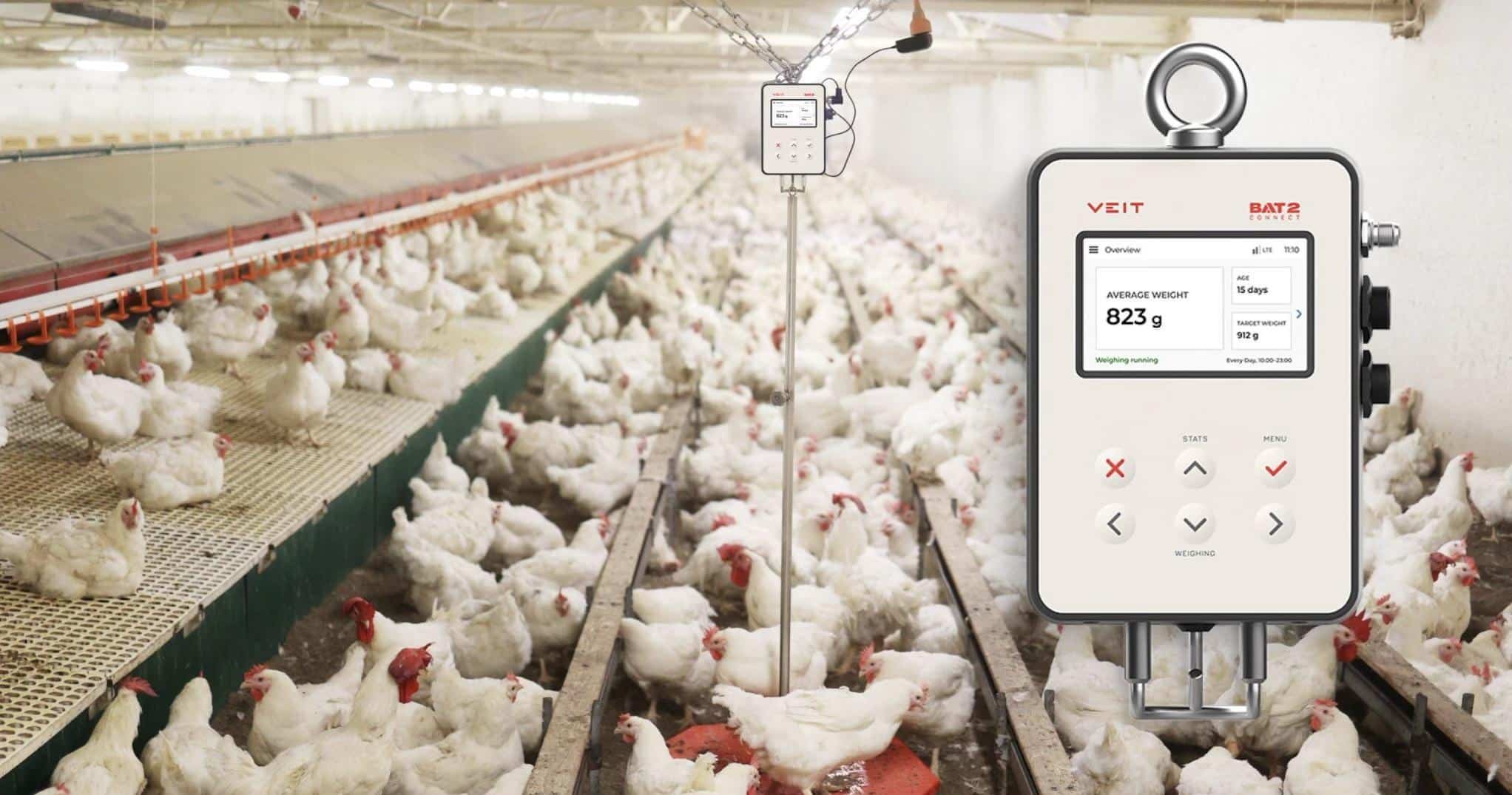
With automatic poultry weighing systems collecting thousands of individual bird weights every day, you get more than an average. You get the full picture: the growth curve in real time, the rate of daily gain, the flock’s coefficient of variation, and — critically — a projection of when the flock will actually reach the target weight class.
That projection changes daily based on real performance, not assumptions. If the flock slows down due to a heat wave, the data shows it within 24 hours. If growth accelerates after a feed change, you see that too. Instead of guessing, you are watching the flock tell you when it is ready.
? Interesting fact: A large European integrator reported that switching from fixed-schedule to weight-based slaughter timing across 120 houses improved average processing yield by 1.2% and reduced feed cost per kilogram of live weight by 2.8%. The single biggest driver was eliminating the 1–2 day timing errors that had been invisible without daily weight data.
3 Numbers That Tell You When to Pull the Trigger
1. Daily weight gain (DWG). When DWG starts declining from its peak — typically around day 28–32 for fast-growing broiler lines — the clock is ticking. Every day past the inflection point, you are paying more per gram of growth. Track DWG daily to see exactly where the flock sits on the curve.
2. Feed conversion ratio (FCR). FCR in the final week of the cycle can be 30–50% higher than in week 3. The question is whether the additional weight gained justifies the additional feed consumed. If FCR is climbing faster than the value of the extra weight, it is time to process.
3. Weight distribution (CV). A tight flock with a low coefficient of variation will hit the target weight class cleanly. A wide distribution means some birds are ready while others are not. If the CV is high, you may need to schedule a partial thin-out or accept that a portion of the flock will miss the optimal window regardless of when you send them.
None of these numbers are useful if you only have them once a week from a 50-bird manual sample. They need to come from continuous, automated weighing that captures the full flock — not a biased snapshot of the slowest birds you managed to catch.
The difference between a good cycle and a great one often comes down to 24–48 hours. Getting those hours right is not about experience or intuition. It is about having the data to see what the flock is actually doing — and making the call based on numbers, not the calendar.