


Unsurprisingly, there’s no dearth of tools available that download, sync, or back up your files. The pitch from Offcloud is more straightforward: one dashboard that’s an all-in-one option, and automation is baked in — with a lifetime plan that costs less than $40 at a fraction of its claimed list value of $209.97.
What Offcloud actually does as a remote fetch and storage hub
Offcloud is a remote fetcher, link unrestrictor, and cloud storage. Rather than upload big or throttled files to your laptop, you get Offcloud’s servers to nab them first — be they from direct links, file-hosting services such as RapidShare and Mega, and media — accessing the latter in conjunction with another subscription — BitTorrent, or Usenet — and then stream or sync the results into storage wherever you choose.
- What Offcloud actually does as a remote fetch and storage hub
- Why the single downloader approach really matters
- Automation and integrations that simplify workflows
- Performance, privacy, and limits of the lifetime plan
- How it stacks up in the real world of heavy traffic
- Who benefits most from Offcloud’s remote automation
- Price and value snapshot for the lifetime Offcloud deal
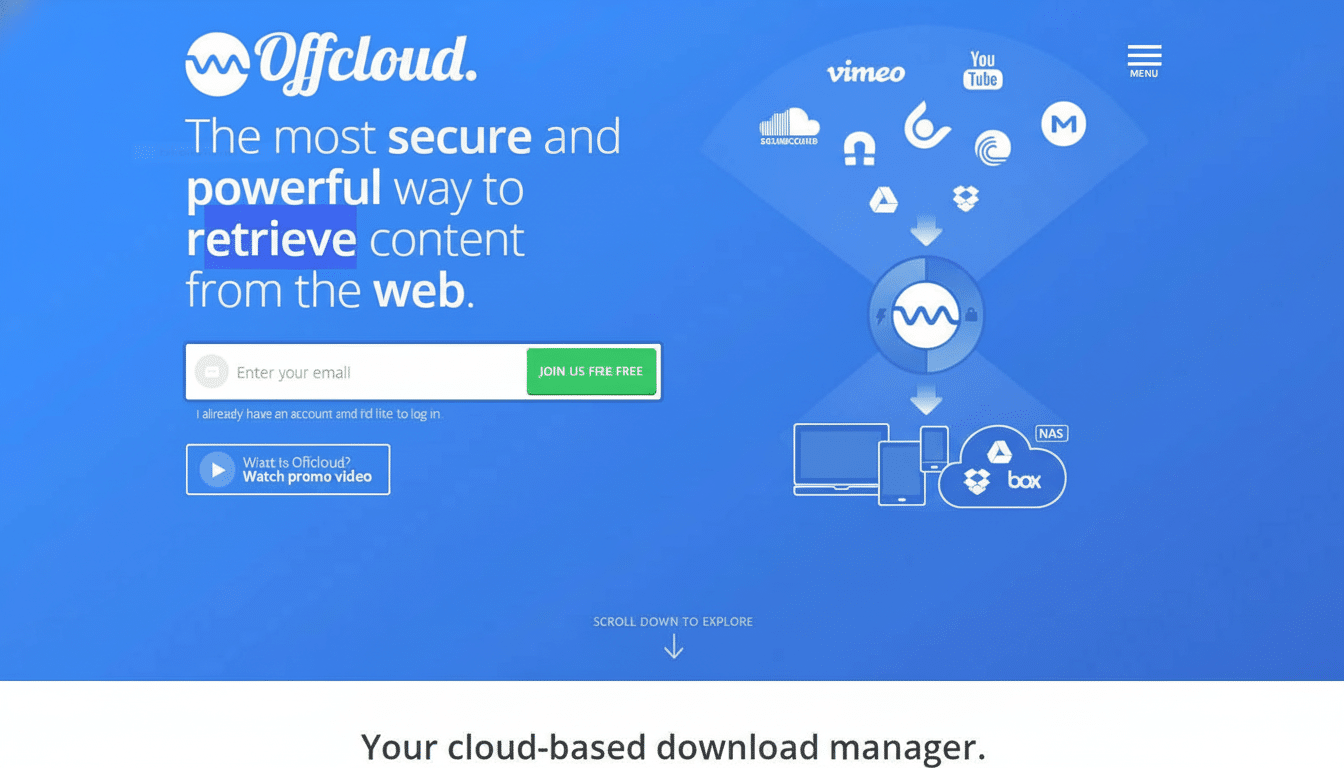
It also tackles the more mundane day-to-day jobs that people must haphazardly cobble together with multiple apps: saving complete web pages as a PDF for research or compliance, taking backups of videos, and converting cloud-hosted audio from supported sources into something you can listen to offline. Think of it as a universal inbox for the internet’s chaotic file formats and sources.
Why the single downloader approach really matters
Users typically switch between browser extensions, desktop clients, and cloud drives to shove content around. Fragmentation is a time sink and more often than not breaks at scale. There, Offcloud streamlines these into “remote” actions — where the transfer occurs in the cloud and not over your local connection — so a 15GB download isn’t going to choke your home Wi‑Fi while you’re on a video call.
That model also limits exposure of your IP address to third-party services, since requests are proxied via Offcloud’s infrastructure. For intricate fetches — say lengthy torrents or multi-gigabyte hoster links — doing so remotely isn’t just practical, it’s less fragile than a browser tab that you might inadvertently close.
Automation and integrations that simplify workflows
The real value of Offcloud appears when you integrate its capabilities into your workflow. With Zapier and IFTTT integrations, you can set up actions such as “when a new file is saved, mirror it to Google Drive and Dropbox,” or “convert a URL to PDF and file it into an archive folder.” WebDAV, FTP/SFTP, and popular clouds (including Google Drive, Dropbox, and OneDrive) mean it’s easy to direct finished files to your existing storage.
Practical examples: a researcher might auto-save source pages as PDFs to a “Citations” folder; a podcaster might fetch audio from host links and drop masters into a shared team drive; a media analyst can back up public videos for fair use review. Aside from the feel of it, automation is especially beneficial when it comes to routine and repeatable tasks, where there are time savings upon time savings.
Performance, privacy, and limits of the lifetime plan
The lifetime plan touts 1TB of proxy bandwidth and 50GB of remote cloud storage, which should be sufficient for frequent transfers for most people. Heavy users can export downloaded files to their own NAS or cloud, and just maintain a lean amount of data in Offcloud’s storage.
With regard to privacy, Offcloud keeps no logs and provides anonymized fetching through its servers. As with all intermediaries, a little due diligence is wise: read its privacy policy, activate two-factor authentication if it’s offered, and route finished files to storage that you control. One piece of advice that the Electronic Frontier Foundation often gives its users is to check how services hold logs and respond to legal requests; you can do it in this case as well.
The legal guidelines are simple: download only content that you have the right to access and back up your purchases. Many services have terms against scraping or redistribution. To protect you, and to keep these tools available, it is important to comply.
How it stacks up in the real world of heavy traffic
Individual point solutions — browser downloaders, torrent clients, PDF printers, cloud-sync apps — can cobble together parts of this workflow, but they don’t combine both automation and remote fetching all in one. That’s significant because the web’s payload is increasingly weighted. As Sandvine’s Global Internet Phenomena Report tells it, video is by far the biggest thing on Earth for downstream traffic, and file-sharing still stirs up significant upstream bandwidth. Remote transfers help keep that load off your local network.
For others, that means buying multiple premium utilities and cobbling scripts together. What Offcloud proposes is cost consolidation and simplicity: one subscription, one dashboard, many pipelines.
Who benefits most from Offcloud’s remote automation
Power users, researchers, students, journalists, and indie creators stand to benefit the most. If there is an activity that involves piecing together assets from a dozen places and putting them in shared drives, Offcloud can make hours of manual labor shrink to triggers and queues that you set up once and just let run in the background.
This “fetch remotely, file automatically” simplicity will also be appealing to casual users who save a video or convert a page to PDF only every now and then — especially on slower connections or when using travel laptops with small drives.
Price and value snapshot for the lifetime Offcloud deal
The headline is pretty simple: lifetime access for less than $40 on something with a list price of $209.97. For a platform that can replace multiple tools and alleviate local bandwidth woes, that’s excellent value — if it serves the kind of requests you handle on a day-to-day basis.
If you’ve been cobbling together downloads, backups, and sync jobs with a hodgepodge of apps, the all-in-one concept behind Offcloud — and the one-time price — makes a compelling argument to consolidate your stack.