


A fresh leak has sketched a clearer picture of Apple’s first foldable iPhone, pointing to an unconventional button layout, a punch-hole front camera, Touch ID authentication, a horizontal dual-camera array, and what could be the largest battery ever in an iPhone.
What the latest iPhone Fold leak claims and design shifts
The details come via Chinese social platform Weibo from leaker Instant Digital, whose post—circulating in machine-translated summaries—claims Apple is shifting familiar controls. The power button and a dedicated camera key reportedly sit on the right edge, while the volume buttons move to the top on the right side, echoing the iPad mini’s top-mounted volume approach and forcing a rethink of long-standing iPhone muscle memory.
- What the latest iPhone Fold leak claims and design shifts
- Why Apple might move buttons on a foldable iPhone
- How cameras and biometrics could differ on iPhone Fold
- Battery size and engineering trade-offs in a foldable iPhone
- Competitive landscape and market context for Apple’s foldable
- Key signals to watch as iPhone Fold rumors consolidate
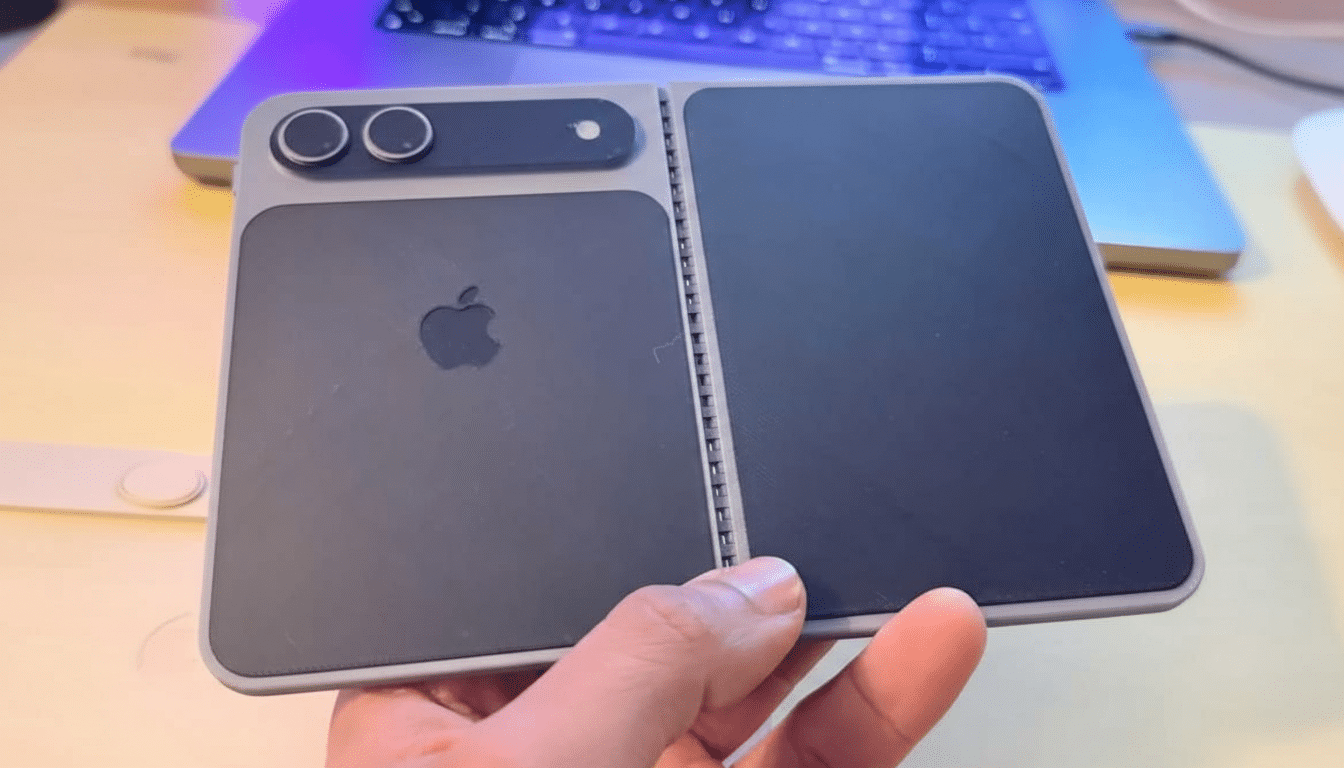
Beyond the buttons, the leak suggests the front-facing camera uses a punch-hole cutout instead of the Dynamic Island, aligning with rumors that Apple’s foldable will lean on Touch ID rather than Face ID to save interior space. On the back, two cameras are said to be arranged horizontally, a departure from recent vertical iPhone stacks. The only color referenced is white, contrasted by a black camera module for a high-contrast look. Notably, the leaker also claims the device will pack the biggest battery ever fitted to an iPhone.
As always, translation quirks and prototype variance warrant caution, but the claims fit a coherent narrative for a foldable-first design.
Why Apple might move buttons on a foldable iPhone
Button placement is about ergonomics and edges. On a book-style foldable, shifting volume keys to the top-right concentrates critical controls away from the hinge and reduces accidental presses when you grip the outer frame to open or close the device. A top cluster is also easier to locate by feel when the phone is unfolded in landscape for video, gaming, or split-screen multitasking.
The inclusion of a camera/shutter button reinforces Apple’s emphasis on quick capture from the outer display—think pocket-to-shot speed. It mirrors photography-first phones that privilege a physical shutter for half-press focus and steady framing. Apple’s recent move toward a dedicated capture control on slab iPhones makes this feel like a logical extension for a foldable form.
How cameras and biometrics could differ on iPhone Fold
A punch-hole selfie camera would simplify UI across two displays: no need to accommodate a Dynamic Island on both the cover and inner panels. While some foldables experiment with under-display cameras, image quality trade-offs remain; a conventional punch-hole preserves clarity for video calls and FaceTime, especially on the cover screen where most quick interactions happen.
Opting for Touch ID over Face ID is a pragmatic space play. Face ID’s dot projector and IR hardware are deep, and foldables are a tight packaging challenge. A side- or top-integrated Touch ID sensor—akin to the iPad Air and iPad mini—saves internal volume, reduces bezel demands, and works consistently whether the device is open or closed. It also meshes well with one-handed unlocks when grabbing the phone from a pocket or bag.

Battery size and engineering trade-offs in a foldable iPhone
The “largest ever” battery claim tracks with known foldable realities. Two displays and a larger inner panel are power-hungry, so manufacturers typically use dual-cell designs to balance weight and heat while enabling faster charge profiles. Expect Apple to prioritize longevity and thermal stability over headline charging wattage; the company’s recent devices have trended conservative on charge speeds in exchange for cycle life and safety.
A horizontal camera bar could also be about thickness management. Spreading modules laterally instead of stacking them vertically can minimize bulge, helping the device close more flush and reducing wobble on a table. It’s the kind of mechanical packaging decision Apple often makes to serve both aesthetics and balance.
Competitive landscape and market context for Apple’s foldable
Analysts at Counterpoint Research estimate global foldable shipments are now approaching 20 million units annually, with clamshells dominating volume but book-style devices driving higher average selling prices. An Apple entry would likely swing supplier roadmaps on hinges, ultra-thin glass, and foldable OLED stacks, areas where Display Supply Chain Consultants has reported increased activity and prototyping.
Durability remains the category’s proving ground. Rivals commonly rate their devices for around 200,000 folds, with some extreme tests claiming far higher. Apple will be judged on hinge rigidity, crease visibility, ingress protection, and long-term panel uniformity—areas where the company typically aims for tighter tolerances, even if it slows time-to-market. Materials like reinforced glass composites and new hinge bearings could be difference-makers.
Key signals to watch as iPhone Fold rumors consolidate
Signals to monitor as the picture sharpens:
- Supply chain chatter around side-mounted fingerprint sensors and top-edge button cutouts
- Reports of dual-cell batteries tied to a new hinge footprint
- Accessory manufacturing patterns that reveal control placement
- Software breadcrumbs, such as beta code referencing punch-hole layouts or shutter-button APIs
None of this is official, and Apple’s prototypes often evolve right up to final engineering. Still, this leak coheres: a top-right volume cluster for grip, a punch-hole to simplify dual-display UI, Touch ID to reclaim space, a horizontal camera layout for balance, and a big battery to power it all. If accurate, the iPhone Fold may feel familiar in the hand—and distinctly different where it counts.