


Google’s next video doorbell may have just revealed itself on a store shelf. A retail box for a not-yet-announced Nest Doorbell 2K was discovered, and the packaging revels in a spec bump that propels Google’s front-door camera into bonafide next‑gen territory.
What the box declares
A leaked retail unit, published by Redditor one2zerojigawat, mentions a 2K (2,048 x 2,048) HDR sensor, a 166° field of view, night vision, and two‑way audio. The square 2K resolution is interesting: it pledges more coverage, vertical and horizontal, than standard 16:9 cameras, which enables the camera to capture both faces and packages in one frame.
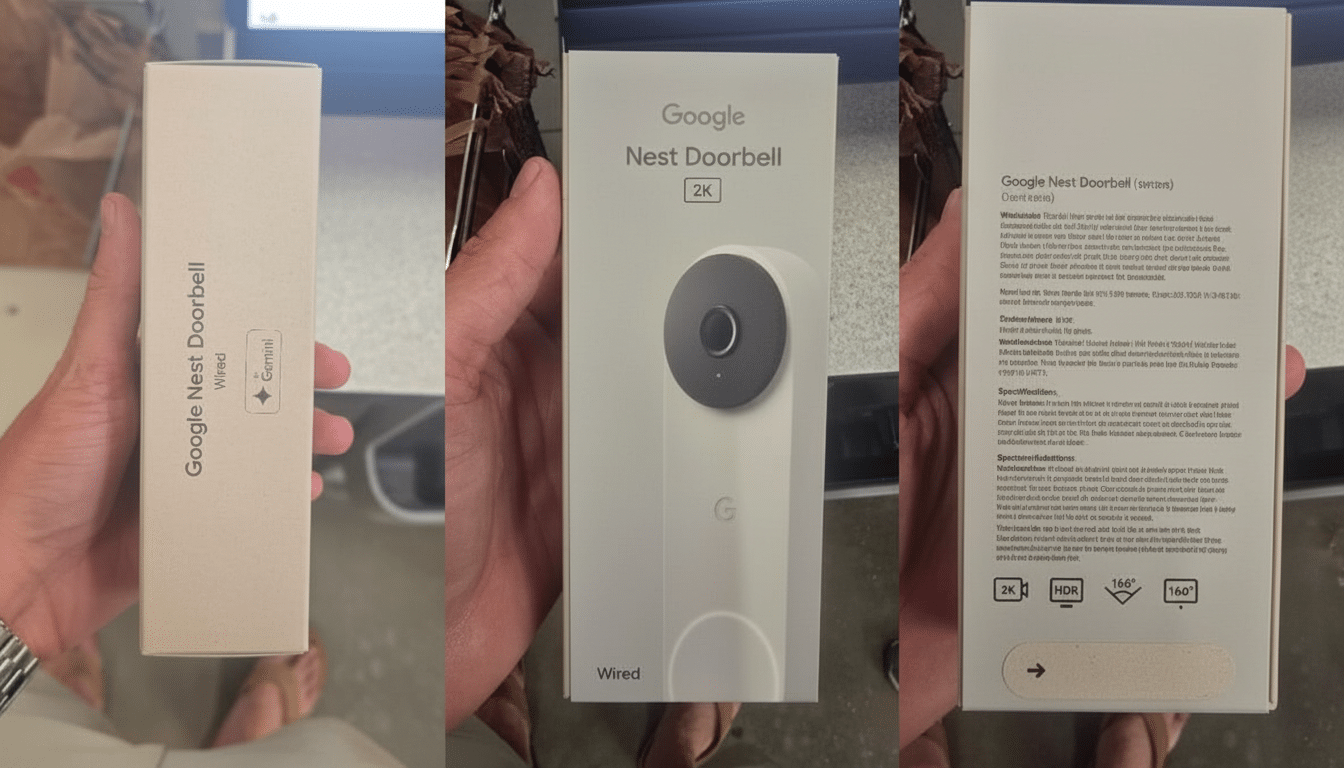
Its packaging also features the “with Gemini” badge, indicating its deep integration with Google’s AI stack within the Google Home ecosystem. The box copy says some features, including Gemini and some AI experiences, require a subscription. The model on display here comes in “Snow,” and looks like it reads “Google Nest Doorbell 2K” on the front with a reference to being the “3rd gen” on the back—perhaps a hint that Google thinks of the name in terms of resolution more than generation.
Why 2K square HDR matters at the door
But most mainstream doorbells max out at 1080p and a horizontal-first frame. It’s a 2,048 x 2,048 feed, which is a considerable jump over the HD video of the existing Nest Doorbell line. Doorstep scenarios are best served by square framing now, because it captures tall subjects (deliveries, for sure) while retaining some awareness of the periphery. HDR also works in the balancing of harsh porch light with shaded entryways, to reduce blown highlights and still maintain facial features.
That 166° field of view is also a hair better than you’ll find on a lot of rivals. For reference, Ring’s Pro 2 has that 1536p “Head-to-Toe” square video with the wide field of view, and Arlo’s wired model is going for a vertical capture of about the same. On paper, Nest’s 2K square resolution would eclipse those 1536p-class feeds with more pixels to zoom when, say, pointing it at faces at a door, or license plates of cars closer than 15ft or so, or highly-detailed labels with small packaging.
AI on the porch: Gemini’s part
The “with Gemini” bit means more than just clip sorting. Look for natural-language summaries of events, a bit more context in those notifications (“Courier dropped package and left towards the street”) and brainier inquiries inside Google Home. The day, Nest Aware plans already include familiar face alerts and expanded event history; Gemini might layer on generative elements like cross-camera event stitching or conversational responses when you review footage.
Google has taken this approach more generally to premium camera features, and that extends to the subscription note in the Top Shot box photo. Nest Aware has historically been the paywall for advanced detection and cloud history. With the acquisition complete, it is all but guaranteed that the recording service will be turned into a paid-only offering though into the future with Google Home Premium, rebranded as Home with several tiers, mirroring how rivals do original AI features for paid plans. For customers, the challenge will be to figure out which of Gemini’s capabilities camp out inside the subscription paywall, and what is left for free.
Durability and installation hints
Weatherproofing is specified, with an operating range from −4°F to 104°F (−20°C to 40°C). That’s typical of year ‑ round usage outside in many climates. The box doesn’t indicate whether that model is wired, battery powered, or supports both, an important detail that could influence installation flexibility and video uptime when the power goes out.
Assuming Google mirrors its existing tactics, there would likely be a separate wired and battery variant, each with compromises. Wired models generally have much quicker wake times and provide power constantly for always-on features, whereas battery models take the hassle out of setup and placement, but at the cost of being more aggressive with power management.
How it compares with the market
That’s high-end.
TheRing Video Doorbell Pro2 is the same resolution, and even more expensive ($250) but the Nest Smart Doorbell isn’t being launched this week.
Ring’s higher-end models and Arlo’s wired doorbells both have people detection and square video, and Nest’s spec sheet boasts more pixels and a more tightly integrated connection to a whole‑home AI assistant. For households that already have some money sunk into Google Home hardware, that combination could be compelling — assuming the subscription math makes sense.
Critics frequently note that resolution is only likely to be helpful when the \emph{bitrate} and lens quality also hold pace. And if Google marries the 2K sensor to strong compression and clean optics, doorstep identification between the human and canine should see a material improvement over older Nest generations, particularly in diverse lighting.
What we don’t know yet
Remaining open is the price, power options, local video processing, and how much AI is on tap without a subscription. It’s also anyone’s guess if onboard storage or 24/7 continuous recording will be supported (a request from power users everywhere). Google usually holds extended history and fancy recognition for paid tiers, so buyers will want to keep an eye out for plan details and any name changes given the consolidation under the Google Home banner.
That said, the retail box offers little doubt about the direction: higher resolution, wider coverage and AI as a marquee feature. If the packaging is true, the Nest Doorbell 2K will be Google’s most capable front‑door camera yet — and a sign that “smart” doorbells are rapidly becoming “AI‑first” doorbells.