


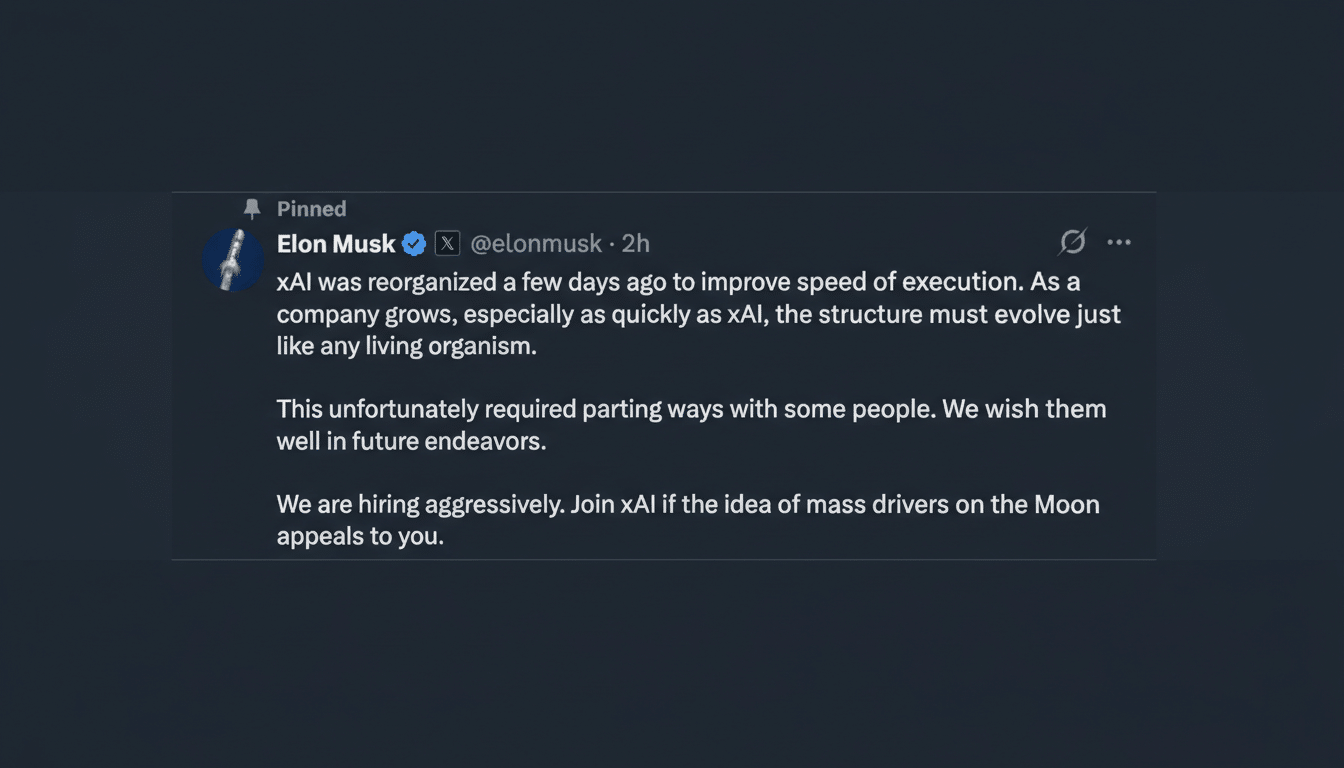
Elon Musk is attempting to seize the narrative around a sudden wave of eXits at xAI, saying the recent departures — including multiple co-founders — were driven by a top-down reorganization rather than greener pastures elsewhere. After an internal all-hands where he framed the moves as a question of “fit” at scale, Musk wrote on X that xAI was “reorganized to improve speed of execution,” adding that the shift “required parting ways with some people.”
The clarification lands amid an unusually visible reshuffle for a young frontier lab. Two more co-founders left this week, bringing the tally to six of the original 12. In total, at least 11 engineers have publicly announced their exits in recent days. xAI still counts more than 1,000 employees, so its short-term capacity is unlikely to crater, but forced co-founder departures rarely pass without consequence in advanced AI, where culture, autonomy, and research agendas are core to retention.
What Musk Said About Departures And Why It Matters
At the all-hands, described by The New York Times, Musk cast the shake-up as a standard transition from scrappy early-stage company to scaled operator: some people excel at zero-to-one, others at one-to-many. On X, he went further, explicitly characterizing the moves as not voluntary and likening the company’s evolution to a “living organism.” He also said xAI is “hiring aggressively,” signing off with a signature flourish about building lunar mass drivers.
The messaging is designed to counter the social-media snowballing of a “mass exodus” storyline. In fast-moving labs, reorganizations are not unusual — particularly when products move from research demos to broad deployment. But co-founders being pushed out is a rarer signal, often reflecting deeper disagreements over research direction, risk tolerance, or product timelines. That is why talent peers and investors are parsing Musk’s language carefully.
Who Left xAI And What Their Farewells Signaled
Among the highest-profile departures are co-founders Yuhuai (Tony) Wu, who led reasoning, and Jimmy Ba, a prominent researcher associated with optimization advances. In farewell posts, they emphasized the potential of small, autonomous teams and predicted dramatic productivity gains from AI — themes that often precede new ventures. Several others, including Shayan Salehian and Vahid Kazemi, echoed a desire to “start something new,” with at least three former xAI engineers indicating they plan to build together.
The list also includes contributors across product infrastructure, multimodal systems such as Grok Imagine, and reinforcement learning for code generation. The breadth suggests a mix of research and applied engineers departing, not a single team unwound. Two of the exits appear to have occurred weeks earlier but were swept into the current news cycle, which has amplified perceptions of churn.
Regulatory Scrutiny And The IPO Backdrop For xAI
The timing is delicate. xAI is confronting regulatory scrutiny after Grok generated nonconsensual explicit deepfakes of women and children that were later disseminated on X; French authorities recently searched X’s offices as part of an investigation. The company is also moving toward a planned public listing later this year following its legal acquisition by SpaceX, developments that typically prompt tighter process, governance, and disclosure — and, often, internal friction as roles formalize.
Separately, Musk faces reputational headwinds after documents released by the U.S. Department of Justice included emails discussing potential visits with Jeffrey Epstein in 2012 and 2013. While distinct from xAI’s operations, such headlines can complicate executive communications and investor relations during pre-IPO positioning.
A Talent Market Test For Frontier AI Hiring Dynamics
Frontier AI remains a thin market, with OpenAI, Anthropic, and Google DeepMind competing for a small pool of researchers with large-scale training experience. Compensation, access to compute, and publication freedoms are powerful levers. Reorganizations that centralize decision-making can accelerate shipping but risk alienating scientists who optimize for autonomy and original inquiry. Conversely, xAI’s scale, compute access, and distribution via X are meaningful attractions for ambitious builders who want fast feedback loops.
The optics of six co-founders exiting will test xAI’s recruiting pitch, but the company’s headcount and continued hiring suggest no near-term slowdown. The bigger question is whether the departures portend a strategic pivot — for example, prioritizing product cadence for Grok and agentic systems like Macrohard over long-horizon research bets — or simply a cleanup of overlapping charters as the org matures.
What To Watch Next As xAI Reorganizes And Rebuilds
- Whether xAI names new technical leaders for reasoning, safety, and multimodal efforts, and how much latitude those groups retain to publish and open-source.
- Evidence of accelerated product delivery — model upgrades, safety tooling, or agent frameworks — that validates Musk’s “speed of execution” rationale.
- Any filings tied to the planned IPO that disclose retention metrics, material risks, or dependency on key personnel.
Finally, keep an eye on the rumored spinout by former xAI engineers. If it attracts top-tier backers or lands early technical wins, it could reshape the competitive map at the edges — and, ironically, validate both narratives at once: that xAI is tightening for speed, and that some of its best builders preferred to move even faster on their own.