


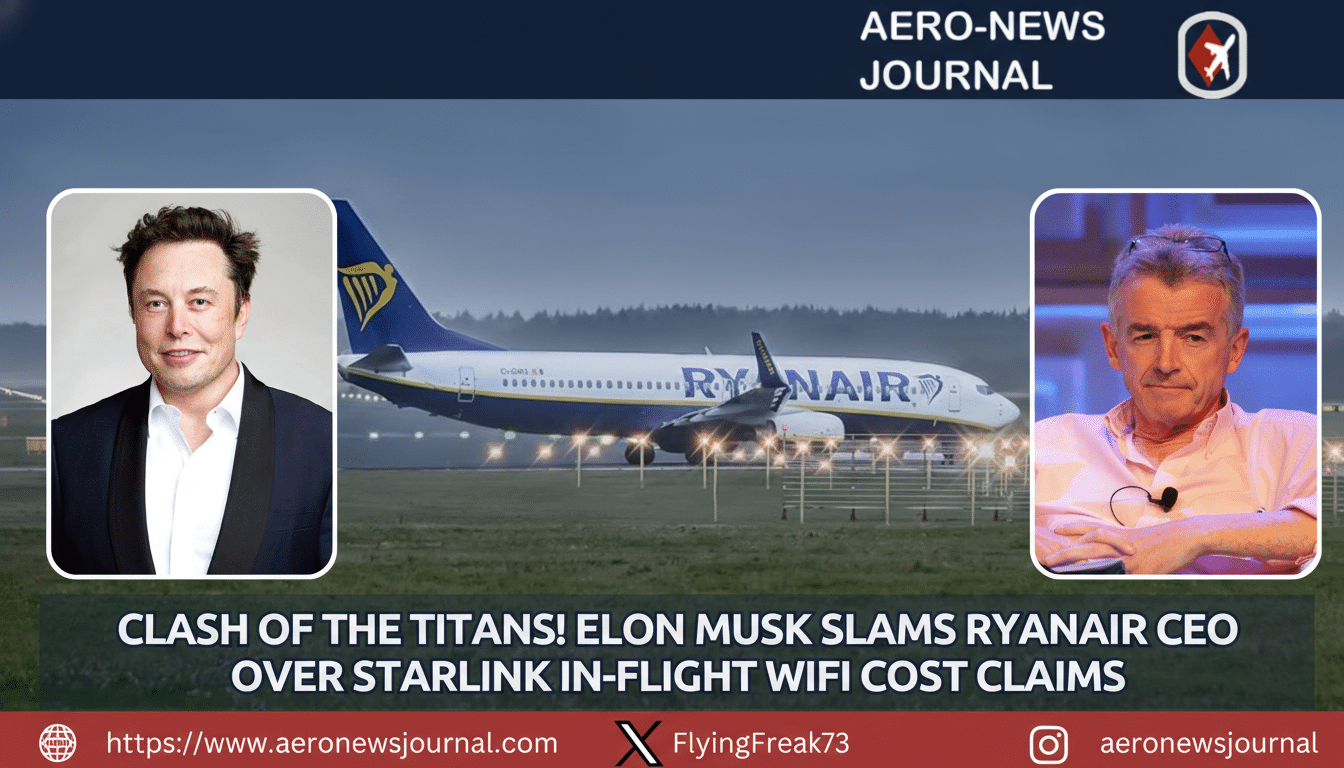
Elon Musk and Ryanair are in a high-altitude war of words over whether Starlink belongs on short-haul flights. What started as a technical disagreement about antennas, drag, and costs has erupted into personal insults, cheeky social media jabs, and even a tongue-in-cheek “seat sale” aimed at the billionaire. Beneath the theater is a serious question: does ultra-fast satellite internet make economic sense on one-hour hops?
How A Low-Cost Model Meets Satellite Ambition
Ryanair’s position is blunt. CEO Michael O’Leary has repeatedly dismissed fitting Starlink across his fleet, arguing the added antenna would increase drag and fuel burn while few passengers would pay for Wi‑Fi on short flights. He’s publicly estimated the penalty could add hundreds of millions of dollars to annual fuel costs and roughly a dollar per passenger—unacceptable in a business built on relentless cost discipline and razor-thin margins. He has also taken personal aim at Musk in interviews, escalating a corporate disagreement into a public spat.
The context matters. Ryanair flew more than 180 million passengers over the past year, largely on sectors often around one to two hours. The carrier’s model prizes weight savings, quick turnarounds, and high seat density. Adding hardware that increases drag—even marginally—must be justified by clear revenue upside or brand value. While many carriers have installed inflight connectivity, low-cost airlines historically see lower paid take-up on short routes than long-haul peers.
What Starlink Promises And The Technical Dispute
Musk counters that Ryanair’s drag claims are overstated. Starlink’s aviation kit uses a low-profile, electronically steered antenna designed to reduce drag compared with traditional Ku/Ka-band radomes. SpaceX markets high throughput—advertised up to 350 Mbps per aircraft—and latency closer to home broadband thanks to its low Earth orbit network. The pitch: quick installs, high speeds that support streaming, and performance that could let airlines offer free Wi‑Fi without crippling congestion.
Who’s right on drag and fuel? The answer depends on aircraft type, antenna profile, routes, and cruise time versus climb. Classic hump-style radomes can raise fuel burn; flatter arrays cut that penalty but don’t eliminate it entirely. SpaceX says the extra drag is minimal; Ryanair says it’s meaningful. Independent, peer-reviewed data on the newest flat-panel systems at fleet scale is limited in the public domain, which is why this argument is as much about modeling assumptions as engineering.
Several airlines have already bet on Starlink, including airBaltic, Icelandair, JSX, ZIPAIR Tokyo, and Hawaiian Airlines, with a mix of live services and announced rollouts. Their logic is that fast, reliable connectivity improves satisfaction and loyalty—and, if offered free, can drive engagement with onboard retail and advertising. Whether that playbook fits a pan-European ultra-low-cost carrier is the crux of Ryanair’s pushback.
Passenger Demand And The Paywall Problem
Paid Wi‑Fi on short-haul typically sees single-digit to low double-digit take rates, according to aviation market analysts such as Valour Consultancy. When airlines drop the paywall, usage jumps dramatically; U.S. examples show connection rates can surge when Wi‑Fi becomes free or bundled with loyalty programs. That creates a strategic fork: either charge a small fee and accept modest uptake, or offer it free and seek returns via ancillary sales and brand differentiation—while absorbing equipment and fuel costs.

Ryanair argues its customers prioritize low fares over connectivity. Surveys from industry groups like SITA and Inmarsat suggest passengers increasingly value onboard internet, but willingness to pay varies sharply by route length and price sensitivity. O’Leary has even suggested he’d reconsider if Starlink paid for the installation and the fuel impact—an invitation that underscores how tight the economics are on short sectors.
From Technical Debate To Social Media Crossfire
The conversation quickly veered off the runway. After a high-profile outage on Musk’s platform X, Ryanair mocked the billionaire online. Musk fired back with quips about buying the airline and installing a chief named “Ryan,” later posting a poll about a hypothetical purchase and using an offensive slur while calling for O’Leary’s ouster. Ryanair responded with a press conference and a jokey “idiots” seat sale, claiming the spat boosted bookings. The attention-grabbing back-and-forth obscures the quieter, spreadsheet-driven calculations that will ultimately decide whether antennas go on wings.
Could Musk Buy Ryanair? Legal And Market Odds Are Slim
For all the bluster, a takeover is far-fetched. European rules require EU-based airlines to be majority owned and effectively controlled by nationals of the EU, Norway, Liechtenstein, Iceland, or Switzerland—a constraint highlighted by outlets such as the BBC. Any change of control would also face regulatory scrutiny from aviation safety authorities and competition watchdogs. Beyond legal hurdles, Ryanair’s market value and shareholder structure make a snap purchase unrealistic.
What To Watch Next As Ryanair Weighs Starlink Economics
Expect Ryanair to keep testing the business case while leveraging the PR sparring for attention. Watch whether Starlink secures more short-haul European references and publishes independent data on drag and fuel impact for flat-panel installs. Also watch the pricing model: if more airlines move to free Wi‑Fi underwritten by sponsors, e-commerce, or partnerships, the competitive pressure on holdouts will grow.
In the end, this isn’t about who lands the sharper insult. It’s about whether high-speed inflight internet can pay its way on short flights without breaking the low-cost formula—a calculation decided by kilobits, kilograms, and cash, not tweets.