


Alibaba-backed AI startup Moonshot is pushing multimodal coding into new territory with Kimi K2.5, a model that can turn a single video of a webpage into working front-end code. The company is pitching it as a leap for “vibe coding,” where users convey intent visually rather than through detailed specs, and early demos show the system recreating layout, motion, and interactivity from nothing more than a screen recording.
How Coding From Video Works to Generate Front-End Code
Upload a short clip of a site scroll or an app walkthrough and K2.5 parses structure, components, and transitions frame by frame. The model then outputs HTML, CSS, and JavaScript that approximates the original’s look and feel, including sticky headers, scroll-triggered animations, and interactive elements. Moonshot calls this “coding with vision,” emphasizing that users can express desired behavior by showing it, not describing it.
- How Coding From Video Works to Generate Front-End Code
- Performance and Benchmarks for Kimi K2.5 Versus Rivals
- Vibe Coding in Practice for Prototypes and Workflows
- Agent Swarm and Speed Claims for Parallelized Coding Tasks
- Access, Pricing, and Availability for Kimi K2.5 Features
- Competitive Landscape and What to Watch in AI Coding Tools
In Moonshot’s own demos, K2.5 captures the aesthetic and information hierarchy convincingly, albeit with the kinds of visual slips common to AI renderings—minor icon distortions or map details that look hand-drawn. That trade-off may be acceptable for ideation and rapid prototyping, where speed to a convincing mock-up often matters more than pixel perfection.
Performance and Benchmarks for Kimi K2.5 Versus Rivals
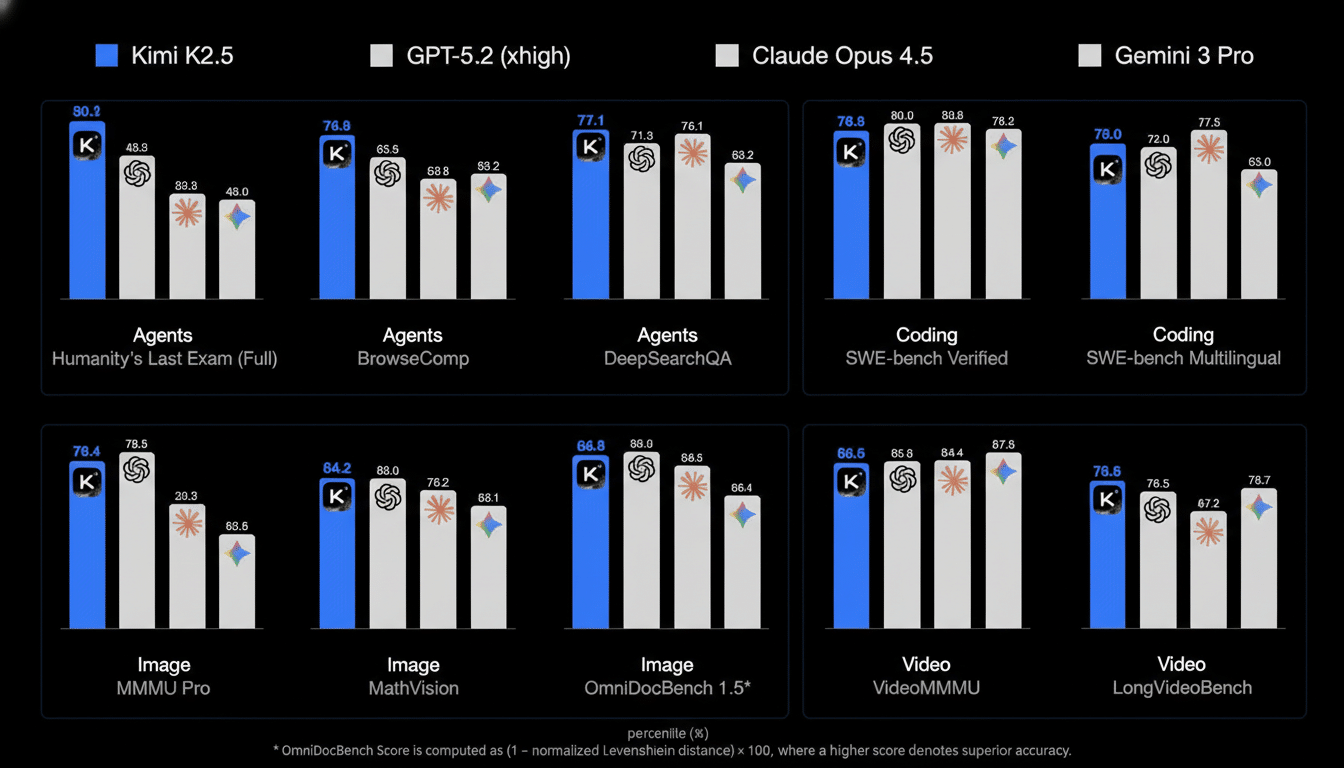
K2.5 builds on last summer’s Kimi K2 and was pretrained on roughly 15 trillion text and visual tokens, positioning it as a native multimodal model. Moonshot says K2.5 delivers coding results on par with frontier systems from OpenAI, Google, and Anthropic on the SWE-Bench Verified and SWE-Bench Multilingual benchmarks—widely used evaluations for software engineering tasks across real repositories.
Benchmarks are useful for comparing models on controlled tasks, but they rarely capture the messiness of production codebases, dependency conflicts, or design system constraints. The more consequential test will be whether K2.5 can generate code that plays nicely with enterprise CI/CD, passes accessibility checks, and withstands design iterations without collapsing into rewrites.
Vibe Coding in Practice for Prototypes and Workflows
Video-to-code unlocks plausible workflows:
- Turn a marketing team’s Loom walkthrough into a working landing page
- Convert a competitor’s motion design into an internal prototype for A/B testing
- Bootstrap a native app shell from a product demo
It also lowers the bar for non-developers to communicate intent—no Figma handoff or redline specs required.
Caveats abound. Recreating an existing site raises IP and brand risks; autogenerated layouts often miss responsiveness, accessibility, and performance budgets; and integrating dynamic data or analytics still demands engineering discipline. Expect teams to use K2.5 as a speed layer, then refine with human review, design tokens, and unit tests. That is broadly consistent with how developers already use assistants like Claude, ChatGPT, and Gemini, which can produce code from screenshots but typically require more manual assembly to reach a finished asset.
Agent Swarm and Speed Claims for Parallelized Coding Tasks
Alongside K2.5, Moonshot previewed an “agent swarm” that coordinates up to 100 sub-agents to attack multi-step jobs in parallel—think multi-file refactors, integration tests, or multi-view component updates. The company reports internal evaluations with up to an 80% reduction in end-to-end runtime compared with a single agent executing steps sequentially.
Parallelism can accelerate throughput, but it also introduces orchestration overhead and potential conflicts across files or frameworks. The key question is whether the swarm can maintain determinism and code quality at scale—areas where research groups and industry labs alike continue to iterate.
Access, Pricing, and Availability for Kimi K2.5 Features
K2.5’s coding features are available through the Kimi Code platform and plug into developer environments including Cursor, VS Code, and Zed. The model is accessible via Kimi’s web app and API, with the agent swarm offered as a beta option for customers on the Allegretto and Vivace tiers, priced at $31/month and $159/month.
Competitive Landscape and What to Watch in AI Coding Tools
Moonshot’s bid enters an increasingly crowded arena where Anthropic’s Claude, OpenAI’s GPT-4 class models, and Google’s Gemini are vying for developer mindshare. The differentiator here is the single video-to-code step that compresses design handoff into a visual prompt. If that behavior proves reliable in real workflows, expect rivals to roll out similar capabilities fast.
Watch for hard evidence beyond demos:
- Reproducible benchmark suites for video-to-UI generation
- Accessibility and performance audits of generated sites
- Enterprise controls around data retention for uploaded videos
If K2.5 can meet those bars while keeping costs predictable, vibe coding may evolve from a flashy demo to an everyday tool in the product pipeline.