


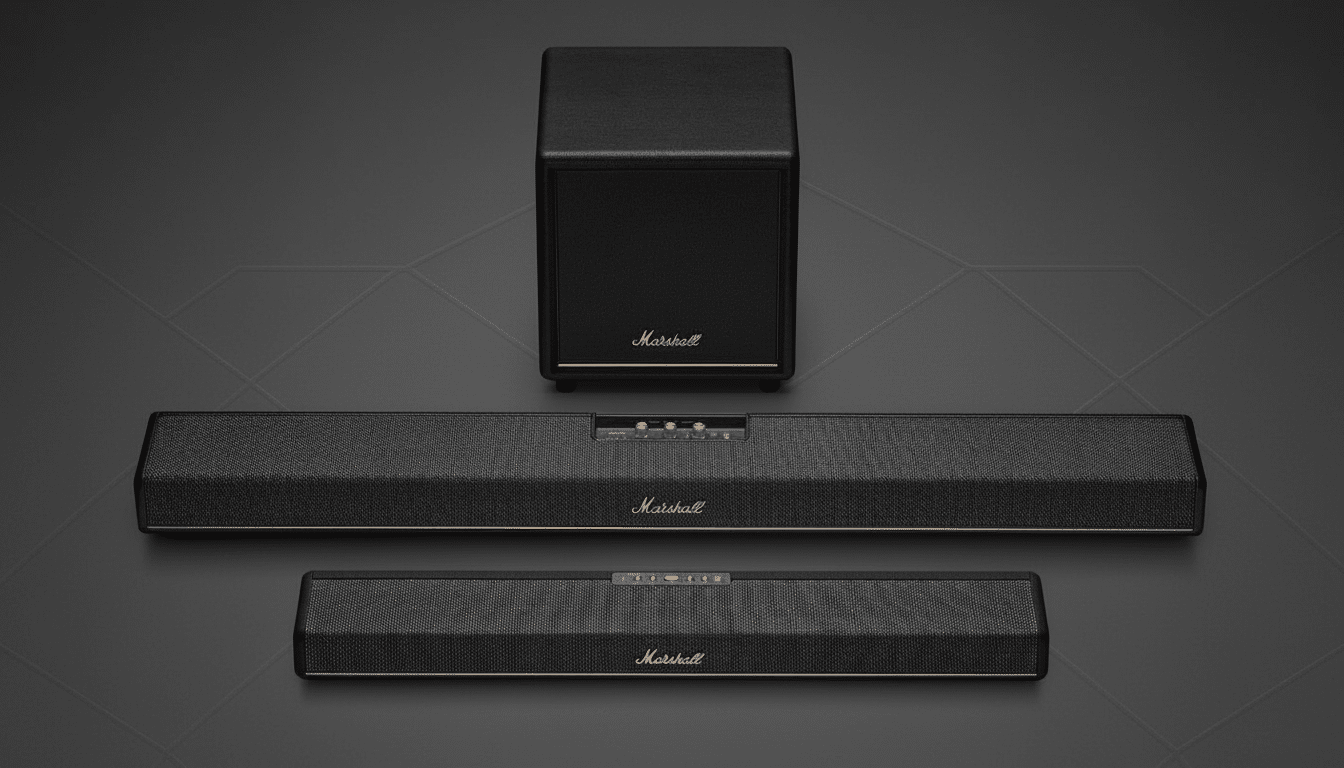
Marshall is expanding its home theater offering with the Heston 60 soundbar and Sub 200 subwoofer, a pair designed for smaller living rooms but big cinematic boom.
Each is priced at $699.99 for the soundbar and $599.99 for the sub (available in classic black or, typical of the brand, its signature cream finish), a rare, decor-friendly move when it comes to TV speakers.
Design made for real rooms and flexible placement options
The Heston 60 brings Marshall’s initial soundbar idea to a smaller-than-before 28-inch-wide chassis (aimed at 43- to 55-inch TVs) while retaining the identifiable guitar-amp stylings of its brand.
A crafty mounting scheme also allows you to sit this soundbar atop a media console or mount it on your wall; as set up, the grille faces skyward, while the logo plate and control face can switch magnetically so everything matches.
It’s a more digestible version of the larger Heston 120 (43 inches wide) that aims at bigger rooms and screens. The idea, clearly, is to offer a smaller footprint while maintaining the premium experience, not short shrift.
Audio formats, streaming, and smart connectivity touches
The Heston 60 ticks the right boxes, for all its bulk. It is compatible with Dolby Atmos and DTS:X as well, but instead of using dedicated up-firing drivers, it employs a 5.1-channel configuration with virtual height processing. In other words, you’ll hear above-you effects without the ceiling-bounce hardware used by 5.1.2 systems. And in many living rooms with reflective ceilings and typical seating distances, virtualization can be remarkably convincing, according to guidance from Dolby.
Music streaming is as up to date as it gets: Apple AirPlay, Google Cast, Spotify Connect, and Tidal Connect all hitch a ride on Wi‑Fi; Bluetooth takes care of fast handovers. Automatic room calibration with built-in microphones retunes bass and mids to fit a variety of rooms—an approach now common among high-end soundbars since room acoustics tend to be about half the sound you pay for, as AES and CEDIA training materials have repeatedly driven home.
Physical connectivity is pragmatic. Legacy sources from CD players to turntables with preamps can connect via a 3.5mm analog input, and if you own a wired sub then you’ll get some added grunt thanks to a dedicated subwoofer output. There’s no second HDMI input for passthrough, so gaming consoles and streamers should connect to the TV, not the bar. And an Ethernet jack is of course nowhere to be found on this model. Knurled knobs give way to straightforward buttons on the Heston 120 to keep the footprint tidy.
One forward-looking feature is a standout: Bluetooth Auracast. The Bluetooth SIG’s broadcast-audio tech also allows sharing to multiple devices at once. Marshall says the Heston 60 will add support for certain Marshall speakers to be used as wireless surrounds using the tech, though timing on when that would come wasn’t confirmed.
Sub 200: small, potent, and not locked down
Marshall’s first home-theater subwoofer has been designed specifically for wireless collaboration with both the Heston 60 and Heston 120, but is also a good citizen on a mixed system. On the back, a standard RCA input means you can pair it with third-party AV receivers, integrated amps, or soundbars (provided they accept sub-out), welcome news in a category where many wireless subs are brand-locked.
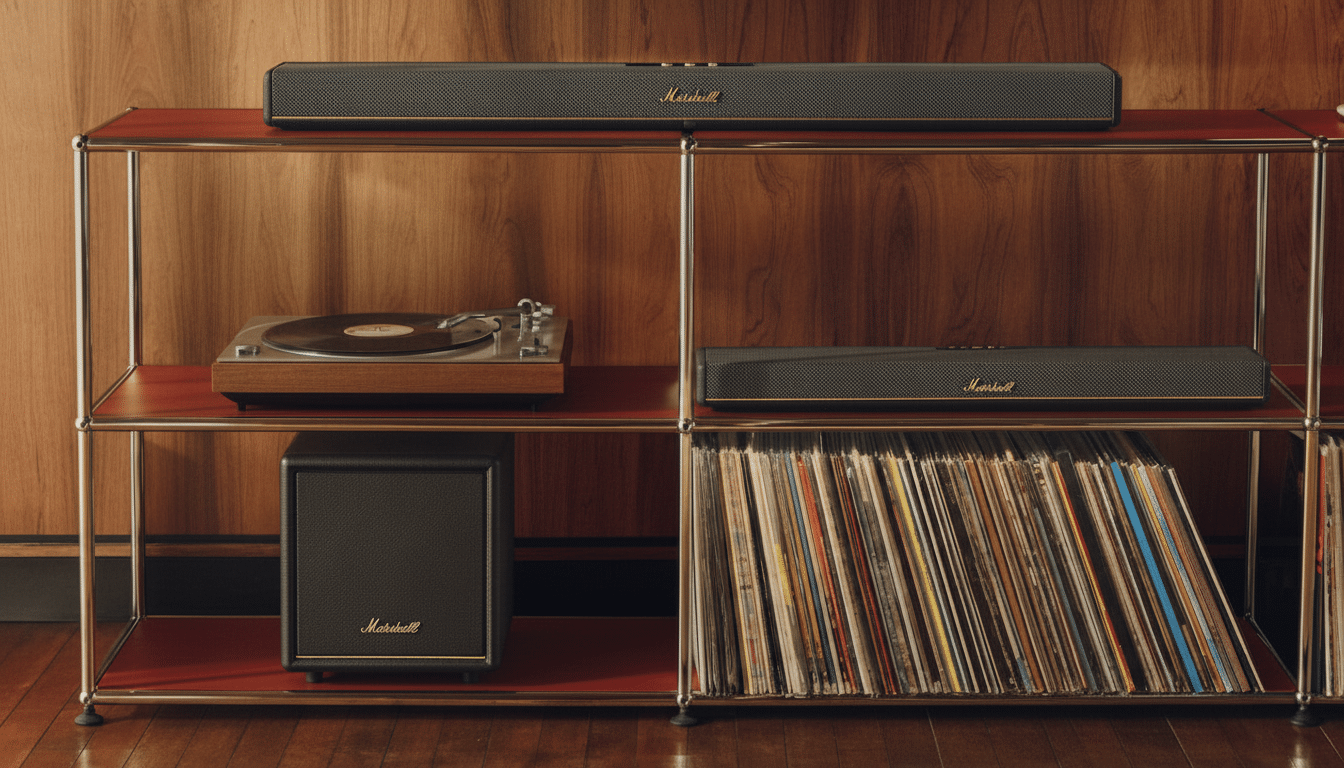
To keep the cabinet to roughly an 11-inch cube, Marshall has gone with two 5.25-inch woofers, rather than one larger driver, each amped at 120 watts apiece. The company states 99 dB of output and a 30–150 Hz frequency response. Thirty hertz doesn’t dip into the sub-infrasonic range — some movie-theater-centric subs reach down to the teens — but this low end should produce satisfyingly boomy bass for apartments and midsize rooms without driving neighbors crazy.
But the controls are simple on purpose: there’s a knurled level knob with an LED ring for easy visual feedback. There’s not any phase adjustment onboard, but most setups will be okay with that, thanks to positioning flexibility and the Heston bars’ tuning tools.
How it compares with rivals — and who it’s really for
The Heston 60 sacrifices some raw muscle — coaxing 56 watts peak versus the Heston 120’s 150 watts peak — and transitions from a preferable 5.1.2 array to instead produce an impressive-sounding virtual height. “It features a five-channel speaker that uses virtual height, which is unique for a soundbar at this price point,” said Boseman compared with the $1,299.99 Heston 120.
It does not, however, have the larger model’s HDMI input and Ethernet. In exchange, you get a smaller, living room-friendly bar that is still compatible with upper-end formats and whole-home streaming.
The Heston 60 plus Sub 200 ends up around $1,300 for the pair, which is higher than common bundles like a Sonos Beam Gen 2 with Sub Mini, but that gets you brand-agnostic sub connectivity and an idiosyncratic industrial design.
For shoppers who care as much about furniture-grade looks as they do about Atmos, the cream finish and amp-inspired details will be a plus.
Another angle: repairability. Marshall tells me that major components on both the soundbar and sub—driver modules, boards, grilles, and external trims—are replaceable. That position is in sync with the right-to-repair momentum seen from groups like iFixit and consumer advocates in both the EU and U.S., and could appeal to consumers tired of disposable electronics.
Early takeaway on Marshall’s Heston 60 and Sub 200
Meanwhile, smaller rooms can go big with Heston 60, which brings the brand’s badass looks and modern streaming to a space without gutting features; or Sub 200 for bass that will outlive one ecosystem. If you’re looking for a compact, Atmos-ready bar with genuine design flair — and don’t need passthrough HDMI — there’s very little to argue against the new Marshall duo making its way onto your living room short list.