


A deep-red Moon is on the way. A total lunar eclipse will unfold slowly across the night, safe to watch with the naked eye, and it will favor pre-dawn skywatchers in North America while offering evening views across eastern Asia and Australia. Weather permitting, hundreds of millions will have a shot at the spectacle.
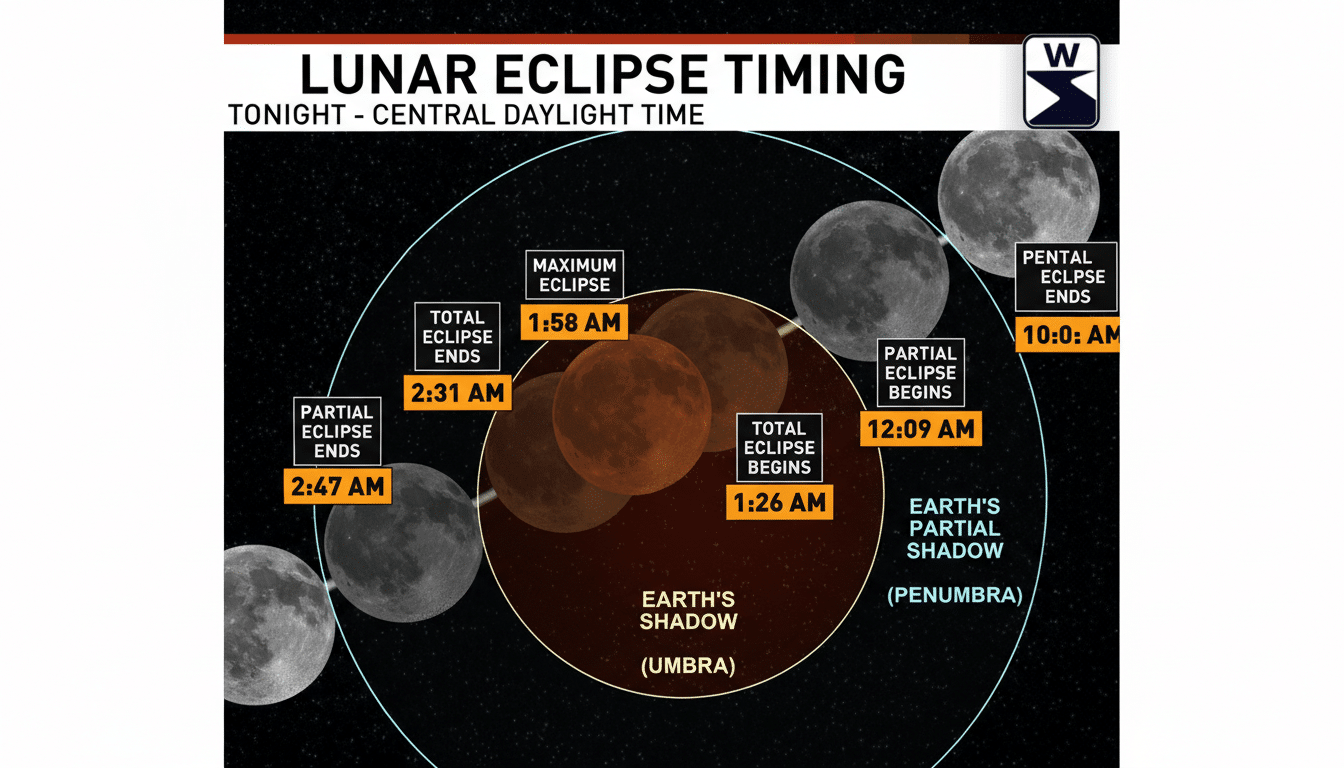
Unlike a solar eclipse, which demands precise timing and protective eyewear, a lunar eclipse is leisurely and accessible. The full show spans roughly five and a half hours from the first subtle shading to the last hint of shadow, with about an hour of totality when the entire lunar disk turns a coppery red.
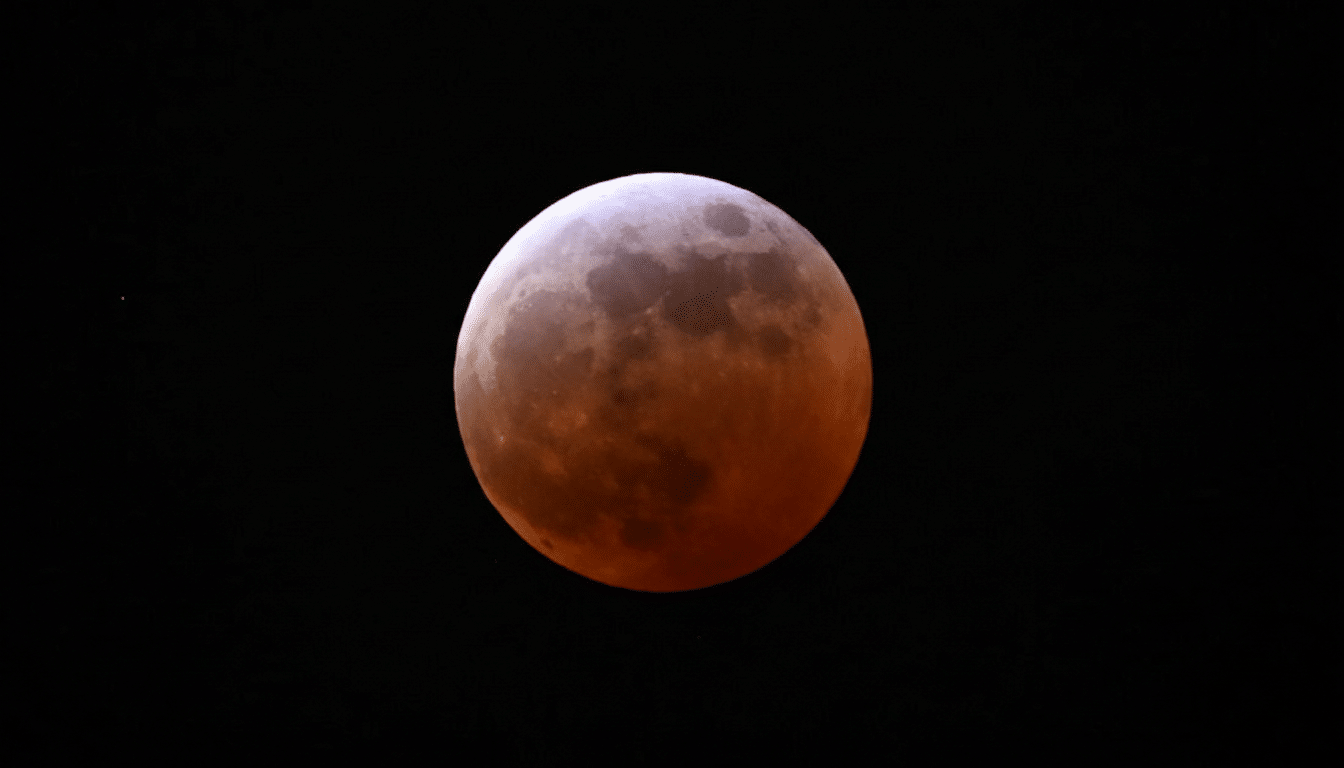
The crimson hue appears because Earth’s atmosphere acts like a lens and filter. Shorter blue wavelengths scatter, while red and orange light curve through the atmosphere and onto the Moon’s surface—a planetary-scale version of sunrise and sunset wrapped around Earth’s limb.
Where and when the lunar eclipse will be visible to you
Best placed are observers across most of North and Central America, where the eclipse plays out before dawn. In the eastern time zones, totality occurs with the Moon low toward the western horizon; farther west, the Moon sits higher and the view lasts longer before daybreak brightens the sky.
Across eastern Asia—Japan, Korea, Taiwan, and coastal China—the event arrives during the evening, ideal for casual viewing after sunset. Australia and New Zealand also get a prime-time show, with the Moon climbing as the shadow deepens. Throughout the Pacific basin, island communities can watch the entire sequence arc overhead through the night.
This one largely skips Europe and Africa, where the timing keeps the Moon below the horizon during the key phases. Even so, eclipse calculators used by NASA and independent skywatching services estimate that more than 40% of the global population lies within the footprint for totality or at least a substantial partial phase.
What to watch for during each stage of the lunar eclipse
The eclipse unfolds in stages. First comes the penumbral phase—a faint, smoky dimming that’s easy to miss. Then the umbra’s edge cuts a clean, dark “bite” into the Moon. As the shadow swallows the disk, totality begins and the color swing accelerates from pewter to rust to ember red.
Expect the sky to turn richer too. With the full Moon’s glare suppressed, fainter stars pop, and the Milky Way may even hint into view from dark sites. The Moon sits against the backdrop of the constellation Leo, near the bright star Regulus, adding an easy signpost for binocular users.
Brightness varies from eclipse to eclipse. Atmospheric clarity on Earth—haze, wildfire smoke, or volcanic aerosols—can make the Moon either deep brick-red or a lighter copper. Observers often rate the glow on the Danjon scale (L0 to L4). Planetary scientists at NASA watch these changes as a natural probe of Earth’s upper atmosphere.
How to see and photograph the lunar eclipse safely
No special gear is required—just an unobstructed view and cooperative weather. In the Americas, aim for a clear western horizon; in Asia and Australia, look east as the show begins and follow the Moon upward. Darker surroundings heighten the color, but even urban observers can enjoy the main act.
Binoculars or a small telescope sharpen the shadow’s edge and reveal delicate color gradients along the lunar maria and craters. For photos, brace your smartphone or camera on a tripod, use night or low-light mode, and tap to focus on the Moon. Short exposures during the partial phase preserve detail; longer exposures during totality bring out the deep reds and the surrounding starfield.
If you want exact local circumstances—how high the Moon will be and when each phase starts and ends in your location—consult trusted sources such as NASA’s eclipse predictions, the U.S. Naval Observatory, or professional almanacs compiled by observatories and national meteorological services. These tools translate the global geometry into city-by-city guidance.
Why this total lunar eclipse matters for skywatchers
Total lunar eclipses are among the most democratic sky events: they require no tickets, last long enough to share with family or a classroom, and vividly demonstrate orbital mechanics in plain sight. For many regions ringing the Pacific, this is the most accessible “blood moon” in years—an event where science, spectacle, and simple curiosity meet on a single stage.