


One of the year’s sharpest gaming monitor deals just landed, with the 27-inch LG UltraGear OLED dropping to $499.99 at major retailers. That is $400 off the typical $899.99 list price, matching its best-known low and pulling a flagship-class panel into midrange money territory.
Why This LG UltraGear OLED Deal Truly Stands Out
OLED gaming monitors have usually lived at the $800 to $1,000 mark, even for 27-inch models. Seeing a bona fide 1440p OLED at $499.99 resets the value equation. In this range, shoppers are typically weighing speedy IPS displays. Here, you get OLED’s contrast and motion clarity along with a 240Hz ceiling—something that, until recently, cost hundreds more.
- Why This LG UltraGear OLED Deal Truly Stands Out
- Key Specs That Matter for Competitive PC Gaming
- Console and PC Flexibility With High-Refresh Support
- Burn-In Concerns Addressed With Modern OLED Safeguards
- How It Stacks Up Against Rivals at This $499.99 Price
- Who Should Buy This OLED and What to Expect at 1440p
- Bottom Line: An Excellent OLED Gaming Monitor Value
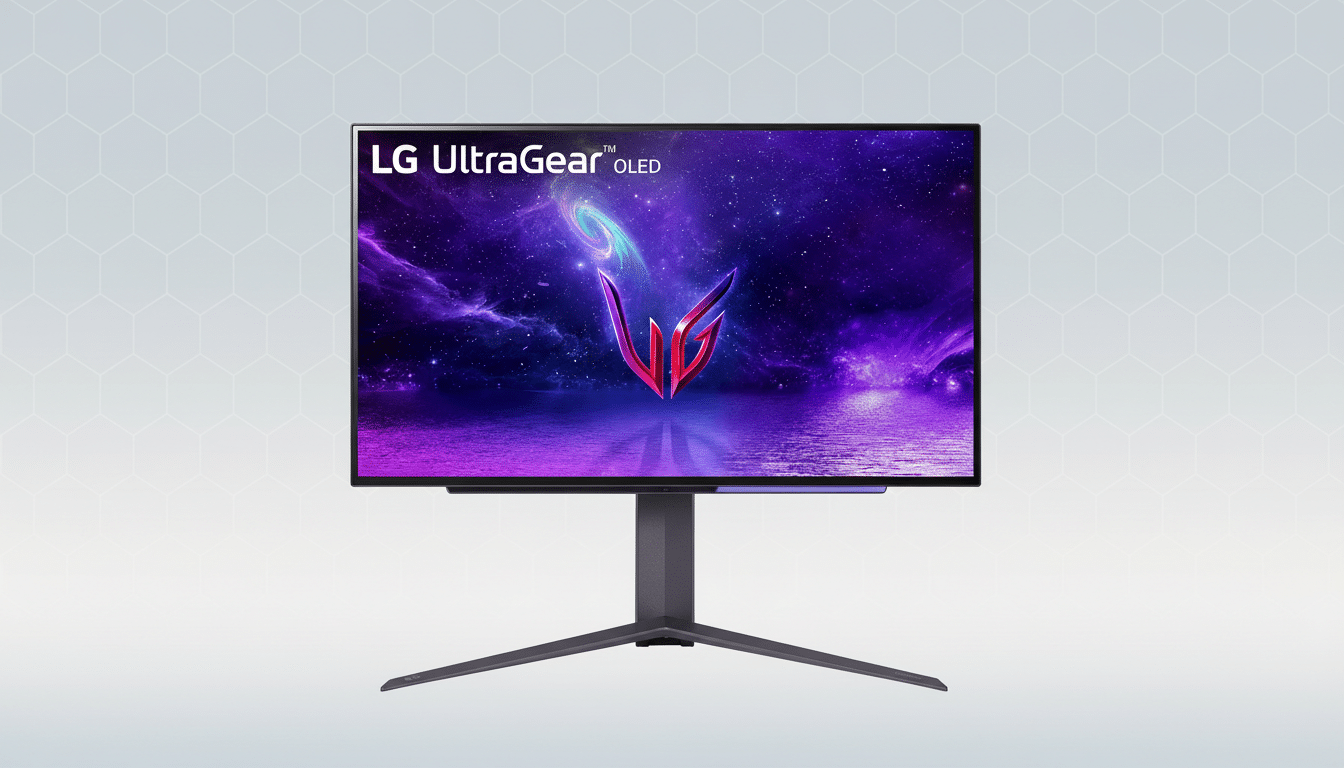
Price aside, the LG UltraGear line carries a strong track record with esports players and visual purists. Independent outlets like RTINGS and PCMag have consistently highlighted the series’ near-instant response times, deep blacks, and low input lag—core traits that directly affect moment-to-moment play.
Key Specs That Matter for Competitive PC Gaming
At 2560 x 1440, 27 inches is a sweet spot. You get a dense pixel grid without the heavy GPU tax of 4K, easing stable high frame rates in competitive titles. Valve’s Steam Hardware Survey has shown QHD adoption steadily climbing among PC gamers, a trend that aligns with this panel’s spec sheet.
The OLED panel’s per-pixel lighting yields effectively infinite contrast and true blacks, which makes dark scenes in games like Alan Wake 2 or Diablo IV feel more dimensional than on even the best IPS screens. A 240Hz refresh rate paired with a quoted 0.03ms response time delivers razor-sharp motion. Variable refresh rate support—AMD FreeSync Premium Pro and G-SYNC Compatible behavior—helps smooth out dips without stutter or tearing.
HDR is another quiet win. While sustained brightness on 27-inch OLEDs trails mini-LED, highlights can pop dramatically, with small bright elements pushing into the upper hundreds of nits and, in favorable scenes, approaching the four-figure peaks reported in lab testing. Wide color coverage near-full DCI-P3 means better saturation for modern game art and creator workflows.
Console and PC Flexibility With High-Refresh Support
The UltraGear’s input mix supports high-refresh gameplay across platforms, including 120Hz modes on current-gen consoles via HDMI and 240Hz on PC over DisplayPort. If you split time between a desktop and a PS5 or Xbox Series X, the 27-inch form factor and QHD resolution are a practical fit for a desk setup without overwhelming viewing distance.
Burn-In Concerns Addressed With Modern OLED Safeguards
Modern OLED monitors bake in panel care tools to mitigate image retention, including pixel shifting, logo dimming, and scheduled pixel refresh cycles. Long-running endurance tests from outlets like RTINGS indicate newer OLED generations handle static content better than early panels, though sensible habits—hiding HUDs when possible, enabling screen savers, and using taskbar auto-hide—remain smart practice. Warranty terms for OLED wear vary by region, so it’s worth checking the fine print where you buy.
How It Stacks Up Against Rivals at This $499.99 Price
Rival 27-inch OLEDs and QD-OLEDs with similar or faster refresh rates often hover between $699 and $999. Examples include Alienware’s AW2725DF and MSI’s 360Hz QD-OLED entries, which are excellent but far pricier. High-end IPS alternatives, such as 240Hz 1440p models from ASUS and Acer, still cannot match OLED’s black levels and instantaneous pixel response. At $499.99, the LG essentially leapfrogs that IPS group on image quality while staying competitive on speed.
Who Should Buy This OLED and What to Expect at 1440p
If you play fast shooters, racers, or MOBAs, the 240Hz ceiling and ultra-low latency are tangible upgrades. Single-player fans get richer HDR, perfect blacks, and no glow in moody set pieces. Creators who color grade for web or SDR will appreciate the wide gamut, though absolute HDR mastering still favors brighter mini-LED pro panels.
For GPU pairing, cards in the class of a GeForce RTX 4070 or Radeon RX 7800 XT are well-suited for 1440p high-refresh play, but VRR helps even midrange hardware feel smooth. While 360Hz and even 500Hz displays exist, testing by publications like PCMag and esports analysts suggests diminishing returns for most players beyond 240Hz—making this panel a well-judged upper limit for the price.
Bottom Line: An Excellent OLED Gaming Monitor Value
This is the rare OLED monitor deal that marries elite picture quality, competitive speed, and a price that undercuts many premium IPS models. At $499.99—$400 off and 44% below list—the 27-inch LG UltraGear OLED is an easy recommendation for PC and console gamers who have been waiting for a justifiable leap to OLED without stretching the budget.