


I got hands-on time with Lenovo’s latest concept at Mobile World Congress, and it instantly reframed what a laptop can be. The ThinkBook Modular AI PC looks like a polished 14-inch business notebook from the front, but a quiet revolution is happening on the back and inside. It’s modular, magnetic, and genuinely useful in ways most show-floor prototypes aren’t.
A Concept That Feels Surprisingly Practical
Lenovo has a history of crowd-stopping experiments, from dual-screen prototypes to transparent panels. Many were “look, don’t touch” showcases. This one feels different because it behaves like a regular laptop until you start reconfiguring it. The design is thin and professional, yet its components invite you to rearrange your workspace in seconds.
- A Concept That Feels Surprisingly Practical
- A Second Screen Hidden In Plain Sight On the Lid
- Ports That Move With You To Fit Any Workspace
- Specs Are Secondary But Telling About Priorities
- Why It Matters In The AI PC Era For Workflows
- How It Compares To Other Modular Plays Today
- Early Impressions And Practical Caveats To Note
- The Bottom Line On Lenovo’s Modular AI PC Concept
A Second Screen Hidden In Plain Sight On the Lid
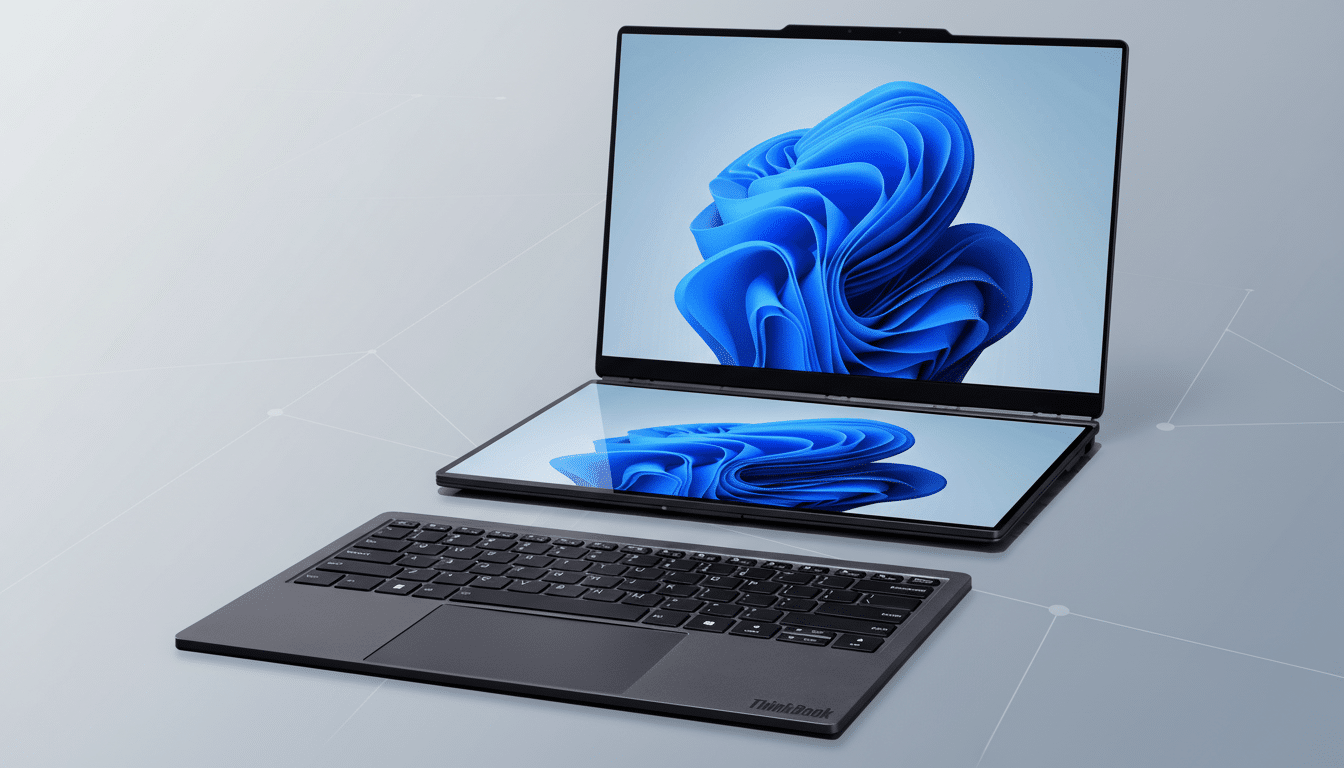
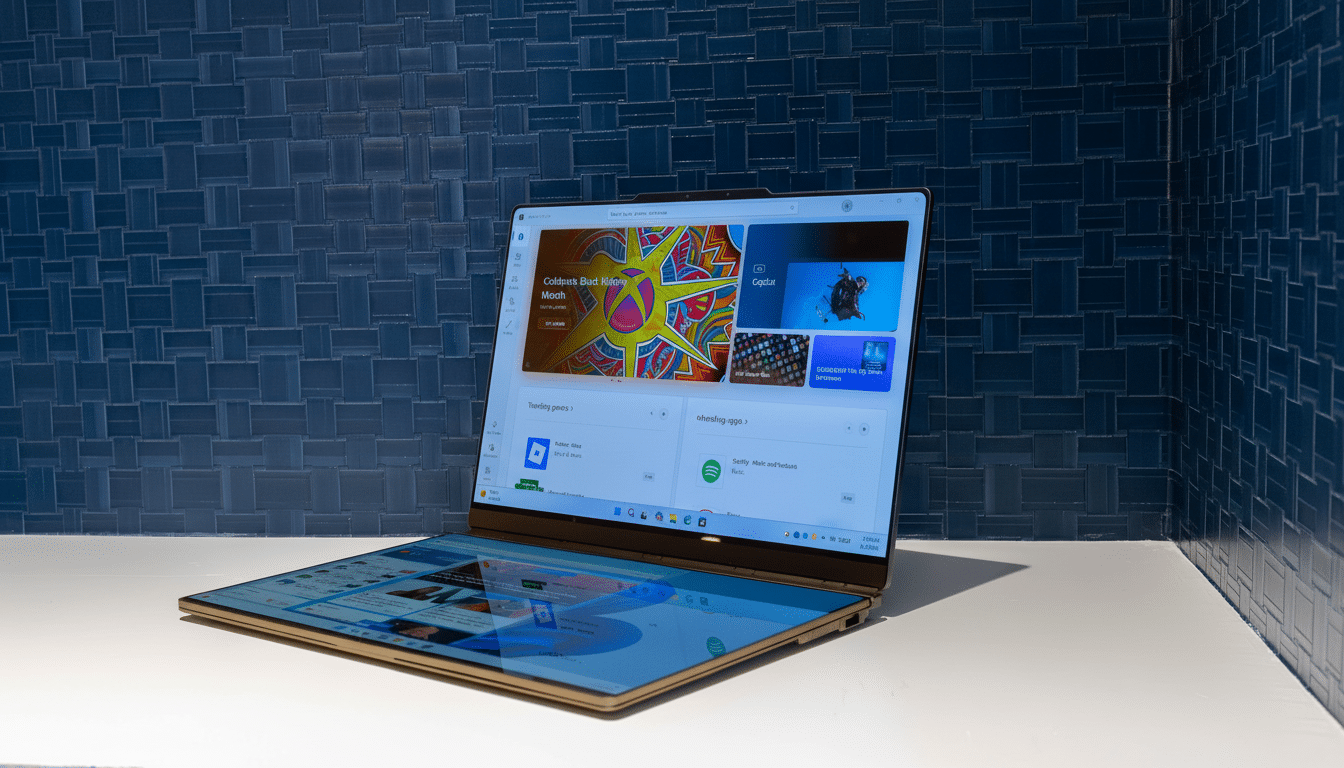
Attached flush to the rear lid via pogo pins is a second 14-inch display that’s nearly invisible until you know it’s there. Flip the laptop toward a client across the table and you’ve got an instant mirrored view without awkward swiveling. Pop it off and it becomes a portable monitor with a kickstand, usable in portrait or landscape. It draws juice from a compact pogo-pin power adapter, so it’s travel friendly without tethering you to a dock.
The cleverness continues inside. The primary keyboard lifts out, letting you slot in that second panel in its place for a stacked dual-screen rig while the keyboard works wirelessly. It’s a riff on dual-screen productivity—think Yoga Book 9i—but with more flexibility. According to Jon Peddie Research, multi-display setups can drive productivity gains of ~42%, and this is one of the most portable takes on that benefit I’ve seen.
Ports That Move With You To Fit Any Workspace
Equally smart are the swappable I/O modules. USB-A, USB-C, and HDMI blocks can shift from left to right depending on your desk layout, hotel room constraints, or docking orientation. There’s even a tiny carry case so the pieces don’t wander off. It’s the kind of low-drama fix that solves real-world annoyances—no more adapters jutting out at the wrong angle, no more cable spaghetti fighting for space.
Specs Are Secondary But Telling About Priorities
Under the hood, the concept ran on an Intel Core Ultra 7 255H with an onboard NPU, paired with 32GB of memory and a 1TB PCIe SSD. The headline compromise is the 33Wh battery, which is small by modern 14-inch standards and unlikely to sustain long dual-screen sessions. Still, concept hardware is about proving interaction models, not final endurance figures, and Lenovo has room to iterate.
Why It Matters In The AI PC Era For Workflows
As AI PCs take shape—IDC projects they’ll represent a majority of shipments by 2027—the conversation is shifting from raw specs to adaptable workflows. Local AI features like automatic note capture, context-aware windowing, and on-device summarization become more valuable when the system itself can rearrange around your task. A detachable client-facing display makes sense for sales walk-throughs, design reviews, and telehealth triage; a stacked dual-screen mode benefits developers, analysts, and video editors. Modularity isn’t a gimmick when it unlocks distinct roles in the same chassis.
How It Compares To Other Modular Plays Today
We’ve seen modularity from Framework’s user-repairable laptops and Lenovo’s own ThinkBook Plus experiments, but this concept tackles a different problem: fluid collaboration and layout agility. Rather than focusing on user-serviceable internals, it’s about magnetic, desk-friendly reconfiguration. It feels like a pragmatic midpoint between radical prototypes and shipping dual-screen machines.
Early Impressions And Practical Caveats To Note
In practice, the magnetic mounts felt secure and the UI transitions were drama-free—no odd scaling bugs or input confusion during quick swaps. The detachable display’s kickstand is sturdy enough for airline trays and hotel desks, and the wireless keyboard didn’t introduce noticeable latency. That said, a higher-capacity battery system, smart charging for the second screen, and robust hinges will be critical if this goes retail. Durability testing—especially for pogo pins and magnets—will make or break the experience.
The Bottom Line On Lenovo’s Modular AI PC Concept
Plenty of concept laptops impress, then fade. This one sticks because it solves day-one problems with believable hardware. It’s easy to imagine elements of this design trickling into production ThinkBooks—particularly the movable ports and detachable rear display—just as past showpieces informed later models. If Lenovo can scale battery life and nail reliability, this modular AI PC could make today’s clamshells feel, well, a little last decade.