


After spending a few months in the company of Gemini, ChatGPT, Copilot, and half a dozen niche bots, I was looking at an assistant that seemed designed for quotidian use rather than maximal single-prompt capability.
Lenovo’s latest Qira does more than talk. It reaches from phones to PCs to tablets, and even a new wearable from Motorola, performing multi-step tasks across apps and devices with context that you can really see and trust.
- Why Qira Is Different From Chatbots You Already Use
- Ambient Intelligence Across Devices and Platforms
- On-Device First With Sensible Privacy and Security
- A Wearable That Gets Shit Done With Qira Integration
- How It Compares to ChatGPT, Gemini, and Copilot
- Availability and What to Watch Next From Lenovo Qira
Why Qira Is Different From Chatbots You Already Use
Many assistants are great at answers, but weak on action. Qira is established as an agent that gets workflows finished, beginning to end, offline — you pick up a file on one of the devices, open an app without pause or reflection (“is this right?”) but one that tends to be the best choice once it is opened; click through to the right contact and finish the job without further nudging. In demos, Qira nailed ride-hailing and messaging without a user having to touch the phone, showing every step of its reasoning so users can see what’s going on.
That visible “action trace” matters. With today’s chatbots, more often than not a firm answer can hide an error — until it ends up wasting your time or money. Qira replays what — exactly which app it opened, what it typed, what it submitted — in an attempt to ward off blind trust. It’s as though you can write off a helpful intern but not a ghostwriter you can’t audit.
Ambient Intelligence Across Devices and Platforms
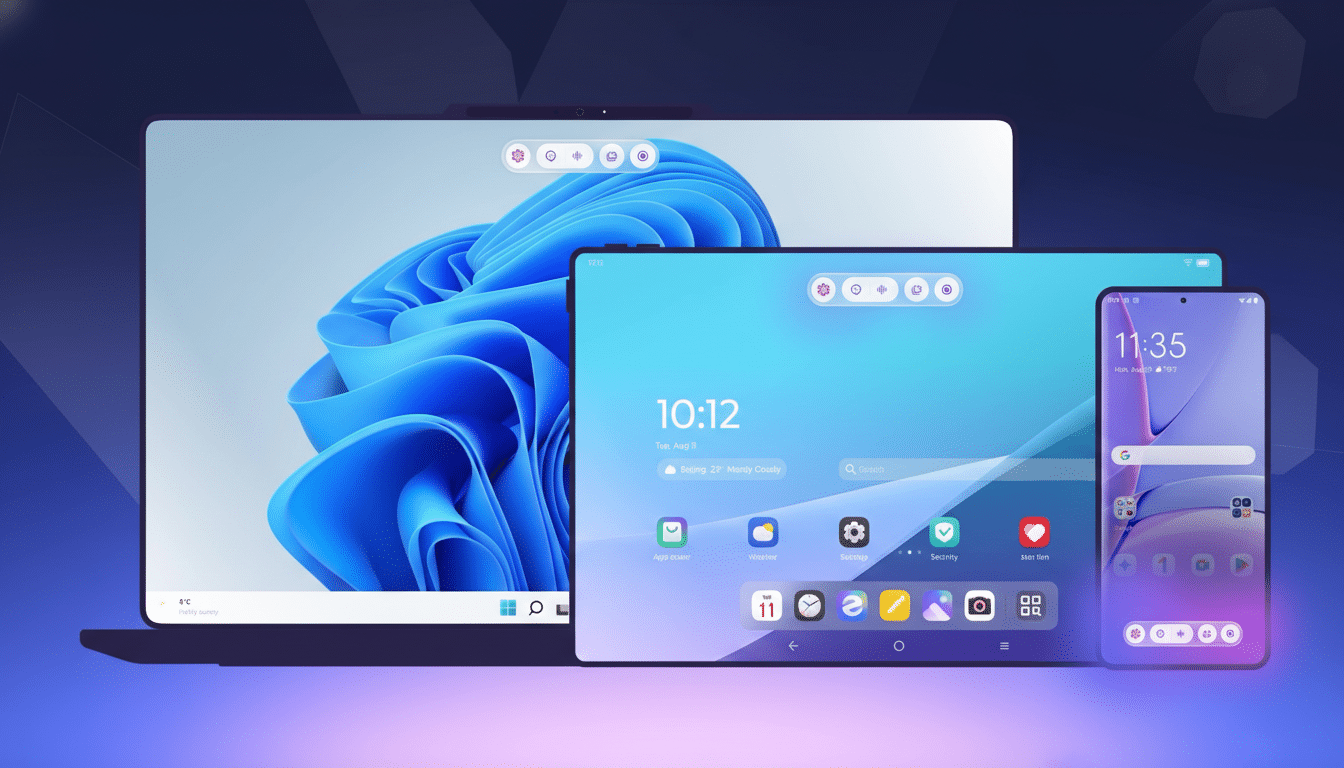
Lenovo describes Qira as an “ambient intelligence,” rather than a single app. Leveraging user-sanctioned interactions and documents across your Lenovo and Motorola hardware, the system assembles a fused knowledge base, which it also leverages to predict what you may want next. Two examples point to the worth: Next Move offers recommendations based on what you’re doing now, and Catch Me Up covers missed activity across apps and devices.
The cross-device thread is critical. Analysts have long mentioned that fragmented workflows are the enemy of productivity, and McKinsey recently found generative AI drives near-term gains by accelerating knowledge work across apps and repositories. Qira is designed to hover above that sprawl, allowing for the elimination of manual context switching, which conventional assistants are seldom very good at addressing.
On-Device First With Sensible Privacy and Security
Qira’s architecture is on-device biased by default, maintaining personal information locally and reaching to the cloud with protections as needed. That dovetails with the wider move to NPUs for PCs and phones — running inference locally cuts latency and exposure. This hybrid model is now table stakes for privacy-conscious users — including regulated industries — but too many assistants still treat this as an afterthought.
Lenovo, for instance, also highlights the importance of a “tick-in-the-box” and not silent data mining. That permission model will need to be strong, and readable enough to gain trust, especially as Qira cobbles together signals from one’s calendars, files, and communications. The pledge is to be clear: your knowledge graph, your rules.
A Wearable That Gets Shit Done With Qira Integration
Motorola’s Project Maxwell, a proof-of-concept pin that works with Qira, illustrates how ambient help could function if your phone remains tucked away in your pocket. Previous AI pins fizzled because they promised magic but delivered latency and guessing. Maxwell’s demo was rooted: the camera represented visual context, voice represented intent, and Qira carried out tasks — telling you how to get directions or a ride, or send a text — all while showing every step of its maneuvers on the phone if you want to look.
The hardware itself is practical, including a magnetic clasp and camera, which handles Qira’s vision. If Lenovo can deliver decent battery life, manage heat properly, and make the microphone sound good, this could be the first runner emanating from a wearable agent that feels like an actual daily tool versus a prototype.
How It Compares to ChatGPT, Gemini, and Copilot
Open and cloud assistants are still ahead when it comes to raw reasoning and knowledge breadth. Qira takes the lead in orchestration, however. ChatGPT can write that email for you; Qira opens the correct client, fills out the recipient, and attaches the file that you just edited on your PC — without having to juggle all those windows. Gemini on Android is inching closer to more device actions, and Copilot is buried throughout Windows, but neither provides Lenovo’s cross-hardware handoff with step-by-step progress you can audit.
The catch is ecosystem scope. Qira beams you up to Lenovo and Motorola’s world. The question is how gracefully it will play with third-party hardware and services that aren’t these big, obvious apps. An open developer framework and robust fallback behaviors when permissions aren’t available will be the determining factors as to how well this scales.
Availability and What to Watch Next From Lenovo Qira
Lenovo says Qira will first make its way to some of Lenovo’s devices in Q1 2026, with Motorola phones to come. Branding will coincide with device lines — Lenovo Qira on PCs and tablets, Motorola Qira on phones and wearables. A staggered rollout is the sensible approach for buffing out edge cases, but it also means that the first wave will set expectations for reliability and speed.
Just like the “who would have thought you’d be able to accurately measure an electrocardiogram with a heartbeat sensor” or “who knew folding a smartphone was possible” kinds of real-world demonstrations that see devices through, Lenovo would need developer APIs, deep integrations between Qira and your core productivity suites, including those you use in-house, as well as on-device performance parity for Qira to fundamentally redefine what it means for an assistant to be at your beck and call.
The market has been waiting for an agent which leaves no stone unturned until reaching completion. From early showings, this has the potential to be the one that finally outwits the prompt box at its own game.