


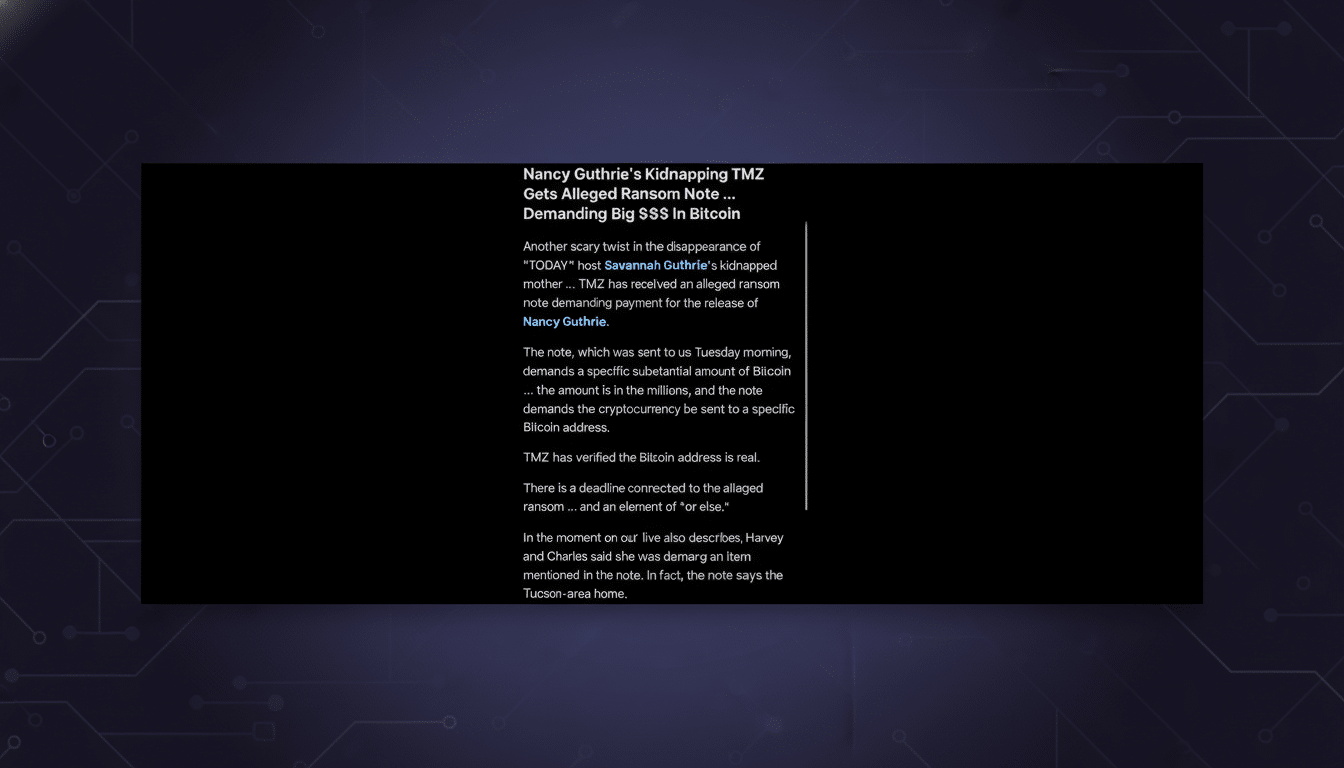
As investigators sift through unverified ransom notes in the disappearance of Nancy Guthrie, one element stands out as chillingly familiar to cybercrime experts: the demand for Bitcoin. Whether the messages are authentic or not, the choice of cryptocurrency tracks with a broader shift in how extortionists seek to get paid quickly, irreversibly, and across borders without relying on the traditional financial system.
Why Bitcoin Is The Ransom Currency Of Choice
Kidnappers gravitate to Bitcoin because it blends speed with a degree of anonymity. Wallets can be created in minutes without names attached, and funds settle in a matter of minutes at any hour, anywhere in the world. There are no bank managers to flag a suspicious wire or credit card companies to issue a chargeback.
Finality is another draw. Once Bitcoin is transferred, there is no centralized authority to reverse a payment or freeze a wallet. That permanence is attractive in high-pressure extortion scenarios where criminals want certainty they can keep what they extract.
Bitcoin Is Traceable Yet Difficult For Authorities To Stop
Contrary to myth, Bitcoin is not invisible. Every transaction sits on a public ledger, and firms like Chainalysis, Elliptic, and TRM Labs specialize in tracking flows. Law enforcement has leveraged that transparency before, including when the Department of Justice clawed back part of the Colonial Pipeline ransom by accessing a suspect’s private key and following funds on-chain.
But transparency does not equal prevention. Criminals frequently move funds through long “peel chains,” cross-asset swaps, and lightly regulated offshore exchanges to complicate attribution. Sanctions on mixing services by the U.S. Treasury’s Office of Foreign Assets Control show governments can raise the cost of laundering, yet they do not stop the initial payment from leaving a victim’s control.
Why Speed And Borderless Reach Often Trump Physical Cash
Ransom schemes rely on speed. Bank wires can be delayed or blocked; couriers and cash drops are risky and slow. Bitcoin can be demanded in exact amounts and received within a single block confirmation window, with the added advantage that it can be moved again instantly if criminals fear active tracking.
The data underscores the trend. Chainalysis estimates more than $3.4 billion in cryptocurrency was stolen in 2025, with roughly $713 million tied to hacks, scams, or coercion of individuals. Analysts and private security assessments have warned that “crypto kidnappings” are occurring regularly as organized groups pivot from online-only fraud to physical extortion of digital wealth.
Volatility is a known risk for criminals, but it can be managed by quick conversion through over-the-counter brokers or exchanges. The calculus for kidnappers is simple: the convenience and finality of a Bitcoin transfer outweigh short-term price swings, especially when deadlines are tight.
How Investigators Counter Crypto Ransoms
Kidnapping negotiators typically push for proof of life and seek to slow the clock, regardless of payment method. In a crypto-demand scenario, authorities also monitor any ransom address immediately, using blockchain analytics to map related wallets, identify cash-out points, and alert exchanges with know-your-customer rules to flag suspicious inflows.
Investigators coordinate with analytics firms and international partners because launderers often hop across jurisdictions. Even when funds become hard to recover, tracing can surface co-conspirators, infrastructure, or touchpoints with regulated entities. That pressure has led to arrests in multiple extortion cases despite the irreversibility of initial payments.
What Bitcoin Demand Signals In The Guthrie Case
In the Guthrie investigation, the Bitcoin angle does not necessarily reveal motive or even confirm the sender’s identity; hoaxers frequently mimic criminal playbooks. It does, however, align with a global pattern in which extortionists default to crypto because it is borderless, fast, and difficult to unwind once sent.
Authorities are likely scrutinizing any wallet addresses cited in the messages while seeking verification from the purported abductors. Whether the demand is genuine or a copycat, the takeaway is clear: Bitcoin has become the standard ask in ransom notes not because victims are crypto-savvy, but because criminals believe it is the most efficient way to get paid and stay a step ahead of traditional financial tripwires.