


Iran has kept most of its 92 million residents offline for more than a week, turning a sweeping communications blackout into one of the country’s longest on record as anti-government protests persist nationwide.
Network metrics tracked by NetBlocks indicate connectivity has been disrupted for over 170 hours, surpassing major outages in 2019 and 2025. Researchers say the current shutdown ranks among the longest globally in recent years, trailing Sudan’s multiweek cutoff in 2021 and Mauritania’s weeks-long outage in 2024, with precise standings varying by methodology.
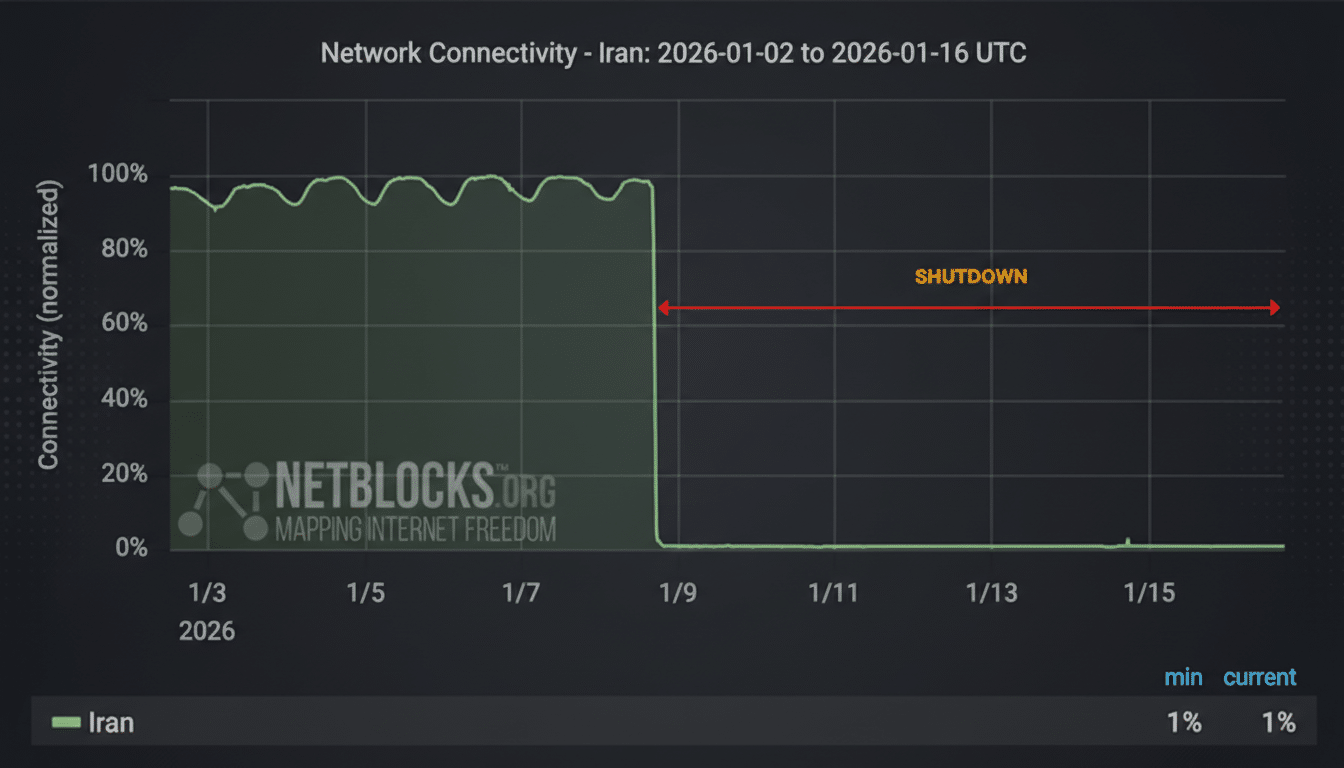
The blackout has included both internet and phone services, a tactic authorities in Tehran have repeatedly employed during periods of unrest to limit coordination and choke off the flow of images and accounts to the outside world.
What Makes This Blackout Different From Prior Outages
Unlike past shutdowns that targeted hotspots or throttled specific platforms, this one began as a sudden, nationwide cut that initially even knocked some government ministries offline. Since then, authorities have selectively restored access for critical operations, allowing limited banking rails and fuel payment systems to function—an approach often described as “whitelisting” essential services while keeping the broader public in the dark.
Iran’s National Information Network, the domestically routed “intranet,” continues to carry some traffic for state-approved sites and services. That segmentation lets core economic machinery grind on in a constrained way while social media, messaging apps, and independent news sources remain unreachable for most users.
How Authorities Are Enforcing The Cutoff
Technical evidence points to a mix of blunt and granular controls. Mobile operators—MCI, Irancell, and RighTel—have repeatedly disabled data services, and backbone routes managed by the national provider have seen withdrawals and filtering consistent with deep packet inspection, according to network engineers and data from monitoring groups such as Cloudflare Radar, Kentik, and OONI.
Aggregate measurements show national traffic falling to the single digits of typical baselines at points during the week, with brief, uneven recoveries that appear designed to prioritize state entities and specific economic functions. The pattern mirrors techniques observed in prior crackdowns but at a larger scale and for a longer stretch.
Economic and Human Costs Mount Amid Shutdown
Shuttering the internet ripples quickly through commerce. Small businesses that rely on Instagram storefronts and messaging apps to fulfill orders are cut off from customers, while logistics, ride-hailing, and delivery platforms stall. NetBlocks’ Cost of Shutdown Tool estimated Iran’s 2019 blackout at roughly $1.5 billion; experts warn the current outage could be extracting comparable losses, potentially hundreds of millions of dollars per week.
Human rights organizations, including the Center for Human Rights in Iran and Human Rights Activists in Iran, have documented hundreds of demonstrations across cities and towns. Independent verification of casualties and arrests remains difficult under blackout conditions, but rights groups fear the death toll is in the thousands, underscoring why connectivity is central to accountability and emergency response.
Workarounds Face a Crackdown as Users Seek Access
Some Iranians have managed to reconnect via satellite gear, including Starlink terminals reportedly smuggled into the country after U.S. sanctions exemptions—under Treasury’s General License D-2—expanded the provision of communications tools. Authorities have responded by criminalizing possession, jamming neighborhoods, and seizing equipment, according to reports from local digital rights advocates.
Common circumvention methods have been blunted. VPNs and proxy services are being blocked with server-side filtering and techniques such as SNI inspection, forcing users into a cat-and-mouse game of rotating endpoints that often go dark within hours.
International Alarm and the Stakes for Rights and Security
Access Now and Amnesty International have condemned the nationwide shutdown, calling it a violation of fundamental rights. Diplomatic fallout is mounting, with foreign missions reducing staff and airlines adjusting routes as authorities briefly restricted airspace—reminders that an information blackout can quickly become an economic and security story.
For investigators, journalists, and families, the loss of connectivity complicates everything from verifying videos to checking on loved ones. Open-source analysts say gaps in geolocated footage and eyewitness posts have widened, making it harder to document abuses and assess the scale of protests in real time.
What to Watch Next as Connectivity Metrics Shift
Signals to monitor include whether partial restorations spread beyond whitelisted banking and fuel systems, if regional mobile data returns in staggered windows, and how traffic baselines move in measurements from NetBlocks, Cloudflare Radar, and OONI. A sustained outage that drags into multiple weeks would push Iran’s blackout into a tier occupied by only a handful of countries in recent years.
For now, the calculus from authorities appears steady: keep most citizens offline while allowing narrow economic lifelines to prevent a total freeze. As protests continue, the length of the shutdown has become a metric of its own—one that underscores both the state’s resolve to control information and the public’s determination to be heard.